ROA maxLength in RPKI and BGP Hijacks: How a Valid Route Delivered a Malicious Update
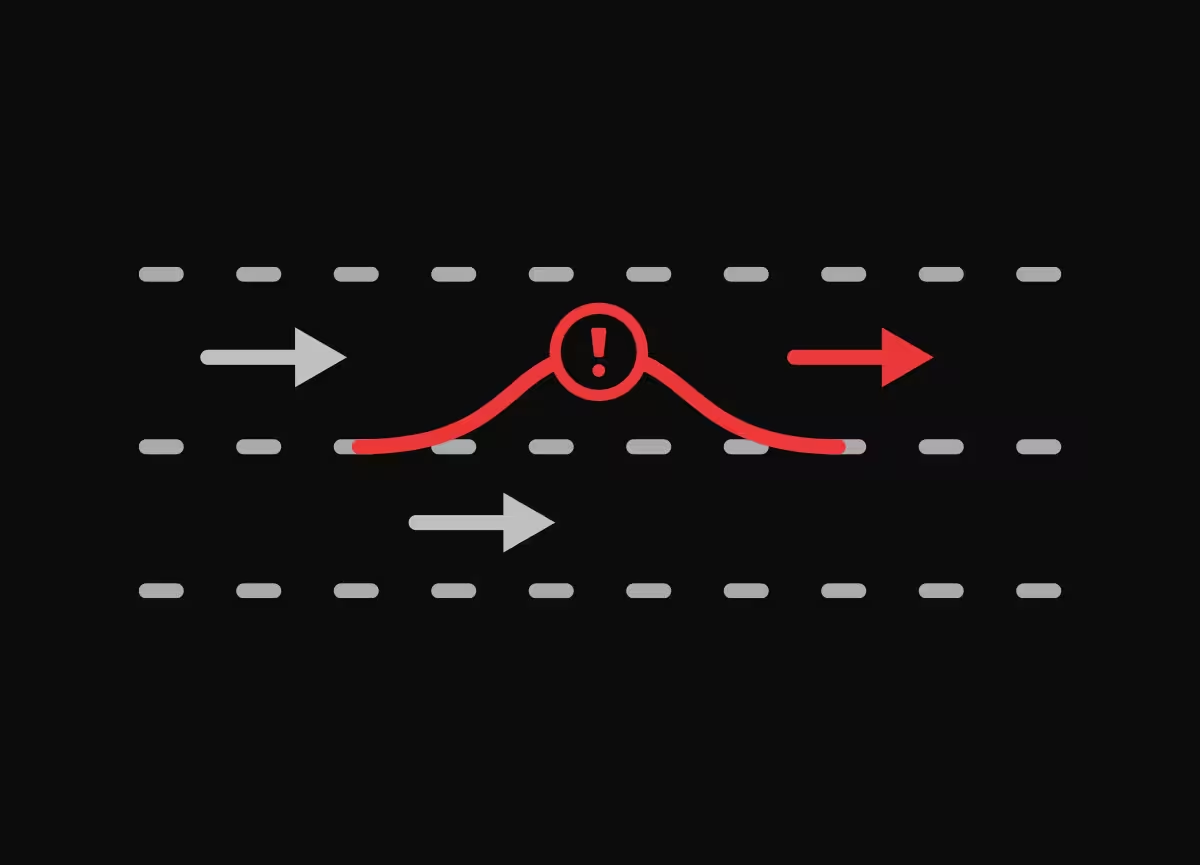
On 28 August 2026, a new route to 162.55.80.0/24 appeared on the Internet. The address range contained infrastructure used by Softaculous, including endpoints for its Virtualizor server-management software. The route was unauthorized, but networks that accepted it sent traffic for those addresses toward an attacker-controlled server. Some Virtualizor installations subsequently received a malicious update.
The incident illustrates a difficult operational truth: a route can pass RPKI origin validation because of a permissive ROA maxLength, and still take traffic somewhere it should not go. It also shows why routing security and software-update integrity have to work together.
How the traffic was diverted
The legitimate route covering the affected addresses was Hetzner Online’s 162.55.0.0/16, originated by AS24940. At approximately 20:57 UTC on 28 August, an unauthorized announcement for 162.55.80.0/24 appeared through AS62390 (NexonHost) and transit AS6204 (Zet.net). A /24 is more specific than a /16, so routers that learned both routes forwarded traffic for the /24 according to the new announcement. The diversion occurred in two waves, ending on 30 August at approximately 06:10 UTC; it was not continuous throughout that entire window. The route also flapped heavily within the waves. Softaculous’s Continue reading
What’s New in NFA v26.03: Automated Threat Mitigation, Advanced Filtering, and Entra SSO
Noction Flow Analyzer v26.03 introduces Network Anomaly and DDoS detection, automated FlowSpec mitigation options, Microsoft Entra single sign-on, and additional controls for sharing and analyzing network data. The release also expands flow-threshold configuration, BGP lookup capabilities, and SNMP visualization options. Building on the BGP diagnostics and threshold-monitoring updates introduced in v26.02, this version adds operational tools for network engineers, NOC teams, and service providers that use NFA for traffic analysis and incident investigation.
Network Anomaly and DDoS Detection with FlowSpec Mitigation
NFA now supports network threat and DDoS detection using multiple attack detection algorithms. Users can configure anomaly detection rules, review current anomaly feeds and historical activity, and exclude selected IP addresses through a whitelist. Detected threats can be addressed using FlowSpec mitigation actions for traffic dropping, rate limiting, and IPv4/IPv6 traffic redirection. NFA supports detection of the following anomaly types: DNS, NTP, SNMP, and memcached amplification attacks; SSH, UDP, TCP SYN, TCP ACK, and TCP ACK PUSH floods; HTTP/HTTPS, smurf, CLDAP, and SSDP flood attacks. Read the documentation →
Noction Flow Analyzer v26.03 introduces Network Anomaly and DDoS detection, automated FlowSpec mitigation options, Microsoft Entra single sign-on, and additional controls for sharing and analyzing network data. Continue reading
IRP v4.3.1 Brings Enhanced DDoS Detection, OIDC SSO, and Per-Provider Communities
Noction Intelligent Routing Platform v4.3.1 expands Automatic Anomaly Detection coverage, adds enterprise authentication options, and provides more granular control over provider-specific routing policies. The release also adds support for Ubuntu 26 LTS, introduces per-user default instances, and refines several configuration and data-handling workflows. Here are the details:
Expanded Reflection and Amplification Attack Detection
IRP’s Automatic Anomaly Detection now covers five additional reflection and amplification vectors: SSDP/UPnP, Memcached, CLDAP, Chargen, and SNMP. AAD identifies these attacks by analyzing sustained traffic concentration on known reflector ports, inbound response patterns without corresponding outbound requests, and deviations from the network’s established traffic baseline. Read the blog →
Noction Intelligent Routing Platform v4.3.1 expands Automatic Anomaly Detection coverage, adds enterprise authentication options, and provides more granular control over provider-specific routing policies. The release also adds support for Ubuntu 26 LTS, introduces per-user default instances, and refines several configuration and data-handling workflows. Here are the details:
Expanded Reflection and Amplification Attack Detection
IRP’s Automatic Anomaly Detection now covers five additional reflection and amplification vectors: SSDP/UPnP, Memcached, CLDAP, Chargen, and SNMP. AAD identifies these attacks by analyzing sustained traffic concentration on known reflector ports, inbound response patterns without corresponding outbound requests, and deviations Continue reading
Extending Automatic Anomaly Detection in Noction IRP v4.3.1: new reflection & amplification attack coverage
Automatic Anomaly Detection in IRP
Noction IRP v4.3 added Automatic Anomaly Detection (AAD), a behavior-based traffic analysis engine built into the Intelligent Routing Platform. Instead of fixed thresholds, AAD watches traffic telemetry from NetFlow, sFlow, or mirrored traffic and builds its own baseline for what “normal” looks like on a given network. When traffic breaks from that baseline for a sustained stretch (a packet-rate spike, one protocol suddenly dominating, an inbound surge with nothing matching it outbound), AAD flags it and can trigger mitigation through IRP’s existing BGP controls: Remote Triggered Blackholing and BGP FlowSpec.
At launch, AAD already covered DNS and NTP amplification, UDP floods, TCP SYN/ACK floods, HTTP(S) floods, SSH floods, and ICMP/Smurf-style attacks.
Additional vectors covered
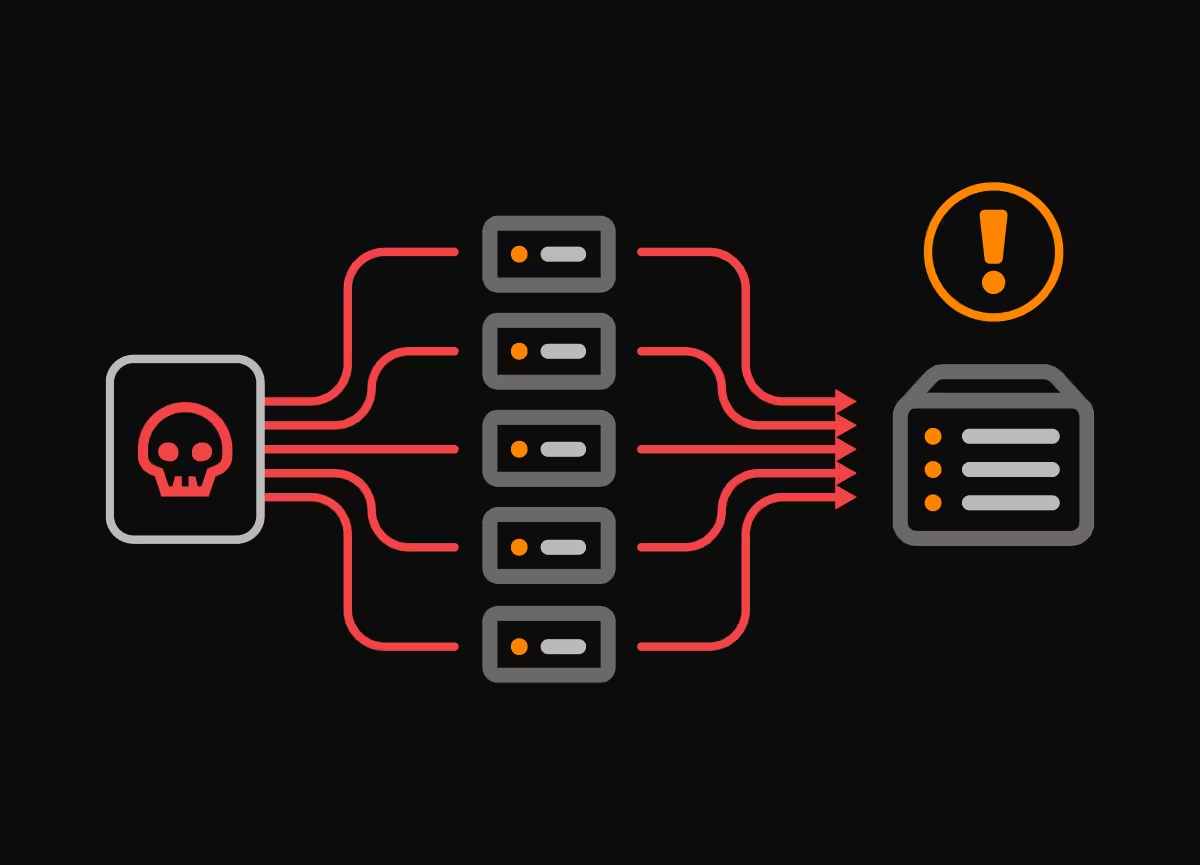
Reflection and amplification attacks stay popular because they’re cheap to run. An attacker spoofs a victim’s IP address, sends a small query to an open, publicly reachable service, and lets that service handle the work of sending back a much larger response. CISA’s advisory on UDP-based amplification attacks lists a long list of exploitable protocols beyond DNS and NTP, and vendor telemetry from Netscout and Akamai continues to show these vectors being abused, largely because so many misconfigured, internet-facing Continue reading
The RPKI Paradox: why invalid routes keep showing up
RPKI was supposed to be the fix for one of BGP’s oldest problems: nothing stops a network from announcing someone else’s IP addresses, on purpose or by accident. More than a decade into the project, adoption numbers finally look good, and yet RPKI invalid routes haven’t gone away. Route hijacks still happen, leaks still happen, and (this is the part that surprised me when I dug into the research) the tools built to catch all this still cry wolf constantly.
Here’s the short version: RPKI did its job. It just wasn’t as big a job as everyone hoped, and thousands of invalid routes a day are proof that the story doesn’t end at “deployed.”
The good part: RPKI actually got deployed
A Route Origin Authorization (ROA) is a cryptographic statement from an IP address holder saying, “this AS, and only this AS, is allowed to originate this prefix.” Routers that check incoming announcements against ROAs sort them into three buckets (Valid, Invalid, or Not Found) through a process called Route Origin Validation (ROV).
That’s the whole mechanism. Simple in concept, it took the industry years to actually roll it out at scale. It’s happened now: a majority of Continue reading
BGP and Multi-Cloud Routing
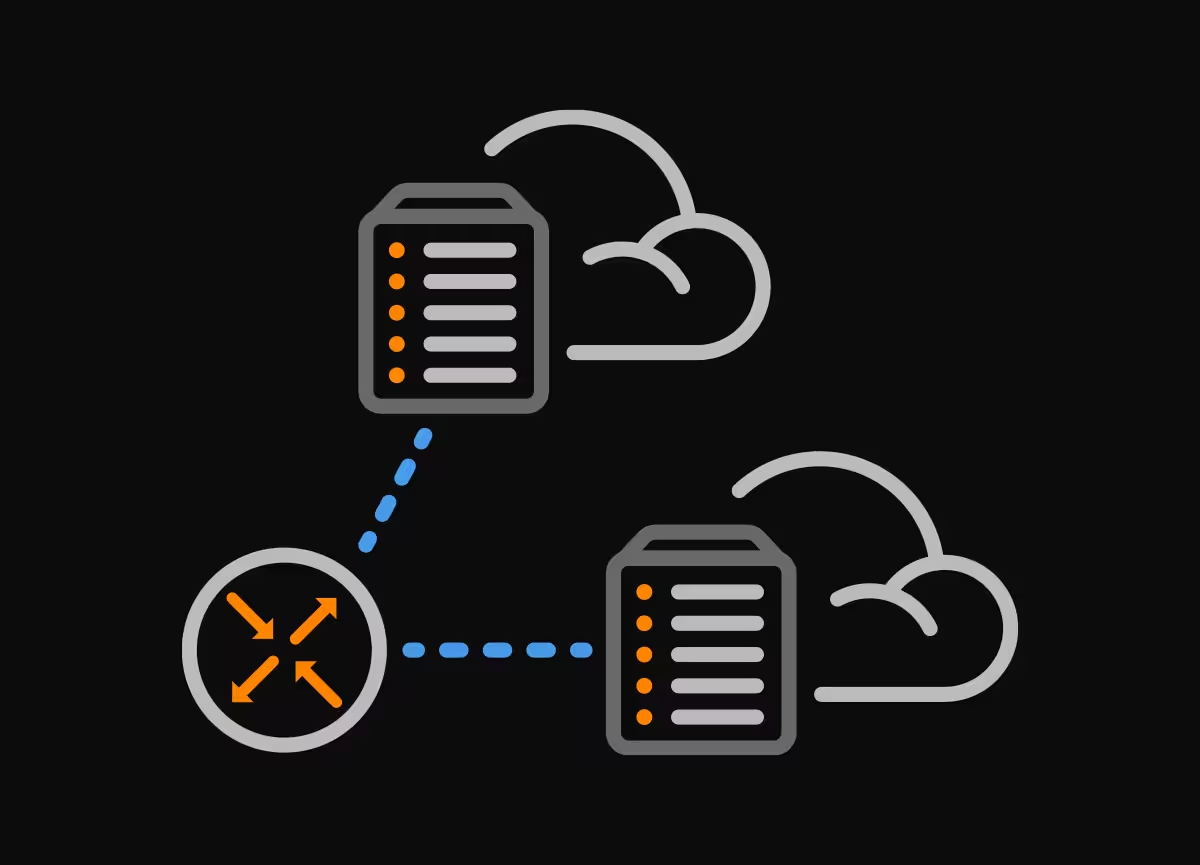 For years, enterprise cloud networking was built around a simple assumption: pick a primary cloud provider, connect the data center to it, and expand from there.
That model no longer reflects how many organizations actually operate.
Today, workloads often live across AWS, Azure, and Google Cloud at the same time. Sometimes this is intentional. Sometimes it is the result of acquisitions, separate engineering teams, SaaS dependencies, regional requirements, or SaaS platforms that depend on a specific cloud provider. Either way, the network has to make these environments behave like one reliable system.
That is where the hard part begins.
Cloud-native routing tools are useful inside each provider, but they do not automatically solve routing between providers, between clouds and colocation hubs, or between multiple cloud environments and an enterprise WAN. Once routing needs to become dynamic, policy-driven, and resilient across administrative boundaries, BGP becomes the common language.
BGP is not new, and it is not always simple. But in multi-cloud networking, it remains one of the few mechanisms that AWS, Azure, Google Cloud, carriers, colocation providers, SD-WAN platforms, and enterprise routers can all understand.
What inter-cloud routing actually means
The term “inter-cloud routing” is often used loosely, so it is Continue reading
Meet NFA v26.02, featuring BGP visibility tools, extended threshold matching, and SNMP reporting enhancements.
We’re excited to announce the release of Noction Flow Analyzer v26.02. This version includes a focused set of improvements that enhance BGP visibility, expand threshold-monitoring options, improve flow-processing performance, and refine the SNMP reporting experience. This update builds on the foundation of v26.01 and introduces new tools for network engineers who rely on real-time routing intelligence and traffic analysis.
BGP diagnostics and visibility tools
The biggest addition in v26.02 is a complete set of BGP diagnostics and visibility tools. These give network administrators new insights into routing behavior directly within NFA. The new BGP diagnostics panel introduces ping and traceroute checks, allowing engineers to run connectivity and path diagnostics without leaving the NFA interface. Additionally, a BGP Data Lookup feature enables direct queries against NFA’s internal BGP tables, supporting exact-match and more-specific match modes for precise prefix investigations. Finally, BGP History Lookup provides access to historical route events, including key attributes such as prefix, next-hop, AS path, and more. This makes it easier to trace routing changes over time and connect them with traffic events.
We’re excited to announce the release of Noction Flow Analyzer v26.02. This version includes a focused set of improvements that enhance Continue reading
ASPA: The cryptographic upgrade for BGP path security
 The Internet routing security story of the past decade has largely been about fixing route origins. RPKI Route Origin Validation (ROV) gave operators a cryptographic way to verify that the AS announcing a prefix was actually authorized to do so. That work has now reached majority coverage, with over half of all IPv4 and IPv6 routes now protected by Route Origin Authorizations (ROAs).
But origin validation only tells you where a route claims to start. It says nothing about the path it took to get to you. A route can have a perfectly valid origin and still arrive via a completely illegitimate chain of ASes, through a misconfigured transit network, a malicious route leak, or a manipulated AS_PATH. This gap is exactly what ASPA (Autonomous System Provider Authorization) is designed to close.
ASPA has moved from theory into early operational deployment, even though the core ASPA profile and verification work remain in IETF draft form as of March 2026. ARIN and RIPE NCC both support ASPA object creation in production. Major networks have begun deploying ASPA validation globally. Router implementations exist in BIRD and OpenBGPD. This article is intended to explain what ASPA is, how it works technically, what it Continue reading
Deprecated AS_SET: Why the IETF changed the rules of BGP aggregation.
 For over three decades, BGP’s AS_SET path segment has been a legal, if problematic, feature of Internet routing. In May 2025, the IETF formally ended that era. RFC 9774 doesn’t merely discourage AS_SET: it prohibits it entirely.
This post unpacks what AS_SET is, why it was created, what went wrong, and what network operators need to do now that the IETF has made its deprecation a binding standard requirement.
Background: What is the AS_PATH attribute?
Every BGP UPDATE message carries an AS_PATHattribute – a record of the Autonomous Systems a route advertisement has traversed on its way from origin to destination. It serves two critical functions: loop prevention (a router seeing its own AS in the path discards the route) and policy (operators use AS_PATH to make routing decisions based on where traffic comes from or how it’s being forwarded.
The AS_PATH is composed of path segments, each of which is one of four types:
| Type | Description | Status |
|---|---|---|
| AS_SEQUENCE | An ordered list of ASes the route has passed through. The most common and well-understood type. | Valid |
| AS_SET | An unordered set of ASes created during route aggregation. Now deprecated. | Deprecated |
| AS_CONFED_SEQUENCE | Ordered list of Member AS Numbers within a Continue reading |
NetFlow/sFlow Monitoring in AI Environments
 If you’ve spent time supporting AI infrastructure, whether that’s a GPU training cluster, a fleet of inference nodes, or a multi-tenant model serving platform, you’ve probably noticed something: the network telemetry tools that served you well in a traditional data center feel slightly out of place here. Not useless. Just not quite designed for this.
The traffic patterns are different. The failure modes are different. The things you need to catch early are different. And if you’re running NetFlow or sFlow collection – which you should be – understanding where that data genuinely helps versus where you’re looking at the wrong instrument is the difference between a useful monitoring stack and a false sense of coverage.
Why AI Traffic Is Different
Most of the networking intuition you’ve built over a career was forged on north-south traffic – clients reaching services, users reaching the internet, workloads reaching storage. Even in modern microservices environments with heavy east-west traffic, flows are relatively short-lived, heterogeneous in size, and largely TCP-based with normal congestion dynamics.
AI training breaks most of those assumptions simultaneously.
A distributed training job across a GPU cluster is synchronous in a way that most networked workloads are not. Every GPU in Continue reading
Interface Monitoring in IRP v4.3: Bringing Physical Interface Awareness to Commit Control
 Commit Control is a core safety mechanism in the Noction Intelligent Routing Platform (IRP). It governs how routing changes are applied by enforcing bandwidth-related limits, ensuring that traffic shifts toward providers remain controlled and predictable. These limits are essential for protecting networks from sudden overloads and unintended traffic spikes.Historically, Commit Control has relied on configured bandwidth assumptions. While this works well under stable conditions, real networks are rarely static. Physical interfaces may fail, bonded links can lose members, and available capacity may be reduced without immediate operational awareness. In such cases, Commit Control may continue to operate correctly from a configuration perspective, while the underlying physical capacity has already changed.
With IRP v4.3, we introduce Interface Monitoring, a feature that allows Commit Control to continuously align its decisions with the actual state and capacity of provider-facing interfaces.
Why Physical Interface Awareness Matters for Commit Control
Commit Control is designed to answer a critical question: Is it safe to commit a routing change that increases traffic toward this provider?
The answer depends not only on policy and configuration, but also on whether the provider connection can physically handle that traffic.
Physical failures are an unavoidable part of Continue reading
BGP Routing Information Base (RIB) Deep Dive
The post BGP Routing Information Base (RIB) Deep Dive appeared first on Noction.