 Dillon Barry
Author Archives: Dillon Barry
Dillon Barry
Author Archives: Dillon Barry
Jamin Ball’s recent piece, “Systems of Record Won the SaaS Era — Clearinghouses Will Win the Agents Era,” is the cleanest articulation I’ve seen of where the durable moat goes next. His argument is simple and, I think, correct: the SaaS era rewarded whoever owned the system of record, and the agent era will reward whoever owns the clearinghouse. This is a new seat that sits between mutually-distrusting agents and decides which one is cleared to act, on what data, with what limits, and can prove what happened after the fact. The lock-in moves from your data to your permissions. The source-of-truth era becomes the source-of-permission era.
I agree with all of it. Governance has graduated from a compliance checkbox at the end of the sales cycle to the first question a CIO asks. Once agents act autonomously and eventually spend real money, “is the model good?” stops being interesting now that every model is good enough and “can I see what every agent did, set policy on what it can touch, and prove it to my auditors?” becomes the whole conversation. That seat is strategic real estate. Whoever holds it is hard to dislodge.
A KubeVirt VM runs inside a pod. That is the trick that lets Kubernetes schedule a VM like any other workload. It also means the VM and the pod have different lifecycles. The VM is long-lived and has a stable identity. The pod is disposable. When the VM reboots, gets evicted, or live-migrates, the pod underneath is destroyed and a new one is created.
That matters because a VM’s IP is load-bearing. Firewall rules, load balancer entries, and DNS records all point at it. On Kubernetes, standard pod IPAM ties the address to the pod, so a new pod would mean a new IP, and a changed IP is what breaks those dependencies. KubeVirt on its own does not carry the IP across a migration. Its issue tracker has a user reporting exactly this, with a maintainer confirming sticky IPs were never built into the project. The network identity needs something to carry it. That something is Calico.
The diagram below shows the difference this makes. Default pod networking on the left, Calico on the right.
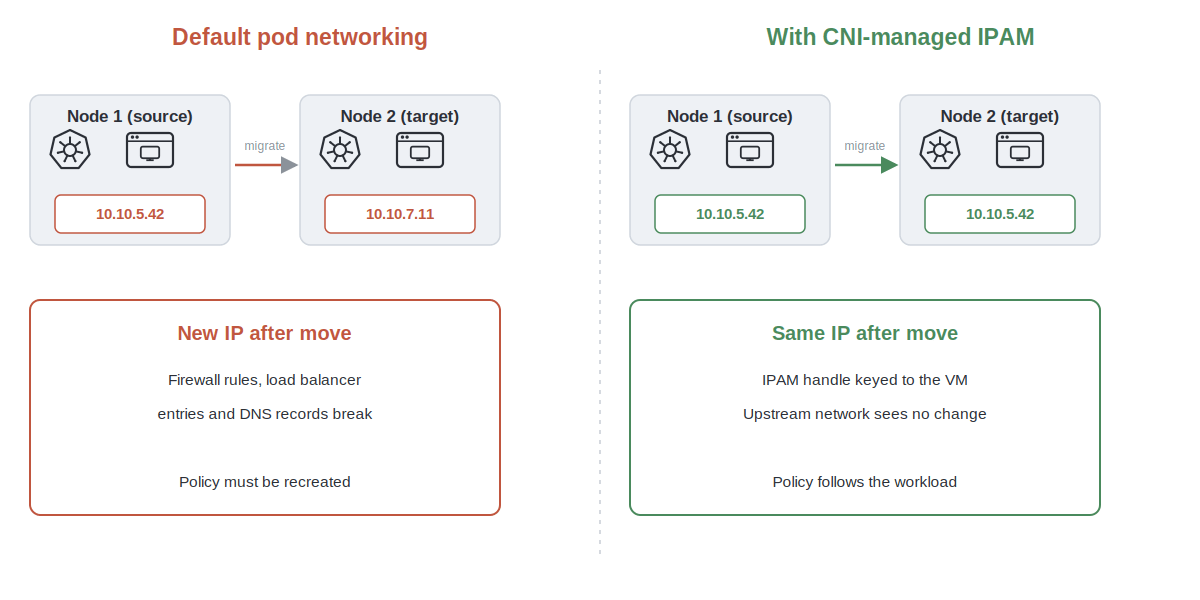
Calico’s approach is elegant and specific. Instead of building the IPAM Continue reading
You know every service in your cluster by name. You know which team owns each one, what it talks to, how it scales, where its logs go. The agents are a different story.
That’s not a criticism, it’s an observation, and it’s one we keep running into. Every company we talk to is shipping agents of some kind, from scales of 10s to 1000s. Customer service bots that field tier-one tickets. Internal copilots that draft emails and summarise meetings and write the boring half of every PR. SREs that handle their own incidents at 2am while the team sleeps. What used to be a few experimental builds in a dev cluster is now dozens in some shops and hundreds in the biggest, growing faster than most teams are tracking.
That growth curve is the interesting part. Services tend to come into existence through a fairly heavyweight process. There’s a ticket, a design review, an owner, a runbook. Agents tend to arrive the way side projects do:
Two platforms, two teams, two procurement relationships, all doing one job. There’s a reason it ended up this way. There isn’t a reason it has to stay this way.
Ask anyone at a typical enterprise why the VM platform and the container platform are separate, and they’ll give you a sensible answer. The VM estate has been there for fifteen years. It runs the workloads the business depends on. Kubernetes got stood up later, when application teams started building microservices, and giving them their own environment made more sense than retrofitting one onto VMware. Two platforms, two teams, two roadmaps.
That’s how most enterprises got here.
The reasoning was sound at the time. The question is whether it still is.
This is the consolidation question most enterprises haven’t actually revisited, and it’s the one quietly absorbing more of your budget each year.
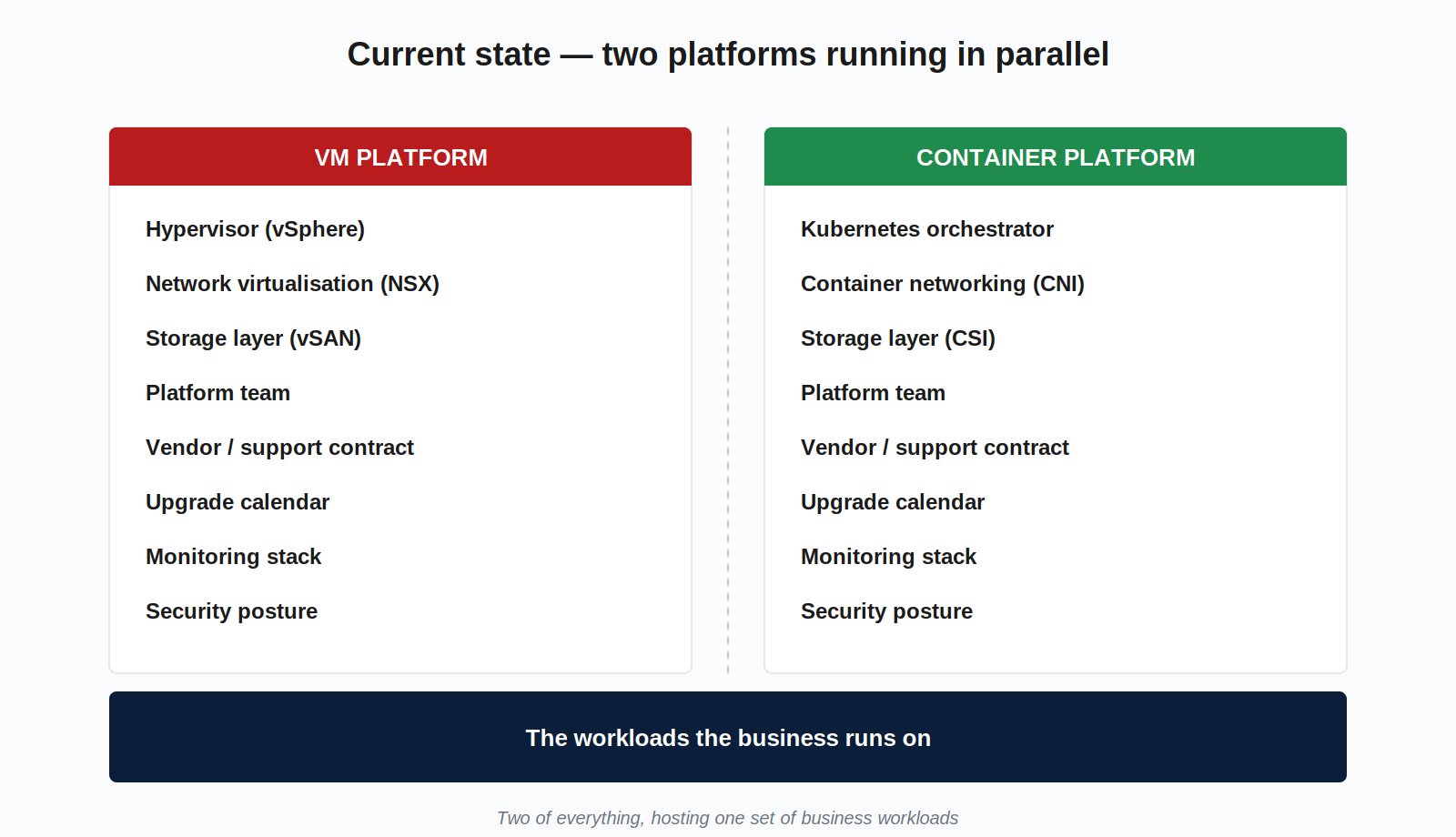
If you operate both platforms, you know the shape of this already. There’s a VMware team: vSphere admins, network engineers who know NSX, storage specialists, plus a separate procurement relationship for the underlying virtualisation stack. Then there’s a Kubernetes team: platform Continue reading
Here is what nobody putting together the business case for a VM migration to Kubernetes will tell you upfront: the compute is the easy part.
Moving workloads off vSphere and onto Kubernetes is conceptually straightforward. The tooling has matured. The architecture is proven. Compute moves, storage remaps, and the platform team has a plan.
The network is where projects quietly stall.
Not because the technology does not work. Because nobody scoped the network properly before the project started. A platform migration turned into a multi-team coordination exercise. The firewall team needed a change window. The security team needed to review a network placement that changed when it should not have needed to. The application team discovered hardcoded IPs that nobody documented.
Six months later, half the VMs are still on vSphere and the project is technically “in progress.”
This is not a skills gap. It happens at the most mature organisations with capable teams. It is a scoping problem, and it has a specific cause: the gap between how VM networking works and how Kubernetes networking works is wider than it looks on a migration plan.
This post is for the people who approve these projects. Here is what Continue reading
Organisations are re-evaluating their VM infrastructure. The economics have shifted, the tooling has matured, and the case for running two separate platforms, one for containers, one for VMs, is getting harder to justify. Platform teams that spent years managing hypervisor infrastructure are being asked to consolidate, and most are landing on the same answer: Kubernetes.
KubeVirt makes running VMs on Kubernetes possible. But KubeVirt networking – what happens to a VM’s IP address, VLAN, and security posture when it lands in a cluster – is where most migration plans hit a wall. The reasons go beyond cost:
The decision to migrate is being made. The question is how to do it without causing chaos.
KubeVirt extends the Kubernetes API with new custom resource Continue reading