Closing the Loop on SDN Service Assurance
 Next-generation applications will demand a new level of service assurance that can be delivered by third-party SDN technologies, married with monitoring and automation.
Worth Reading: The Wild West of Performance Measurement


The post Worth Reading: The Wild West of Performance Measurement appeared first on 'net work.
Business White Paper: OpenDaylight Powers Carrier-Grade OpenStack Performance
 The "OpenDaylight Powers Carrier-Grade OpenStack Performance" whitepaper discusses how the marriage of SDN and NFV has been difficult to achieve in CSP networks.
Practical DMVPN Example
In this post, I will put together a variety of different technologies involved in a real-life DMVPN deployment.
This includes things such as the correct tunnel configuration, routing-configuration using BGP as the protocol of choice, as well as NAT toward an upstream provider and front-door VRF’s in order to implement a default-route on both the Hub and the Spokes and last, but not least a newer feature, namely Per-Tunnel QoS using NHRP.
So I hope you will find the information relevant to your DMVPN deployments.
First off, lets take a look at the topology I will be using for this example:
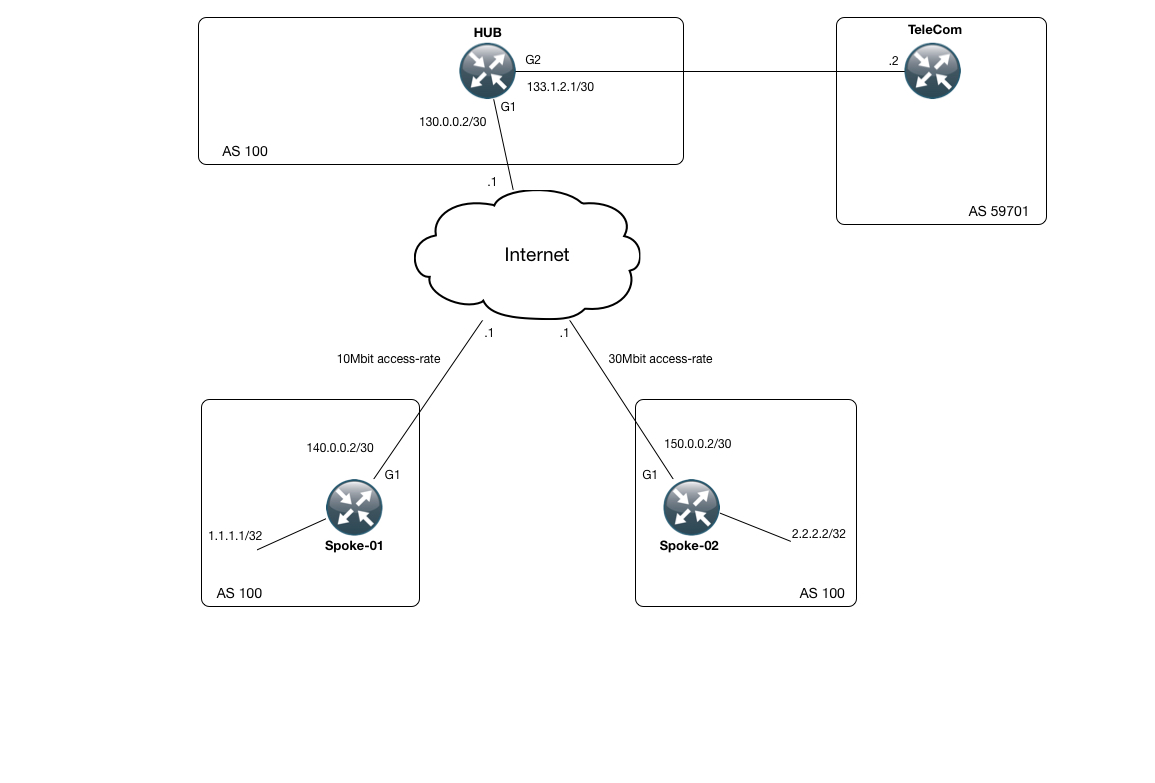
As can be seen, we have a hub router which is connected to two different ISP’s. One to a general purpose internet provider (the internet cloud in this topology) which is being used as transport for our DMVPN setup, as well as a router in the TeleCom network (AS 59701), providing a single route for demonstration purposes (8.8.8.8/32). We have been assigned the 70.0.0.0/24 network from TeleCom to use for internet access as well.
Then we have to Spoke sites, with a single router in each site (Spoke-01 and Spoke-02 respectively).
Each one Continue reading