Link Aggregation Terminology Explained
Confused about EtherChannel, PAgP, and vPC? Here's a quick guide.
netmiko support for Brocade ICX and MLXe
netmiko is a “Multi-vendor library to simplify Paramiko SSH connections to network devices,” written by Kirk Byers. It doesn’t solve all of your pain with dealing with CLI-only network devices, but it tries to at least take away the low-level hassle of setting up a connection, and handling variations with things like enable mode, line-breaks, etc.
I’ve submitted a couple of PRs over the last few days to support Brocade ICX and MLXe devices – #235, #236 and #237. These have now been merged into the master code.
This has not yet had extensive testing. Please try it out, and report any issues.
I’m currently looking at VDX support. Looks like a few oddities around detecting the prompt, and dealing with the banner. Feel free to pitch in!
BRKARC-3300 – IOS-XE: Enabling the Digital Network Architecture

Presented by Muhammad A Imam, Sr Manager Technical Marketing Engineering
Brand new session!
The goal of the session is to give an understanding of IOS-XE Denali 16.x.
“How many have downloaded 16.x?” — maybe 10% put up their hands
The upcoming 16.3 (target for this month) will support Cat 3850,3650, ISR, and ASR 1000.
The original operating system on the AGS, back in 1986, was simply called “Operating System”. There are still parts of Operating System in IOS today (scary!!).
IOS-XE (code name BinOS) came around in 2007 on the ASR 1000. In 2010, IOS-XE (code name Nova) was released for the Cat4k. These two editions of XE were similar, but different and were written by different engineering teams.
The vision for IOS-XE Denali is a single code base across Cisco enterprise platforms. Benefits include: similar features, consistent version numbers, consistent release schedule, consistent test and validation of releases, consistent commands (eg “show platform …”).
“We are changing the way we write code” –Muhammad; code is being pulled out of the IOSd blob and written as a subsystem within IOS-XE (over time).
Crimson database:
- New component in Denali
- Maintains state for subsystems
- Holds configuration
- Continue reading
BRKEWN-2017 — Understanding RF Fundamentals and the Radio Design of 11n/ac Networks
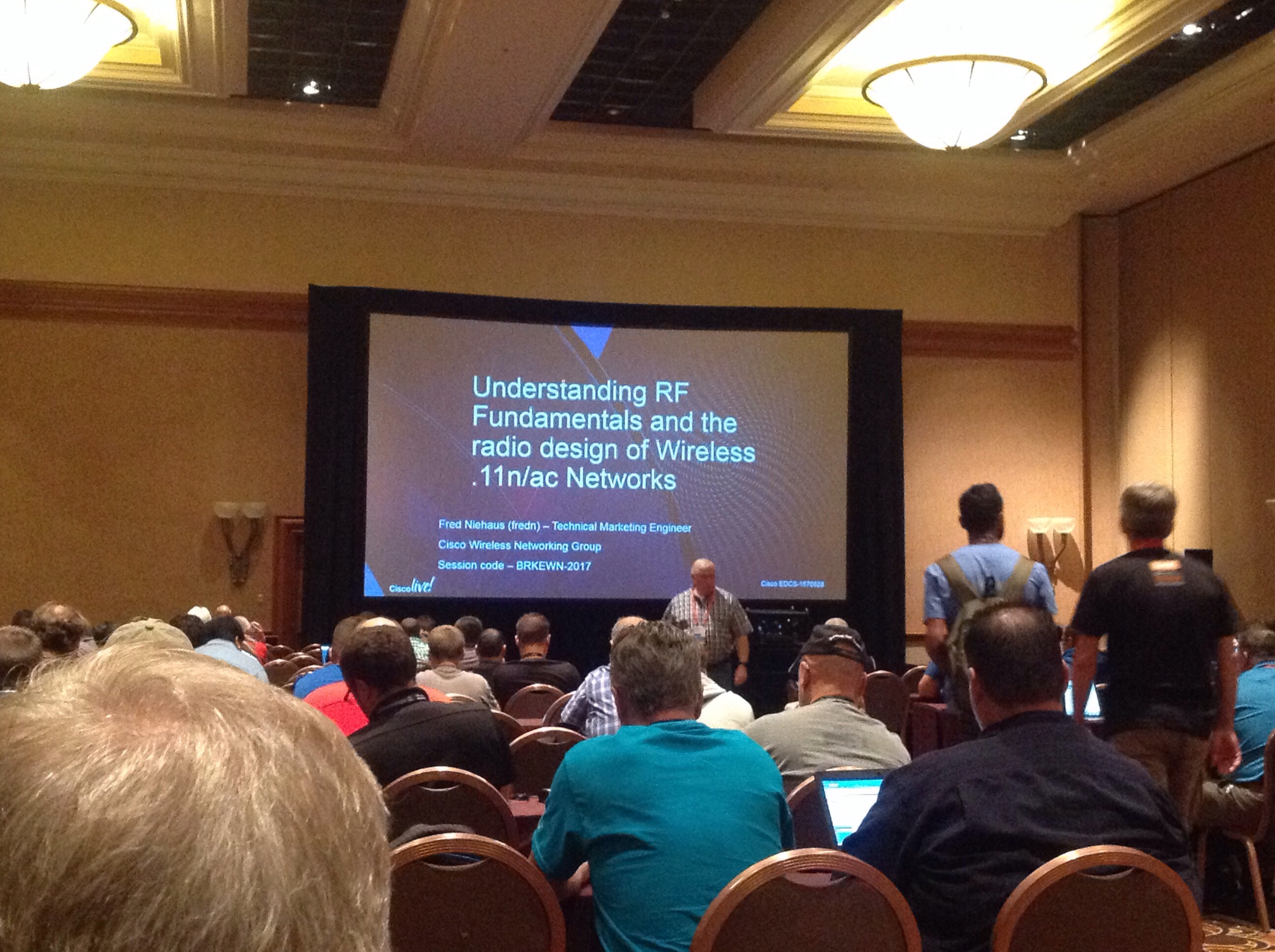
Presenter: Fred Niehaus, Technical Marketing Engineer, Cisco Wireless Networking Group
BRKRST-2042 — Highly Available Wide Area Network Design
Presented by: David Prall, Communications Architect, Cisco For reference, David is the “father of IWAN”. This session was not what I was expecting. I was expecting design and architecture, but it was all about features in IOS and IOS-XE (eg, FHRPs, talked about routing protocol timers, PfRv3, BFD). I guess I need to pay more attention to the session code (RST == routing; ARC == architecture).BRKNMS-2701 – How I Learned to Stop Worrying and Love Prime Infrastructure

Presenters:
- Lewis Hickman, Consulting Systems Engineer
- Jennifer Valentine, Systems Engineer
Quick survey in the room: 60-70% of attendees running PI 3.x; 10-20 PI 2.x; some still on LMS.
“There are 37 different ‘Cisco Prime’ products” — Lewis
“Cisco Prime” isn’t a product; “Cisco Prime Infrastructure” is. Cisco Prime is a family of products.
PI traces its lineage back to 1996: CWSI > Cisco Works LMS > Cisco Prime LMS > WCS > NCS > Prime Infrastructure.
“1232 SysObjIds supported in PI today” — Lewis (aka, 1232 different devices supported by PI)
Two people (only!!) in the room running Network Analysis Module.
UCS Server Assurance module: enables mgmt of UCS servers; will integrate into vCenter and map VMs to physical hosts for you.
Operations Center: manager of managers for PI
Licensing in PI 3.x:
- One license for Lifecycle and Assurance now
- Different license files for different device types
- Different device types require a specific number of “tokens”
- When a license is installed in PI 3.x, it gets converted into the appropriate number of tokens
- As you add devices to PI, it draws down on the number of free tokens in the pool
- Hint: You don’t Continue reading