VTY ACL doesn’t block HTTP/S access
I was doing some testing on a 3750X and saw that the http and http servers were enabled. I knew you could apply an ACL to restrict HTTP access, but had assumed that the HTTP security was an optional extra on … Continue reading
The post VTY ACL doesn’t block HTTP/S access appeared first on The Network Sherpa.
Fun with GRE and HSRP
I recently came across a design in which GRE tunnels were built utilizing HSRP VIP addresses. At first I was unsure of how well this would work so as usual I decided to lab it up. It turns out that this is an excellent counter design to having to place metrics or do any type […]
The post Fun with GRE and HSRP appeared first on Packet Pushers.
Fun with GRE and HSRP
I recently came across a design in which GRE tunnels were built utilizing HSRP VIP addresses. At first I was unsure of how well this would work so as usual I decided to lab it up. It turns out that this is an excellent counter design to having to place metrics or do any type […]
The post Fun with GRE and HSRP appeared first on Packet Pushers.
Running VLAN, VXLAN and GRE together using Neutron & Openstack
There are numerous blogs out there with step by step instructions to setup OVS networking for openstack neutron to run various types of networks. I came up with this post to best explain how everything works in the Neutron land and what a typical openstack deployment looks like. If you are looking for a more step-by-step procedure to set things up this post is a good place to start i.e. understanding the networking concepts and design behind running all the commands listed on other blogs.
A Neutron openstack deployment or any cloud environment these days typically consist of a Network Controller (SDN controller) and a cluster of compute hosts or servers. The type of networking you choose to connect all of these together is entirely upto you and I've seen various ways by which this can be done. There is no correct or right way of doing this. It's what works for you but if you don't really have anything already setup and are planning on starting afresh you could probably use this as a template to design your networking.
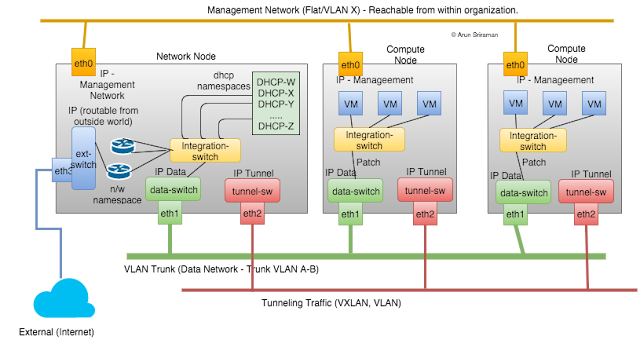
What you see above are three servers - one network node and two compute nodes.
First we'll go through Continue reading
A Neutron openstack deployment or any cloud environment these days typically consist of a Network Controller (SDN controller) and a cluster of compute hosts or servers. The type of networking you choose to connect all of these together is entirely upto you and I've seen various ways by which this can be done. There is no correct or right way of doing this. It's what works for you but if you don't really have anything already setup and are planning on starting afresh you could probably use this as a template to design your networking.

What you see above are three servers - one network node and two compute nodes.
First we'll go through Continue reading
The Top NFV & Telecom Influencers in 2015
 These people help make the wheels go round for NFV.
Last Chance! Manage & Implement NFV with an Intelligent OSS Stack with the Comarch DemoFriday
 Join Comarch on January 29th for a webinar on how SDN & NFV can be adopted to better services through BSS/ OSS stack
Network Break 68: Juniper Firewall Burned, 2015 In Review
Network Break 68 looks at Juniper's ScreenOS vulnerabilities, analyzes NetApp's acquisition of SolidFire, and cheers Apple for opposing U.K. surveillance. Lastly, we review of some of our favorite stories from 2015, and a list of things we probably won't care about next year. Probably.
The post Network Break 68: Juniper Firewall Burned, 2015 In Review appeared first on Packet Pushers.
Network Break 68: Juniper Firewall Burned, 2015 In Review
Network Break 68 looks at Juniper's ScreenOS vulnerabilities, analyzes NetApp's acquisition of SolidFire, and cheers Apple for opposing U.K. surveillance. Lastly, we review of some of our favorite stories from 2015, and a list of things we probably won't care about next year. Probably.
The post Network Break 68: Juniper Firewall Burned, 2015 In Review appeared first on Packet Pushers.
Dual Core Network Design
Dual core design, also known as dual plane or disjoint plane topologies, refers to a highly redundant network chosen by companies whose main objective is to improve the resiliency of their network. Created using different data planes, dual core design is implemented by companies that receive the service from the different service providers. Put simply, […]
The post Dual Core Network Design appeared first on Network Design and Architecture.
New Year’s Resolutions for SDN Success
Software-defined networking is still in the early stages. If you're considering deployment, follow these five recommendations to ensure your company is one of the success stories.New Year’s Resolutions for SDN Success
Software-defined networking is still in the early stages. If you're considering deployment, follow these five recommendations to ensure your company is one of the success stories.
Training the Next-Generation Network Engineer
The networking industry is at a crossroads. In the past few years, we’ve seen a flurry of activity in the world of software-defined networking (SDN), but this has mostly just resulted in a bunch of new products. I don’t feel that this has done nearly enough to improve network operations. In fact, this has in many ways resulted in more complexity.
What we desperately need more than shiny new products (hardware or software) is a better understanding of simple tools and open source software. We need to be willing to take more direct control over our infrastructure, instead of relying on a vendor and their support contracts to solve all our problems. While vendors should still serve a critical role in operating a network, I feel strongly that now more than ever, end-users have the power to really own their own management layer, and the roadmap for how their organizations offer network services to the teams that run (and in some cases develop) applications for the business.
To that end, I’ve been spending the past six months or so ramping up my own personal efforts at helping the network community as a whole to start this journey. These simple contributions Continue reading