Intel Warns Pandemic Could Erode Financials, Halts Stock Buybacks
There remains "considerable uncertainty" as to how measures taken by world governments to control...
Red Hat OpenShift Serverless Inches Closer to GA
The platform is based on the Knative project, which continues to be a lightning rod of controversy...
Automate, orchestrate, survive: treating your network as a holistic entity
Organizations need to learn to think about networks as holistic entities. Networks are more than core routers or top-of-rack (ToR) switches. They’re composed of numerous connectivity options, all of which must play nice with one another. What role does automation play in making network heterogeneity viable? And does getting all the pieces from a single vendor really make management easier if that vendor has 15 different operating systems spread across their lineup of network devices?
Most network administrators are used to thinking about their networks in terms of tiers. Access is different from branch, which is different from campus, and so forth. Datacenter is something different again, and then there’s virtual networking complicating everything.
With networks being so big and sprawling that they frequently occupy multiple teams, it’s easy to focus on only one area at a time. Looking at the network holistically—both as it exists, and as it’s likely to evolve—is a much more complicated process, and increasingly important.
Networks grow, evolve and change. Some of this is organic; growth of the organization necessitates the acquisition of new equipment. Other times growth is more unmanaged; something that’s especially common with mergers and acquisitions (M&As).
Regardless of reason, change in Continue reading
Kubernetes testbed
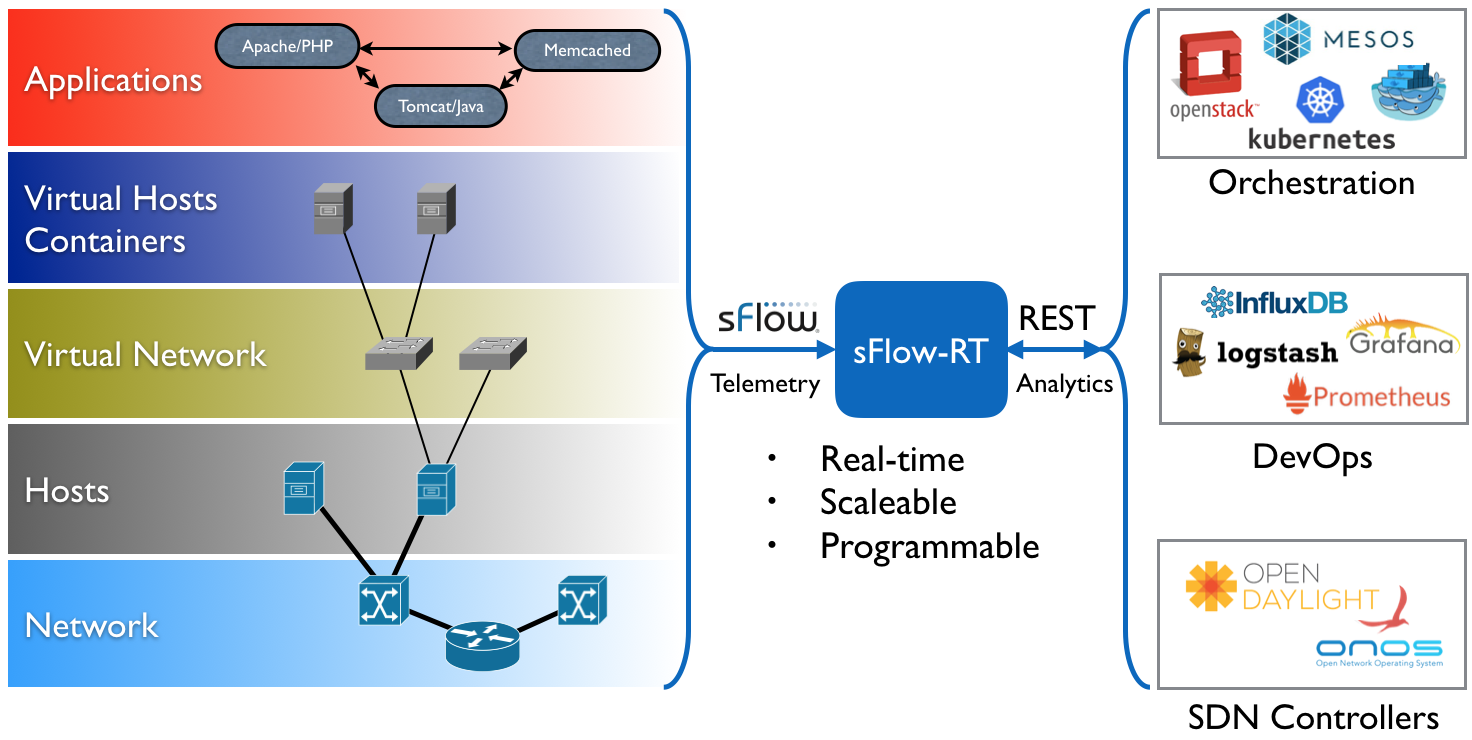
Application development is greatly simplified if you can emulate the infrastructure you want to monitor on your development machine. Docker testbed describes a simple way to develop sFlow based visibility solutions. This article describes how to build a Kubernetes testbed to develop and test configurations before deploying solutions into production.

Create the following sflow-rt.yml file:
apiVersion: v1Run the Continue reading
kind: Service
metadata:
name: sflow-rt-sflow
spec:
type: NodePort
selector:
name: sflow-rt
ports:
- protocol: UDP
port: 6343
---
apiVersion: v1
kind: Service
metadata:
name: sflow-rt-rest
spec:
type: LoadBalancer
selector:
name: sflow-rt
ports:
- protocol: TCP
port: 8008
---
apiVersion: apps/v1
kind: Deployment
metadata:
name: sflow-rt
spec:
replicas: 1
selector:
matchLabels:
name: sflow-rt
template:
metadata:
labels:
name: sflow-rt
spec:
containers:
- name: sflow-rt
image: sflow/prometheus:latest
ports:
- name: http
protocol: TCP
containerPort: 8008
- name: sflow
protocol: UDP
containerPort: 6343
Microsoft Warns of Attacks Exploiting Zero-Day Flaws
Microsoft said it’s “aware of limited targeted attacks” using the remote-code execution...
Hands On With Ansible collections
Ansible collections have been introduced previously through two of our blogs Getting Started with Ansible Content Collections and The Future of Ansible Content Delivery. In essence, Ansible Automation content is going to be delivered using the collection packaging mechanism. Ansible Content refers to Ansible Playbooks, modules, module utilities and plugins. Basically all the Ansible tools that users use to create their Ansible Automation. Content is divided between two repositories:
- Ansible Galaxy (https://galaxy.ansible.com)
- Automation Hub (https://cloud.redhat.com/ansible/automation-hub)
Ansible Galaxy is the upstream community for sharing Ansible Collections. Any community user can create a namespace and share content with anyone. Access to Automation Hub is included with a Red Hat Ansible Automation Platform subscription. Automation Hub only contains fully supported and certified content from Red Hat and our partners. This makes it easier for Red Hat customers to determine which content is the official certified, and importantly supported, content. This includes full content from partners such as Arista, Cisco, Checkpoint, F5, IBM, Microsoft and NetApp.
In this blog post we'll walk through a use case wherein, the user would like to use a Red Hat certified collection from Automation Hub Continue reading
Global Pandemic Strains 5G Supply Chain
Vendors that are projecting stability amid unprecedented calamity and uncertainty face bottlenecks...
Post: Scrapinghub, Fauna, Sisu, Educative, PA File Sight, Etleap, Triplebyte, Stream

Who's Hiring?
- At Scrapinghub you will be designing and implementing distributed systems: large-scale web crawling platform, integrating Deep Learning based web data extraction components, working on queue algorithms, large datasets, creating a development platform for other company departments, etc. - this is going to be a challenging journey for any backend engineer! Please apply here.
- Sisu Data is looking for machine learning engineers who are eager to deliver their features end-to-end, from Jupyter notebook to production, and provide actionable insights to businesses based on their first-party, streaming, and structured relational data. Apply here.
- Triplebyte lets exceptional software engineers skip screening steps at hundreds of top tech companies like Apple, Dropbox, Mixpanel, and Instacart. Make your job search O(1), not O(n). Apply here.
- Need excellent people? Advertise your job here!
Cool Products and Services
- Level up on in-demand technologies and prep for your interviews on Educative.io, featuring popular courses like the bestselling Grokking the System Design Interview. For the first time ever, you can now sign up for a subscription to get unlimited access to every course on the platform at a discounted price through the holiday period only. You'll also Continue reading
Full Stack Journey 040: Learning To Work From Home
A panel of guests share tips, tools, and best practices for working from home in the latest episode of Full Stack Journey. Host Scott Lowe speaks to Puja Abbassi, Lisa Caywood, Simon Crosby, and John Teresick about the challenges and rewards of daily life in the home office.
Full Stack Journey 040: Learning To Work From Home
A panel of guests share tips, tools, and best practices for working from home in the latest episode of Full Stack Journey. Host Scott Lowe speaks to Puja Abbassi, Lisa Caywood, Simon Crosby, and John Teresick about the challenges and rewards of daily life in the home office.
The post Full Stack Journey 040: Learning To Work From Home appeared first on Packet Pushers.

The Bandwidth Alliance Charges Forward with New Partners – Alibaba, Zenlayer, and Cherry Servers
We started the Bandwidth Alliance in 2018 with a group of like-minded cloud and networking partners. Our common goal was to help our mutual customers reduce or eliminate data transfer charges, sometimes known as "bandwidth” or “egress” fees, between the cloud and the consumer. By reducing or eliminating these costs, our customers can more easily choose a best of breed set of solutions because they don’t have to worry about data charges from moving workloads between vendors, and thereby becoming locked-in to a single provider for all their needs. Today we’re announcing an important milestone: the addition of Alibaba, Zenlayer, and Cherry Servers to the Bandwidth Alliance, expanding it to a total of 20 partners. These partners offer our customers a wide choice of cloud services and products each suited to different needs.
In addition, we are working with our existing partners including Microsoft Azure, Digital Ocean and several others to onboard customers and provide them the benefits of the Bandwidth Alliance. Contact us at [email protected] if you are interested.
Customer savings
Over the past year we have seen several customers take advantage of the Bandwidth Alliance and wanted to highlight two examples.
Nodecraft, which Continue reading
A Backdoor Is a Backdoor Is a Backdoor

Beware of false promises and threats to encryption security online.
It’s easy to understand why United States Federal Bureau of Investigation (FBI) Director Christopher Wray would ask companies to provide a means for law enforcement to access private data and communications.
“We’re all for strong encryption and… we are not advocating for ‘backdoors,'” he said at recent cyber security conference. “We’ve been asking for providers to make sure that they, themselves, maintain some kind of access to the encrypted data we need, so that they can still provide it in response to a court order.”
We all want to thwart criminals from using the Internet for harm. But here’s the catch: despite Wray’s claims, there is no way to comply with his request without breaking the security we all rely on to keep people, communications, and data safe online.
No matter what you call it, a backdoor is a backdoor. Any method that gives a third-party access to encrypted data creates a major vulnerability that weakens the security of law-abiding citizens and the Internet at large.
Encryption is essential to security online.
Consider how it contributes to the global effort to contain the COVID-19 pandemic. Encryption protects the electricity Continue reading
Why We Started Putting Unpopular Assets in Memory


Part of Cloudflare's service is a CDN that makes millions of Internet properties faster and more reliable by caching web assets closer to browsers and end users.
We make improvements to our infrastructure to make end-user experiences faster, more secure, and more reliable all the time. Here’s a case study of one such engineering effort where something counterintuitive turned out to be the right approach.
Our storage layer, which serves millions of cache hits per second globally, is powered by high IOPS NVMe SSDs.
Although SSDs are fast and reliable, cache hit tail latency within our system is dominated by the IO capacity of our SSDs. Moreover, because flash memory chips wear out, a non-negligible portion of our operational cost, including the cost of new devices, shipment, labor and downtime, is spent on replacing dead SSDs.
Recently, we developed a technology that reduces our hit tail latency and reduces the wear out of SSDs. This technology is a memory-SSD hybrid storage system that puts unpopular assets in memory.
The end result: cache hits from our infrastructure are now faster for all customers.
You may have thought that was a Continue reading
Mist Targets Enterprises, Retail With Data Analytics
The service is designed to address network visibility needs and help businesses gain insights from...
Automation Example: Drain a Circuit
One of the attendees of our Building Network Automation Solutions online course asked an interesting question in the course Slack team:
Has anyone wrote a playbook for putting a circuit into maintenance mode — i.e. adjusting metrics to drain traffic away from a circuit that is going to be taken down for maintenance?
As always, you have to figure out what you want to do before you can start to automating stuff.
Insecurity
We need a secure and trustable infrastructure. We need to be able to provide assurance that the service we are contacting is genuine, that the transaction is secured from eavesdroppers and that we leave no useful traces behind us. Why has our public key certificate system failed the Internet so badly?#myDockerBday Discounts on Docker Captain Docker + Kubernetes Content
If your #myDockerBday celebration included wanting to learn more about Docker or Kubernetes, you are in luck. In honor of Docker’s 7th birthday, Docker Captains have extended some fantastic deals on their learning content. Take this opportunity to level up your skills and learn Docker with excellent instructors.
Books and EBooks
Through the end of March, you can get Elton Stoneman’s Learn Docker in a Month of Lunches and/or Jeff Nickeloff’s Docker in Action 2nd Edition for 40% off using the code mtpdocker20.

Learn Docker in a Month of Lunches
Elton Stoneman
Go from zero to production readiness with Docker in 22 bite-sized lessons! Learn Docker in a Month of Lunches is an accessible task-focused guide to Docker on Linux, Windows, or Mac systems. In it, you’ll learn practical Docker skills to help you tackle the challenges of modern IT, from cloud migration and microservices to handling legacy systems. There’s no excessive theory or niche-use cases– just a quick-and-easy guide to the essentials of Docker you’ll use every day.

Jeff Nickeloff
Docker in Action, Second Edition teaches you the skills and knowledge you need to create, deploy, and manage applications hosted in Docker containers. Continue reading
Daily Roundup: IBM Leads White House HPC Group as Big Tech Battles COVID-19
Cisco pledged $225 million as IBM took charge of White House HPC group as big tech continues to...
IETF 107 Starts Today as a Virtual Meeting

Later today, the 107th meeting of the Internet Engineering Task Force (IETF) will begin its working group sessions in an unconventional way. Previously, over 1,000 engineers were expected to be in Vancouver, Canada, to engage in the IETF’s work creating the open standards that make the Internet possible.
But with the global COVID-19 pandemic, the IETF leadership decided to cancel the in-person meeting in Vancouver. Instead a scaled-down, completely virtual meeting will take place. Only 12 of the IETF’s 115+ working groups will be meeting this week. Other working groups, and the research groups of the Internet Research Task Force (IRTF) may schedule interim meetings in the weeks and months ahead.
You can participate remotely in IETF 107. The steps are all outlined in this “Guide for IETF 107 Participants“. Useful resources include:
- IETF 107 Agenda
- IETF 107 Materials (slides, links to drafts)
To be clear, most of the work of the IETF in creating the Internet’s open standards ALREADY takes place online. People create “Internet-Draft” documents that propose new ways to make the Internet work better. Those documents are discussed and debated on email lists for working groups. Eventually those working groups reach “rough consensus” and Continue reading