5 Ways Network Security Will Evolve in 2018
A look at how network protection will change as cyberthreats continue to escalate.
A look at how network protection will change as cyberthreats continue to escalate.
Grafana, The open platform for beautiful analytics and monitoring, recently added support for PostgreSQL.
It in now possible to connect Grafana to oVirt DWH, in order to visualize and monitor the oVirt environment.
Grafana dashboard example

If you wish to create dashboards to monitor oVirt environment, you will need to install Grafana.
Grafana automatically creates an admin user and password.
You will need to add a PostgreSQL data source that connects to the DWH database.
For example:

You may want to add a read only user to connect the history database - Allowing read only access to the history database
Now you can start creating your dashboard widgets.
Go to Dashboards -> + New.
Graph panel example:
To add a Graph type panel, on the left side you have the Row controls menu.
Go to the + Add Panel, and pick Graph.
Query example for the - Five Most Utilized Hosts by Memory / CPU:
SELECT DISTINCT
    min(time) AS time,
    MEM_Usage,
    host_name || 'MEM_Usage' as metric
FROM (
    SELECT
        stats_hosts.host_id,
        CASE
            WHEN delete_date IS NULL
                THEN host_name
            ELSE
                host_name
                ||
                ' (Removed on '
                ||
                CAST ( CAST ( delete_date AS date ) AS varchar )
Continue readingI’ve been experimenting with Microsoft Azure recently, and I thought it might be useful to share a quick post on using some of my favorite tools with Azure. I’ve found it useful to try to leverage existing tools whenever I can, and so as I’ve been experimenting with Azure I’ve been leveraging familiar tools like Docker Machine and Vagrant.
The information here isn’t revolutionary or unique, but hopefully it will still be useful to others, even if only as a “quick reference”-type of post.
To launch an instance on Azure and provision it with Docker using docker-machine:
docker-machine create -d azure \
--azure-subscription-id $(az account show --query "id" -o tsv) \
--azure-ssh-user azureuser \
--azure-size "Standard_B1ms" azure-test
The first time you run this you’ll probably need to allow Docker Machine access to your Azure subscription (you’ll get prompted to log in via a browser and allow access). This will create a service principal that is visible via az ad sp list. Note that you may be prompted for authentication for future uses, although it will re-use the existing service principal once it is created.
Most engineers talking about network automation focus on configuration management: keeping track of configuration changes, generating device configurations from data models and templates, and deploying configuration changes.
There’s another extremely important aspect of network automation that’s oft forgotten: automatic response to internal or external events. You could wait for self-driving networks to see it implemented, or learn how to do it yourself.
On March 20th live session of Building Network Automation Solutions online course David Gee will dive deeper into event-driven network automation. As he explains the challenge:
When it comes to running infrastructure and infrastructure services, a lot of the decision making is human based. Someone reads a ticket, someone decides what to do. Someone gets alerted to an event and that someone does something about it. This involvement causes friction in the smooth-running nature of automated processes. Fear not! Something can be done about it.
We all know the stories of ITIL and rigid process management and David will show you how event-driven automation could be made reality even with strict and rigid controls, resulting in an environment that reacts automatically to stimuli from your services and infrastructure. We will discuss what events are, when they're important, how Continue reading
 Enterprises remain concerned over complexity and support challenges.
 The update makes it easier to run production-ready appliances on Kubernetes.
 5G uses the underlying LTE control plane, making it faster to deploy.
In simple terms Meltdown and Spectre are simple vulnerabilities to understand. Imagine a gang of thieves waiting for a stage coach carrying a month’s worth of payroll.
There are two roads the coach could take, and a fork, or a branch, where the driver decides which one to take. The driver could take either one. What is the solution? Station robbers along both sides of the branch, and wait to see which one the driver chooses. When you know, pull the resources from one branch to the other, so you can effectively rob the stage. This is much the same as a modern processor handling a branch—the user could have put anything into some field, or retreived anything from a database, that might cause the software to run one of two sets of instructions. There is no way for the processor to know, so it runs both of them.
To run both sets of instructions, the processor will pull in the contents of specific memory locations, and begin exexuting code across these memory locations. Some of these memory locations might not be pieces of memory the currently running software is supposed to be able to access, but this is not Continue reading
 The service includes cloud-based security information and event management.
 I’ve reduced the travel and conferences I’m attending in 2018 to focus on content – writing, podcasting and video is my future. The negative impact is that I’ll miss meeting many people in the industry. So I am spending 3 weeks in San Jose 15 Jan – 3 Feb 2018 and hoping to meet as many […]
 Its product overlays application delivery and monitoring on SD-WANs from Cisco and Versa Networks.
 The bill would prohibit the U.S. government from buying from the companies.
Fox-IT is recommending that IPv6 is disabled when it is not being used, as disabling Proxy Auto Detection. This of course means that Windows-based hosts are unable to switch preference to IPv6 when it is available (which all versions since Windows Vista will do), and that IPv6 would need to be explicitly re-enabled on hosts.
The article makes some important points, but IPv4 and IPv6 are fundamentally incompatible on a wire level and it needs to be understood they can’t communicate with each other except through translation devices. There are a number of known issues (including this one) with the security of automatic configuration mechanisms running on Local Area Networks, both under IPv6 and IPv4, but these require physical access to Continue reading
Here at Cloudflare, we have a lot of experience of operating servers on the wild Internet. But we are always improving our mastery of this black art. On this very blog we have touched on multiple dark corners of the Internet protocols: like understanding FIN-WAIT-2 or receive buffer tuning.

CC BY 2.0 image by Isaí Moreno
One subject hasn't had enough attention though - SYN floods. We use Linux and it turns out that SYN packet handling in Linux is truly complex. In this post we'll shine some light on this subject.
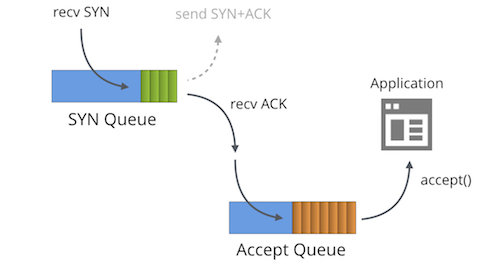
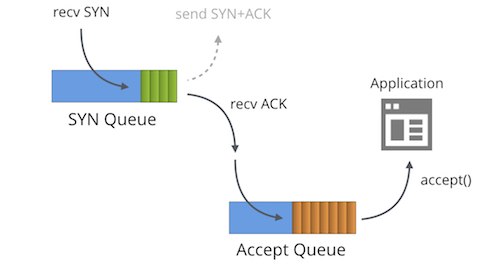
First we must understand that each bound socket, in the "LISTENING" TCP state has two separate queues:
In the literature these queues are often given other names such as "reqsk_queue", "ACK backlog", "listen backlog" or even "TCP backlog", but I'll stick to the names above to avoid confusion.
The SYN Queue stores inbound SYN packets[1] (specifically: struct inet_request_sock). It's responsible for sending out SYN+ACK packets and retrying them on timeout. On Linux the number of retries is configured with:
$ sysctl net.ipv4.tcp_synack_retries
net.ipv4.tcp_synack_retries = 5