Today's Full Stack Journey podcast welcomes software engineer Kat Morgan to discuss finding and following passion projects---which for Kat include KubeVirt and UOR Framework. Scott and Kat have a technical and entertaining conversation about how pursuing passion projects can inform, shape, and create career opportunities.
Sometimes, budget pressures mean you just have to cut costs. Sometimes, cutting costs in one area can give you some financial elbow room to fund something in another. A fifth of all CIOs tell me that they have a mandate to cut network costs in 2023, and another third say they’d be open to doing that if they could fund something else with the savings. Most admit that they don’t have a really good idea of how to accomplish their goal without creating a risk that would potentially overwhelm benefits.Cutting CAPEX is popular in theory. Of 87 enterprises with cost-cutting interest, 55 said they thought their capital budgets would be an attractive place to start. That’s not changed much over the last five years, but what has changed is how enterprises think they could cut CAPEX. It used to be that they believed cost reductions could be achieved with new technologies like hosted router software or white-box devices, but this year they reported concerns that integration costs and risks were too high.To read this article in full, please click here
Large-scale cyber attacks on enterprises and governments make the headlines, but the impacts of cyberattacks can be felt acutely by small businesses that struggle to keep the lights on during normal times. In this blog, we’ll share new research on how small businesses, including those using our free services, have leveraged Cloudflare services to make their businesses more secure and resistant to disruption, along with a real story about how Cloudflare makes a tangible impact for small business customers.
Your local florist, fitness studio, café, or pet shop is likely using a wide variety of cloud-based SaaS apps to stay open for customers, including online accounting software, booking systems, point-of-sale credit card readers, inventory management systems, content management Continue reading
Under-resourced organizations that are vital to the basic functioning of our global communities face relentless cyber attacks, threatening basic needs for health, safety and security.
Cloudflare’s mission is to help make a better Internet. Starting December 13, 2022, we will help support these vulnerable infrastructure by providing our enterprise-level Zero Trust cybersecurity solution to them at no cost, with no time limit.
It is our pleasure to introduce our newest Impact initiative: Project Safekeeping.
Small targets, devastating impacts
Critical infrastructure is an obvious target for cyber attack: by its very definition, these are the organizations and systems that are crucial for the functioning of our society and economy. As such, these organizations cannot have prolonged interruptions in service, or risk having sensitive data exposed.
Our conversations over the past few months with government officials in Australia, Germany, Japan, Portugal, and the United Kingdom show that they are focused on the threat to critical infrastructure, but resource constraints mean that their attention is on protecting large organizations – immense financial institutions, hospital networks, oil pipelines, and airports. Yet, the small critical infrastructure organizations that Continue reading
Recently, the United States Department of Commerce announced that all 50 states and every eligible territory had signed on to the “Internet for All'' initiative. Internet for All is the US government’s $65 billion initiative to close the Digital Divide once and for all through new broadband deployment and digital equity programs. Cloudflare is on a mission to help build a better Internet, and we support initiatives like this because we want more people using the Internet on high-throughput, low-latency, resilient and affordable Internet connections. It’s been written often since the start of the pandemic because it’s true: it isn’t acceptable that students need to go to a Taco Bell parking lot to do their homework, and a good Internet connection is increasingly important for doing adult jobs as well.
The Internet for All initiative is the result of $65 billion in broadband-related funding appropriated by the US Congress as part of the Infrastructure Investment and Jobs Act (IIJA). It’s been called a “once in a generation” funding opportunity, and compared with the Rural Electrification Act which brought power lines to rural America in the 1930s. The components of the broadband portion of the Infrastructure bill are:
In July 2021, Cloudflare announced Project Pangea to help underserved community networks get access to the Internet for free. Today, as part of Impact Week, we’re excited to expand this program to support even more communities by relaxing the technical requirements to participate.
Previously, in order to be eligible for Project Pangea, participants would need to bring at least a /24 block of IP space for Cloudflare to advertise on their behalf (referred to as “Bring Your Own IP”). But everyone should have secure, fast, and reliable access to the Internet, without being gated by costly network resources like IPv4 space. Starting now, participants no longer need to bring a /24 in order to access Pangea services: Internet connectivity, DDoS protection, network firewalling, traffic acceleration, and more, are available for free for eligible networks.
How is Project Pangea helping community networks?
The Internet Society, or ISOC, describes community networks as “when people come together to build and maintain the necessary infrastructure for Internet connection.” Most often, community networks emerge from need, and in response to the lack or absence of available Internet connectivity.
Cloudflare’s global network, which spans more than 275 cities across the world, provides Continue reading
Part of the magic of the Internet is in tens of thousands of networks connecting to each other all across the world in an effort to share information more efficiently. Cloudflare is a member of 279 Internet Exchanges (IX for short), but today we want to highlight one such dot on the global Internet map: the Montgomery, Alabama Internet Exchange, called MGMix. Thanks to the hard work of local leaders and the participation of dozens of networks (including Cloudflare), the Internet in Alabama works better today than it did before the IX launched.
Understanding IXs
Before we talk more about Alabama in particular, let's take a step back to understand the critical role that Internet Exchanges play in our global Internet. In a simple model of exchanging Internet traffic, one person is on their laptop and requests content on a website, uses a video conferencing application, or wants to securely connect to their workplace from home. The person, or “client” in technical terms, is generally using a traditional Internet Service Provider, who they pay to access everything on the Internet. On the other hand, whatever the user is trying to reach – the website, API endpoint, or security service – Continue reading
The hype generated by the “VMware supports DPU offload” announcement already resulted in fascinating misunderstandings. Here’s what I got from a System Architect:
We are dealing with an interesting scenario where a customer had limited data center space, but applications demand more resources. We are evaluating whether we could offload ESXi processing to DPUs (Pensando) to use existing servers as bare-metal servers. Would it be a use case for DPU?
First of all, congratulations to whichever vendor marketer managed to put that guy in that state of mind. Well done, sir, well done. Now for a dose of reality.
The hype generated by the “VMware supports DPU offload” announcement already resulted in fascinating misunderstandings. Here’s what I got from a System Architect:
We are dealing with an interesting scenario where a customer had limited data center space, but applications demand more resources. We are evaluating whether we could offload ESXi processing to DPUs (Pensando) to use existing servers as bare-metal servers. Would it be a use case for DPU?
First of all, congratulations to whichever vendor marketer managed to put that guy in that state of mind. Well done, sir, well done. Now for a dose of reality.
This is a retelling of a presentation I gave at work. In it, I describe a mechanism I've
started using to raise the quality of artifacts I check into version control.
The Internet largely operates in a space defined by markets rather than an intricate framework of regulation. Using a lens of market dynamics and looking at the level to which market-based incentives exist for actors, is the adoption of routing security heading in the direction of market failure? If so, then how should we respond?
Take a Network Break! On today's episode we cover a new certification roadmap from Cisco, speculate on the future of corporate office space, and delve into an FTC lawsuit that aims to stop Microsoft's $69 billion purchase of game developer Activision. We also cover Broadcom financial results and space networking stories from Apple and SpaceX.
Take a Network Break! On today's episode we cover a new certification roadmap from Cisco, speculate on the future of corporate office space, and delve into an FTC lawsuit that aims to stop Microsoft's $69 billion purchase of game developer Activision. We also cover Broadcom financial results and space networking stories from Apple and SpaceX.
The chief technology officers in the tech world have done their time in the engineering trenches, writing their papers, getting their patents, and helping suppliers up and down the IT supply chain make the money that keeps the innovation flowing. …
TL;DR: If you’re a sysadmin or network administrator who doesn’t know vi/vim, I wouldn’t worry about it. Nano as a Linux/Unix editor will suffice in just about every situation you’re likely to be involved in.
Vi (and its successor, vim) is a text editor commonly used on Unix-like systems like Linux, the BSDs, and MacOS (I’m not getting into a what is/isn’t Unix discussion). If it’s remotely Unix-like, typing “vi” will likely get you vi, vim, or another variant. You can pretty much count on vi being there.
When I started as a Unix admin back in the 1990s, primarily working with Solaris and SunOS, knowing your way around vi is what I would classify as an essential skill. The other editors were pico (easy to learn) and Emacs (very high learning curve). Vi versus Emacs was one of the first technology “religious” wars.
I don’t have much experience with Emacs. I gave it a go in the late 1990s at one point, but found the learning curve too discouraging. Besides, I could already do everything I needed to with vi and Emacs users didn’t seem to be able to do something I couldn’t do. It felt like to me Continue reading
At Suncavanaugh Corp., we just got this super cool automation platform. It's called Red Hat Ansible Automation Platform. Now, I'm really excited about all this and I have used Ansible before, but I'm worried about getting it working in our environments. How do I even get started with automation that needs to be production ready? What if I need help building what we need? How do I know what I build is good enough for production? This is pretty scary…
Love,
~ Chagrining in Chapel Hill “
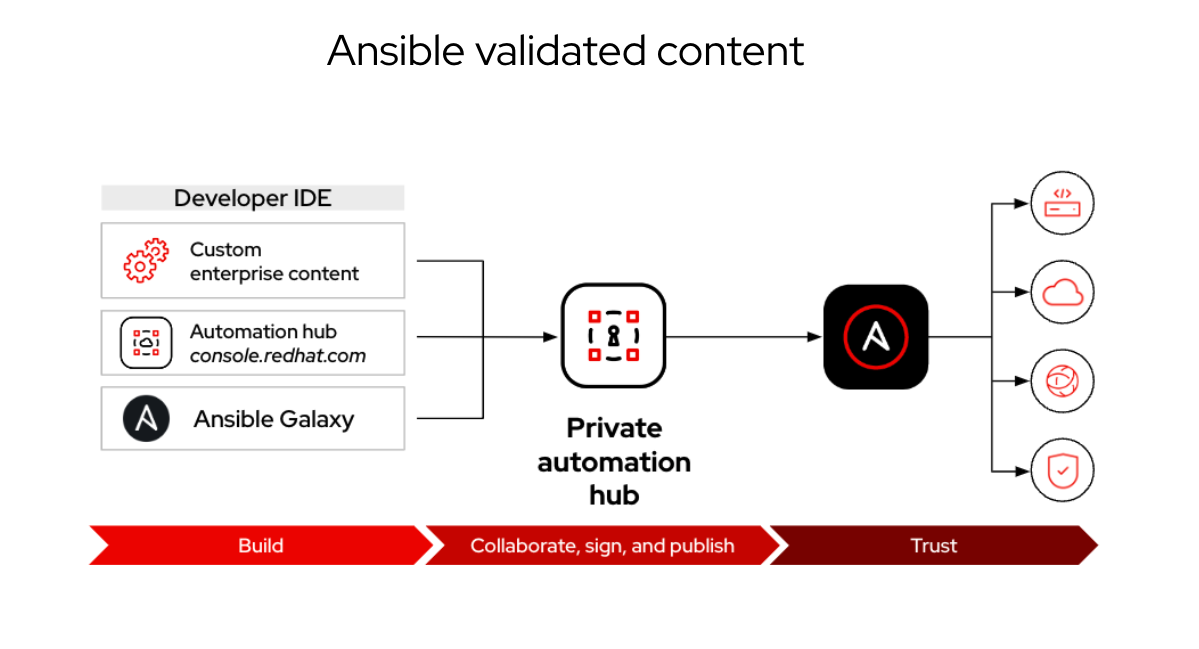
We can understand these concerns, as this is something that many customers experience when they start their journey into automation. Red Hat Ansible Automation Platform has many tools to assist organizations from savings planner to Red Hat Insights, however, actually getting started still requires you to jump into some YAML and build your first production-ready playbook. You want to start automating, but you don’t know where to start. At AnsibleFest 2022, we announced a new addition to the content ecosystem offered through the platform. Drumroll please….. this is Ansible validated content.
Ansible validated content is expert-built automation content packaged as Collections that contain Ansible Continue reading
Today on the Tech Bytes podcast we explore sponsor Fortinet’s Secure Access Service Edge, or FortiSASE, offering, including the FortiClient agent, what cloud-delivered security services are available, SASE use cases, and more. Our guest is Nirav Shah, VP of Products at Fortinet.
Today on the Tech Bytes podcast we explore sponsor Fortinet’s Secure Access Service Edge, or FortiSASE, offering, including the FortiClient agent, what cloud-delivered security services are available, SASE use cases, and more. Our guest is Nirav Shah, VP of Products at Fortinet.