Headcount: The Latest in Hirings, Firings, and Retirings — October 10, 2017
 Intel mourns loss of former CEO; F5 recruits top exec from Oracle; Verizon's top media exec steps down amidst Yahoo failures.
Partnerships to Connect the World
Today the Secretary-General of the International Telecommunication Union Houlin Zhao opened the World Communication Development Conference (WTDC) with a critical message: Partnerships make things happen.
The Internet Society is at the WTDC this week, and our ask is clear. We’re urging the 100+ Ministers attending to implement policies on infrastructure and digital skills that enable connectivity for thousands of communities around the world.
But turning that ambition into action won’t happen if we do not work together.
Today we are pleased to announce that the Internet Society and Argentina’s National Communications Agency (ENACOM) signed a Memorandum of Understanding to cooperate in supporting community networks in Argentina.
It’s an exciting moment for everyone who believes that the Internet brings limitless opportunities for good.
If you believe that closing the digital divide is critical, community networks are something everyone can support. These are networks built in communities, by communities, and through partnerships with a variety of stakeholders. They are a compliment to traditional models for access and are something you can promote, donate to, or even build yourself.
The agreement stands as an excellent example to other governments on how working together can help bring connectivity to some of the world’s Continue reading
Worth Reading: The Madness of Speed Tests
The post Worth Reading: The Madness of Speed Tests appeared first on rule 11 reader.
Network Break 156: The InfoSec Follies; Nokia Wins Big SDN Deal
Get your fill of tech news with Network Break! This week we examine stories from Equifax, Yahoo, Barefoot Networks, Nokia, Google and more. The post Network Break 156: The InfoSec Follies; Nokia Wins Big SDN Deal appeared first on Packet Pushers.

My Lexicon: Nexii
Nexii (noun, pl.; pronounced nex-eye)
Usage
“I have built a leaf/spine fabric using Nexii.”
Explanation
Nexii is the plural of Nexus, obviously. To talk about “Cisco Nexuses” is ugly. Referring to “Cisco Nexus switches” is syllabically inefficient. Nexii is the perfect blend between inappropriate Latin noun pluralization and verbal optimization.
“We need to upgrade the software on our Nexii.”
You’ll thank me later.
If you liked this post, please do click through to the source at My Lexicon: Nexii and give me a share/like. Thank you!
Solutions needed! It’s time to close the digital gender divide
By Raquel Gatto and Joyce Dogniez
If you could sneak peek a future in 10 years in which the Internet is everywhere, would it still be the same access for men and women, boys and girls?
The latest Internet Society report focused on the future of the Internet Society shows that new digital divides are emerging. One of them is a gender divide. Today 250 million fewer women than men use the Internet. If we don’t act now to close this gap, we will lose out on a digital future that includes everyone.
Closing the digital divide and bridging the gender gap is a promise the world made to itself in 2015 when world leaders ratified the Global Goals for Sustainable Development.
This week more than 100 Ministers and 1,500 delegates are attending the World Telecommunications Development Conference, a 10-day meeting dedicated finding new solutions on how Information and Communication Technologies can advance development.
We’re here to send a message that to shape a digital future that benefits all of humanity, we need new thinking, new approaches and new tools for this rapidly changing world around us.
We need your help.
If you’re at the World Telecommunications Development Conference Continue reading
10 Hyperconvergence Vendors Setting the Pace
Hyperconverged infrastructure is hot. Here are some of the companies leading the charge.
ForeScout, CrowdStrike Join Forces to Battle Endpoint and Network Security Threats
 The companies also plan to build a joint security product.
Basics of Multicast Addresses ( 224.0.0.0 to 239.255.255.255)
Today I am going to talk about basics of Multicast from the beginning. Before starting the concept of multicast you need to know about the unicast and the broadcast type of networks.
Unicast: Unicast is the traffic from from the single user to the single destination.
Broadcast: Broadcast is the traffic flow from the single user to everyone in the network.
Multicast: Multicast is the traffic flow from the single user to the specific group of the destinations in the network.
IP Multicast
Unicast: Unicast is the traffic from from the single user to the single destination.
Broadcast: Broadcast is the traffic flow from the single user to everyone in the network.
Multicast: Multicast is the traffic flow from the single user to the specific group of the destinations in the network.
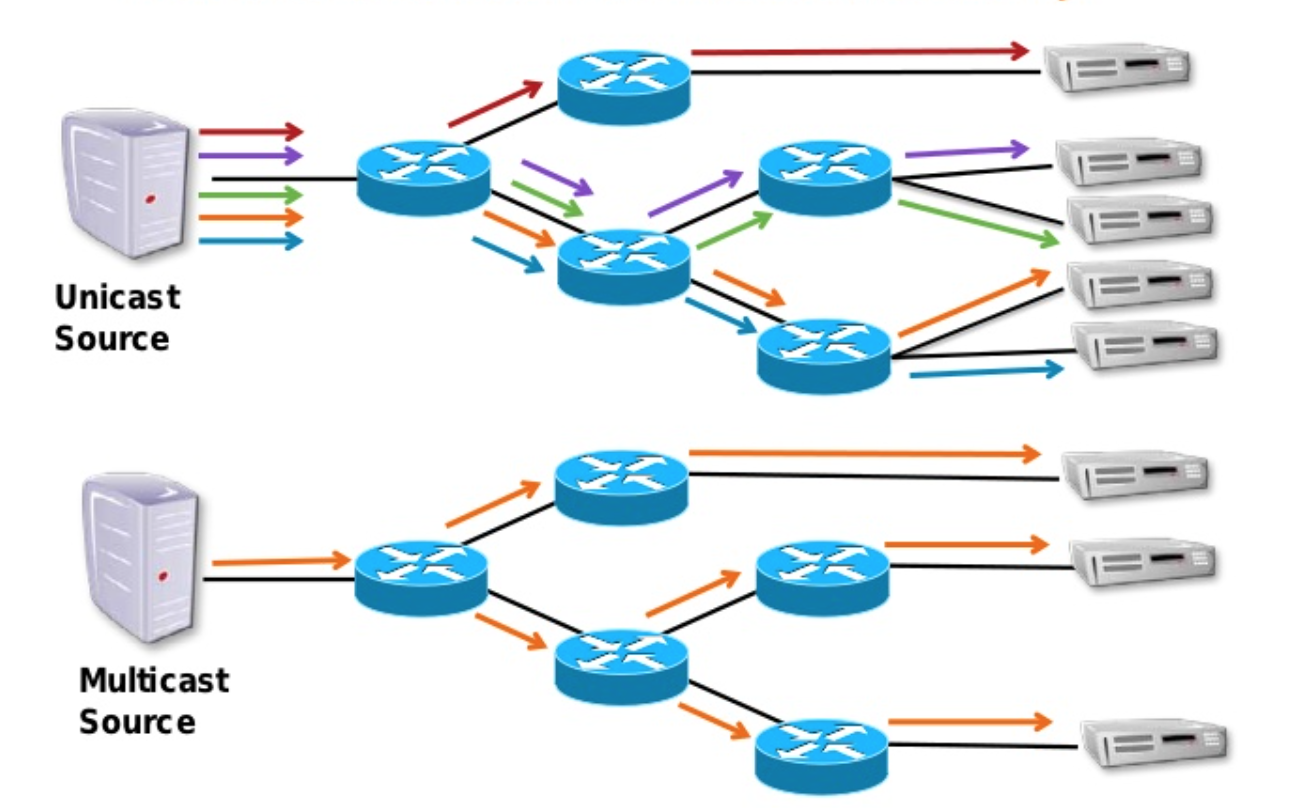 |
| Fig 1.1- Multicast Vs Unicast |
IP Multicast
IP multicast works as follows :
- Multicast groups are identified by IP addresses in the range 224.0.0.0 - 239.255.255.255 (class D address)
- Every host (more precisely: interface) can join and leave a multicast group dynamically : no access control
- Every IP datagram sent to a multicast group is transmitted to all members of the group
- IP multicast service is unreachable
- IP multicast only supports UDP as higher Layer which means there is no multicast TCP.
- All D class addresses are Multicast addresses. The addresses range are shown above from 224.0.0.0 to 239.255.255.255
- These addresses are dynamically Continue reading
DNS- Domain Name Server
Today I am going to talk about the DNS server. I knew some of the you already knew about the DNS. DNS stands for Domain Name Server and is a service to translate hostname into IP address. DNS is a distributed database implemented in a hierarchy of name servers and DNS is an application level protocol for message exchange between clients and servers.
Now question is Why we required DNS service ?
Now question is Why we required DNS service ?
- It is easier to remember a host name than it is to remember an IP address.
- A name has more meaning to a user than a 4 byte number.
- Applications such as FTP, HTTP, email, etc., all require the user to input a destination
- The user generally enters a host name
- The application takes the host name supplied by the user and forwards it to DNS for translation to an IP address
 |
| Fig 1.1- DNS |
How DNS- Domain Name Server Works ?
- DNS works by exchanging messages between client and server machines.
- A client application will pass the destination host name to the DNS process (in Unix referred to as the get host by name() routine to get the IP address.
- The application then sits Continue reading
DHCP Message Types
Today I am going to talk about the DHCP message types and the meaning of all the requests sent by server and client in DHCP process. The messages are shown below
Messages Types
DHCPNACK: Negative acknowledgement from server to client, indicating that the client's lease has expired or that a requested IP address is incorrect.
DHCPDECLINE: Message from client to server indicating that the offered address is already in use.
DHCPRELEASE: Message from client to server canceling Continue reading
Messages Types
- DHCPDISCOVER
- DHCPOFFER
- DHCPREQUEST
- DHCPDECLINE
- DHCPACK
- DHCPNAK
- DHCPRELEASE
- DHCPINFORM
 |
| Fig 1.1- Sample DHCP request |
 |
| Fig1.2 - Sample DHCP Response |
DHCPDISCOVER: Broadcast by a client to find available DHCP servers.
DHCPOFFER: Response from a server to a DHCPDISCOVER and offering IP address and other parameters.
DHCPREQUEST: Message from a client to servers that does one of the following:
- Requests the parameters offered by one of the servers and declines all other offers.
- Verifies a previously allocated address after a system or network change (a reboot for example).
- Requests the extension of a lease on a particular address.
DHCPACK: Acknowledgement from server to client with parameters, including IP address.
DHCPNACK: Negative acknowledgement from server to client, indicating that the client's lease has expired or that a requested IP address is incorrect.
DHCPDECLINE: Message from client to server indicating that the offered address is already in use.
DHCPRELEASE: Message from client to server canceling Continue reading
IP CLOS – EBGP – Multipath Multiple-as
Hi,
We have seen how iBGP was used to do the IP Clos with a RR Setup, how about eBGP.
Configurations / EVE Topology – https://github.com/r2079/JDC
Two simple rules
- All spines have connections to all leaves – eBGP
- No leaf or No spine devices have interconnected BGP.
Here is the topology.

The picture says 1000 words here – How the physical links are connected that’s how the bgp flows.
Lets see the BGP Status on R1 and R2

Since the hurdles of multipath has been explained. The use ADD-Path is not required here, instead since the update comes from Different AS numbers (R4 and R5) giving out the same update, we have to use another knob called MULTIPLEAS. This has to be on all Spine and leaf devices so that proper Load Balancing can be done along with EXPORTLB policy in the forwarding table.
Lets see one of the routers

Verification from R6

Regards
Rakesh
Routing Protocols: a Perfect Example of RFC 1925 Rule 5
In case you’re not familiar with RFC 1925, its Rule 5 states:
It is always possible to agglutinate multiple separate problems into a single complex interdependent solution. In most cases this is a bad idea.
Most routing protocols are a perfect demonstration of this rule.
Read more ...Lanner, 128 Technology Team Up on White Box for SD-WAN, VNF
 It combines Lanner’s uCPE appliances and 128 Technology’s routing software.
Network Automation Engineer Persona: Part One
This is the first post of a series on the persona between “network engineer” and “developer”. This role does not exist in myth, but it is a natural evolutionary step forwards. This position inherits skills from both ends of the scale, but in itself is an emerging role in organisations globally.
Why describe personas? They are important because:
1. They provide a roadmap for a career
2. They provide a set of skill requirements to master for a role matching the persona
3. They provide a set of tool consumption and usage hints
4. They provide a viewing glass to defining thought processes
Some of the challenges both vendors and network technology consumers are facing today are related to the set of evolving personas in our field, therefore it’s crucial to understand them properly. Remember when you wanted to be a network engineer? You became the persona and worked your way through a set of learnings. Your thoughts and habits changed, along with your recognition and self awareness.
Evolution of Roles
Every industry evolves and some industries disappear. The need to move packets about on the Internet hasn’t evolved out of existence just yet; our current highly generalized reality is: Continue reading