Personal Data Services Promise User Privacy
An emerging technology could help enterprises protect customer PII.
Enterprise Sticking With Private Cloud
This slide was posted on Twitter this morning rom Sam Charrington: This matches with what I hear and see in the market. Most enterprises will build private clouds They have so much data in their existing DCs that migrating is impossible/impractical That OpenStack (not VMware SDDC) is the preferred platform Some key market points that I […]
The post Enterprise Sticking With Private Cloud appeared first on EtherealMind.
Host-to-Network Multihoming Kludges
Continuing our routing-on-hosts discussions, Enno Rey (of the Troopers and IPv6 security fame) made another interesting remark “years ago we were so happy when we finally got rid of gated on Solaris” and I countered with “there are still people who fondly remember the days of running gated on Solaris” because it’s a nice solution to host-to-network multihoming problem.
Quoting RFC1925, “It’s easier to move a problem around than to solve it” and people have been extremely good at moving this particular problem around for decades.
Read more ...Datera Enters the Cloud Storage Marketplace with $40M
 The startup goes up against Red Hat Ceph and NetApp SolidFire.
Cisco Live 2016 – Everything Is Coming Together
It seems that Cisco Live is about the only thing I blog about in the last…well, few years. At least I’m still writing, even if it is twice a year. :)
Here’s a summary about Cisco Live for those who live in a dark hole. It’s July 10 – 14, 2016, in Las Vegas. If you do anything with Cisco, you should go. If you do anything with technology that isn’t Cisco, you should go. Bring your significant other. There’s plenty to do for everyone. Anyway, on to the details for this year’s show.
The Mandalay Bay’s South Convention Center will be our campgroun this year. This is the same place from back in 2011, but with quite a few updates to the layout. I can’t remember the numbers from the last time, but I imagine that number will be close to double this year. I have all confidence that the convention center can handle us, though. They did such a wonderful job last time. I hope the food is as good as I remember; it’s been pretty poor going the last few years in Orlando, San Continue reading
My Current IWAN Analogies
I use analogies. Just how my brain works…. and how I sometimes learn and teach. Token-ring source-route bridging analogy was “breadcrumbs thru the network”. Analogy for DLSw+ was a boat getting the breadcrumbs over water between 2 islands.
I think I like analogies cause…. to be superbly honest… when I came to work at Cisco back in 1996 I only knew SNA. I did NOT know IP. I was quickly immersed into learning IP. But I mean seriously… using acronyms to explain other acronyms you don’t understand? Don’t get me started!
Ready to play? Yea yea… my brain jumps around with varying analogies. If one doesn’t hit ya maybe the next will.  Happy nerding!
Waze on Steroids
 Imagine you own a rental car agency with 2 locations across town from each other. Your employees are constantly driving the cars back and forth between the two locations to balance out inventory.
If the employees hit issues during the drive (potholes, glass, mud, sand, dirt, major traffic, construction) this is going to cost your company.
So you can see how knowing what is going on via the varying paths between your locations is critical to your Continue reading
Juniper Networks Warns of 1Q Revenue Slip
 The company blames enterprise sales and delayed service provider deployments.
Brief Me At Interop?
Want to brief me about your product or otherwise have a chat? Send an e-mail to [email protected] while there's still room on my calendar. I look forward to seeing you at Interop!Badu Networks WarpGateway Improves Internet for Wifi
Badu Networks WarpGateway is a TCP proxy appliance improving Internet performance for wireless clients.
The post Badu Networks WarpGateway Improves Internet for Wifi appeared first on Packet Pushers.
Badu Networks WarpGateway Improves Internet for Wifi
Badu Networks WarpGateway is a TCP proxy appliance improving Internet performance for wireless clients.
The post Badu Networks WarpGateway Improves Internet for Wifi appeared first on Packet Pushers.
Taipei: CloudFlare’s 77th Data Center is Now Live
台北:CloudFlare的第七十七個數據中心已經上線喔!

We are excited to announce the launch of our Taipei data center, which is our 28th data center in Asia, and our 77th data center globally. Millions of websites which were previously served from Hong Kong are now served locally from Taipei.
我們高興地宣布CloudFlare的的台北機房建置完成。這是我們在亞洲的第二十八個,在全球的第七十七個數據中心。從現在起台灣的網民可以直接從CloudFlare在台北的節點訪問數以百萬計的網站,不再繞道到香港。
Taipei today
今天的台北

Taipei, home to many renowned tech companies, is famous not only for its vibrant night markets, but also for its warm and welcoming people. From soup dumplings to computer peripherals to Kangsi Coming, its contribution to the world is enormous.
科技重鎮台北,不單擁用充滿活力的夜市,台北人的熱情而友善的人情味也是舉世聞名的。從小籠包、電腦周邊零件到康熙來了,台北對世界的貢獻碩大無朋。
Improved availability and performance
更進一步的可用性和性能
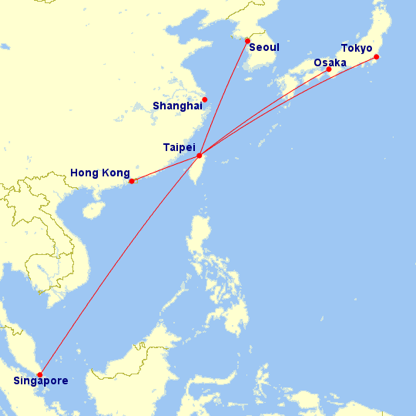
Taipei has one of the fastest Internet speeds. Yet, being located far away from other Internet interconnect centers makes for some unique challenges. When traffic is delivered to local eyeballs from Hong Kong, Tokyo, Singapore or worse-still Los Angeles, it is often subject to long latency and the constraints of limited capacity before arriving in Taipei. Additionally, traffic flowing on undersea cables around Taipei have been subject to cable cuts over the years, mainly because of the active fault lines around the island.
台北有世界上首屈一指的網路速度。可是,因為台北和其他互聯網交換中心的距離,來自香港,東京,甚至洛杉磯的流量往往要通過高延時和有限的頻寬才能傳送到台北。另外,台北位於板塊交界處,地震發生頻繁,海底電䌫中斷時有發生。
With the launch of our Taipei data center, visitors to millions of CloudFlare websites will experience a 4x improvement in performance and Continue reading