ClearPath Gains Entry to HP’s Partner Program
 ClearPath leverages HP's virtual network functions (VNFs) together with its own vCPE technology to target service providers.
Rule 11 is your friend

It’s common enough in the networking industry — particularly right now — to bemoan the rate of change. In fact, when I worked in the Cisco Technical Assistance Center (TAC), we had a phrase that described how we felt about the amount of information and the rate of change: sipping through the firehose. This phrase has become ubiquitous in the networking world to describe the feeling we all feel of being left out, left behind, and just plain not able to keep up.
It’s not much better today, either. SDNs threaten to overturn the way we build control planes, white boxes threaten to upend the way we view vendor relationships, virtualization threatens to radically alter the way we think about the relationship between services and the network, and cloud computing promises just to make the entire swatch of network engineers redundant. It’s enough to make a reasonable engineer ask some rather hard questions, like whether it’s better to flip burgers or move into management (because the world always needs more managers). Some of this is healthy change, of course — we need to spend more time thinking about why we’re doing what we’re doing, and the competition of the cloud Continue reading
They Really Did It: Dell to Acquire EMC for $67B
 Cash, debt, and a tracking stock back what might be the biggest tech acquisition ever.
Industry Influencers: Application-aware Networking
Network Insight Blogger and industry guru, Matt Conran, featured Plexxi in his October 6 post Application-aware Networking-Plexxi Networks. He believes, “Mobility and dynamic bandwidth provisioning force us to rethink how we design networks.” We agree.
Conran defines application-aware networking as the idea that application visibility combined with network dynamism will create an environment where the network can react to the changing behavior of application mobility and bandwidth allocation requirements. With that in mind, he took a comprehensive look at what we’ve been doing to “reverse the traditional design process and let the application dictate what kind of network it wants.”
Conran states that, “Networks should be designed around conversions but when you design a network it is usually designed around reachability. A conversational view measures network resources in a different way, such as application SLA and end-to-end performance. The focus is not just uptime. We need a mechanism to describe applications in an abstract way and design the network around conversations. The Plexxi affinity model is about taking a high-level abstraction of what you want to do, let the controller influence the network and take care of the low-level details. Affinity is a policy language that dictates exactly how you want the network to Continue reading
7 Storage Experts You Must Follow
Storage experts abound on Twitter and writing blogs, both independent and vendor-affiliated. We've chosen some storage gurus who offer a wide range of perspective.phpipam 1.2 beta1 testers needed
Hi all,
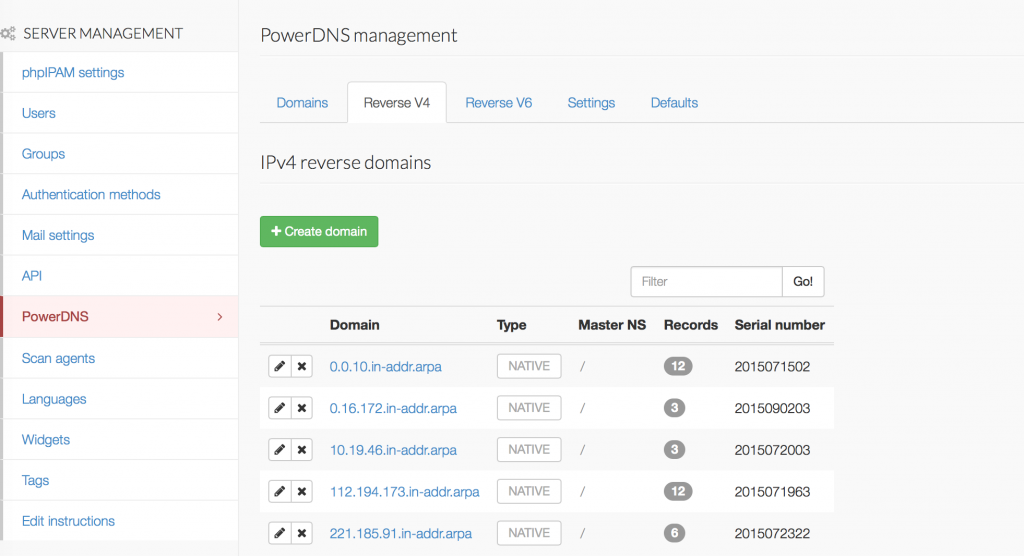
first beta version of phpipam 1.2 is available for download on Github:
If you have time help us squash some bugs before final release, focus is on the following things:
- scan agents;
- PowerDNS integration;
- APIv2 (REST)
- subnets scanning (pear/ping/fping)
Report any issues to our GitHub page (https://github.com/phpipam/phpipam/).
DMVPN Split Default Routing
SD-WAN is all the rage these days (at least according to software-defined pundits), but networking engineers still build DMVPN networks, even though they are supposedly impossibly-hard-to-configure Rube Goldberg machinery.
To be honest, DMVPN is not the easiest technology Cisco ever developed, and there are plenty of gotchas, including the problem of default routing in Phase 2/3 DMVPN networks.
Read more ...Sit Stand Desk Setup
I work from home these days. Therefore it’s important that I have a decent desk setup. My previous setup was pretty crappy, but I only worked from home part-time. I’ve been using a standing desk at home, and wanted to move to a sit/stand model for full-time use. Here’s what I did.
Desk & Monitor Arrangement
I bought the Cubit Highrise desk, with a 1200mm x 700mm surface. This is a New Zealand-made manual height-adjustable desk. The adjustable legs allow for the height to be set anywhere between 660 and 1060mm. I paid $660NZD including shipping, from Total Office. That was the best deal at the time.
I added a Fleximounts L02 monitor stand. This is a desk-mounted monitor stand, with two gas spring arms. One arm has a tray for my MBPr laptop, the other has an LG IPS236 23″ monitor. It cost me $134USD including shipping. It’s in USD because I picked it up on one of my recent trips to San Jose.
I also use a wireless Apple keyboard and an Apple Magic Trackpad.
How’s it working out?
I’ve been very happy. My previous setup was a crappy desk with a platform added to get it to standing height. That Continue reading
CCNA RS Workbook
Hi everyone,
People that know me know that I have always been keen on giving back to the community and helping people in their studies. On that note, I have decided to start creating content for a CCNA RS workbook which will be published online. The goal is to take the blueprint and cover one item from the blueprint in each post.
I hope this will be helpful for people in their CCNA studies.
NANOG 65 Report
NANOG 65 was once again your typical NANOG meeting: a set of operators, vendors, researchers and others, meeting over 3 days, this time in Montreal in October. Here’s my impressions of the meeting.Winston Churchill on IPv6
While researching for another blog post, I stumbled upon this speech by Winston Churchill:
When the situation was manageable it was neglected, and now that it is thoroughly out of hand we apply too late the remedies which then might have effected a cure. There is nothing new in the story. It is as old as the Sibylline Books. It falls into that long, dismal catalogue of the fruitlessness of experience and the confirmed unteachability of mankind. Want of foresight, unwillingness to act when action would be simple and effective, lack of clear thinking, confusion of counsel until the emergency comes, until self-preservation strikes its jarring gong -these are the features which constitute the endless repetition of history.
Obviously mr. Churchill wasn't talking about IPv6 but about way more serious matters… but it's also obvious he was right abut the unteachability of mankind.
SDN Warriors

SDN Warriors Facebook Group is an open group for any Network Engineer who wants to transform to become SDN & NFV Architect, Network Programmability Engineer and Network DevOps. The group is run by mentors who are currently transforming ourselves and willing to help others to do the same. We have the skills and experiences with various SDN solutions, we have done SDN & NFV projects, we have hosted SDN Hackathon event, we have even created our own SDN products.
Non-SDN related topics will be banned, and please use English only
https://www.facebook.com/groups/sdnwarriors/