Some notes on the Raspberry Pi

I keep seeing this article in my timeline today about the Raspberry Pi. I thought I'd write up some notes about it.

The Raspberry Pi costs $35 for the board, but to achieve a fully functional system, you'll need to add a power supply, storage, and heatsink, which ends up costing around $70 for the full system. At that price range, there are lots of alternatives. For example, you can get a fully function $99 Windows x86 PC, that's just as small and consumes less electrical power.

There are a ton of Raspberry Pi competitors, often cheaper with better hardware, such as a Odroid-C2, Rock64, Nano Pi, Orange Pi, and so on. There are also a bunch of "Android TV boxes" running roughly the same hardware for cheaper prices, that you can wipe and reinstall Linux on. You can also acquire Android phones for $40.

However, while "better" technically, the alternatives all suffer from the fact that the Raspberry Pi is better supported -- vastly better supported. The ecosystem of ARM products focuses on getting Android to work, and does poorly at getting generic Linux working. The Raspberry Pi has the worst, most Continue reading

Making the Internet Better Together at APRICOT 2019

Asia Pacific Regional Internet Conference on Operational Technologies (APRICOT) 2019, said to be the largest technical conference in the region, drew hundreds of the world’s leading Internet engineers from over 50 countries to Daejeon, South Korea last week.

The Internet Society, a long-time partner of the event, contributed to the event by not only sponsoring over a dozen of fellows to travel there, but also made multiple high-profile appearances in various sessions, including the opening keynote speech.

The Internet Society’s President and CEO Andrew Sullivan delivered the keynote Up and Down the Stack Through a Nerd’s Eyes: Making the Internet Better the Internet Way with hundreds of people present, including Tae-Jeong Her, Mayor of Daejeon, and Dr Hee-yoon Choi, President of organiser the Korea Institute of Science and Technology Information (KISTI), a government research institute.

Now that so many people depend on the Internet, it is no surprise that businesspeople, policymakers, regulators, and politicians all want a say in the way the Internet evolves. But some of the proposals for the future of the Internet, Sullivan said, betray fundamental misunderstandings of the way the Internet works. The talk urged us all to continue to engage with the big questions Continue reading

Wearable tech in the enterprise grows, but few workplace uses exist

Take a glance at the wrists of your co-workers, and you’re likely to see more and more of them adorned with smartwatches, fitness trackers, and other wearable technology. In meetings, you increasingly see colleagues surreptitiously glancing at their tiny screens, hoping in vain that no one is noticing.It isn’t just you. The latest smartwatch numbers all say that smartwatch shipments are growing fast, and the internet-connected devices are beginning to achieve mainstream acceptance: Last month, The NPD Group's new Smartwatch Total Market Report noted that smartwatch unit sales jumped 61 percent in 2018, while dollar volume rose 51 percent to approach $5 billion in sales. Some 16 percent of U.S. adults now own a smartwatch, the report said, up from 12 percent at the end of 2017.To read this article in full, please click here

Kernel of Truth season 2 episode 3: Storage solutions

Subscribe to Kernel of Truth on iTunes, Google Play, SpotifyCast Box and Sticher!

Click here for our previous episode.

You asked for it, we listened, and now we’re delivering! This episode, host Brian calls on Pete Lumbis and special guest David Illes from Mellanox to answer a question we got on our community Slack channel: “What are middle-tier customers doing for storage of Cumulus enabled solutions?” David and Pete share not only what’s changing for middle-tier customers but also tackle the topic of storage solutions in general. What sort of things are we seeing as customers migrate to Ethernet storage? Listen and find out.

Guest Bios

Brian O’Sullivan: Brian currently heads Product Management for Cumulus Linux. For 15 or so years he’s held software Product Management positions at Juniper Networks as well as other smaller companies. Once he saw the change that was happening in the networking space, he decided to join Cumulus Networks to be a part of the open networking innovation. When not working, Brian is a voracious reader and has held a variety of jobs, including bartending in three countries and working as an extra in a German soap opera. You can find him Continue reading

Bridging the Gap

Mike Bushong and Denise Donohue join Eyvonne, Jordan, and I to discuss the gap between network engineering and “the business,” and give us some thoughts on bridging it.

Outro Music:
Danger Storm Kevin MacLeod (incompetech.com)
Licensed under Creative Commons: By Attribution 3.0 License
http://creativecommons.org/licenses/by/3.0/

BrandPost: Simplifying Operations: Managing Edge Data Centers

IT professionals have been honing their data center management expertise for decades. However, migrating these best practices to an edge computing environment can be challenging.That’s because many workers located in edge environments, such as retail store clerks, lack the necessary data center expertise to ensure edge sites are properly maintained. Complicating matters is the fact that edge data centers can be expensive and complex to run.Clearly, organizations need a new way forward. Fortunately, cloud-based platforms are designed for the edge, and can simplify remote monitoring and management. Here’s what every business should look for in a solution:To read this article in full, please click here

Employee resource groups aren’t the answer, but they’re a first step

Why employee resource groups are important for building a great company culture but they're not enough.

Employee resource groups aren't the answer, but they're a first step

Diversity and inclusion is a process. To achieve diversity and inclusion, it’s not enough to hire diverse candidates. Once hired, we must be welcomed by a safe and belonging culture, and our diverse perspectives must be honored by our coworkers.

Too many times we are approached by well-meaning companies eager to hire diverse candidates, only to look behind the curtain and discover a company culture where we will not feel safe to be ourselves, and where our perspectives will be ignored. Why would we choose to stay in such an environment? These are the companies where diverse employees leave just as quickly as they join.

Employee Resource Groups (ERGs) are an essential part of diversity and inclusion, especially as companies grow larger. Before being heard, or trying to change someone's mind, you need to feel safe.

ERGs serve as a safe haven for those with perspectives and experiences that are "diverse" compared to the company as a whole. They are a place to share stories, particular plights, and are a source of stress relief. A place where we can safely show up fully as Continue reading

Off the Cuff – NFD20 Wrap Up

Last month, Networking Field Day 20 happened in Silicon Valley and our very own Jordan Martin attended the event as a delegate. In this Off the Cuff episode of Network Collective, we sit down with some of the other delegates at NFD20 and talk about our impressions of the event’s general themes and presentations.

The vendors who presented at the event were:

To find out more about Networking Field Day and the other great Field Day events, head on over to https://techfieldday.com

Richard McIntosh
Guest
Drew Conry-Murray
Guest
Brian Gleason
Guest
Mario Gingras
Guest
Nick Shoemaker
Guest
Jordan Martin
Host

Outro Music:
Danger Storm Kevin MacLeod (incompetech.com)
Licensed under Creative Commons: By Attribution 3.0 License
http://creativecommons.org/licenses/by/3.0/

The post Off the Cuff – NFD20 Wrap Up appeared first on Network Collective.

Data center giants announce new high-speed interconnect

A group of big names in the data center space have linked arms to develop yet another high-speed interconnect, this one designed to connect processor chips.It's called Compute Express Link, or CXL, which is aimed at plugging data-center CPUs into accelerator chips. Members of the alliance that developed the spec are Intel, Microsoft, Google, Facebook, HPE, Cisco, and Dell-EMC, plus Huawei and Alibaba.[ Learn who's developing quantum computers. ] Where are IBM, AMD, Nvidia, Xilinx, or any of the ARM server vendors such as Marvell/Cavium? They have their own PCIe-nased spec, called CCIX. The group consists of AMD, Arm, Mellanox, Qualcomm, Xilinx, and Huawei.To read this article in full, please click here

Data center giants announce new high-speed interconnect

A group of big names in the data center space have linked arms to develop yet another high-speed interconnect, this one designed to connect processor chips.It's called Compute Express Link, or CXL, which is aimed at plugging data-center CPUs into accelerator chips. Members of the alliance that developed the spec are Intel, Microsoft, Google, Facebook, HPE, Cisco, and Dell-EMC, plus Huawei and Alibaba.[ Learn who's developing quantum computers. ] Where are IBM, AMD, Nvidia, Xilinx, or any of the ARM server vendors such as Marvell/Cavium? They have their own PCIe-nased spec, called CCIX. The group consists of AMD, Arm, Mellanox, Qualcomm, Xilinx, and Huawei.To read this article in full, please click here

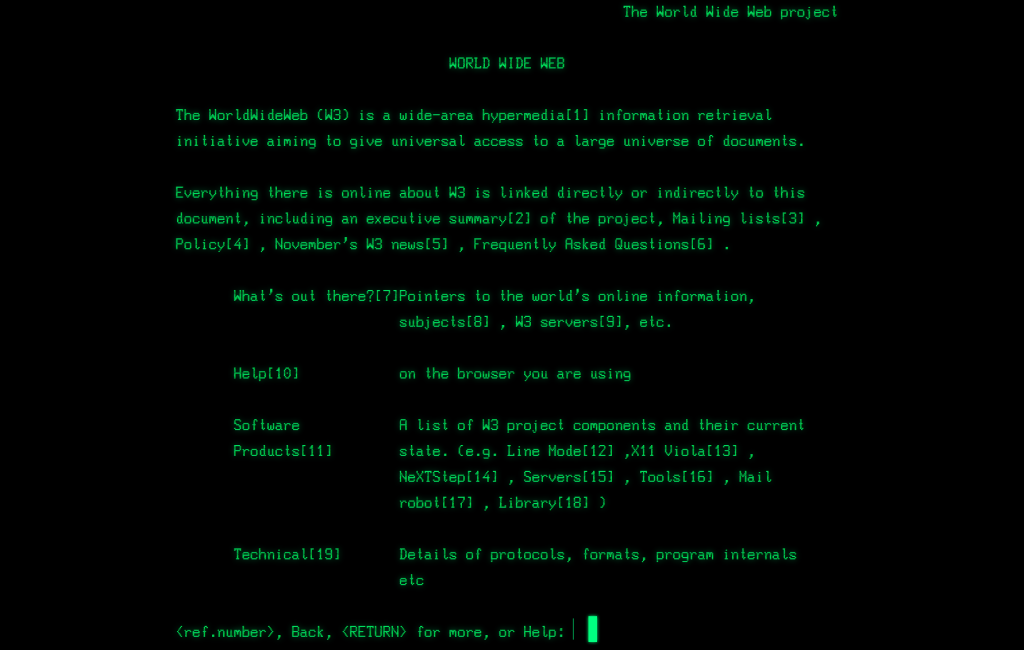
Celebrating the 30th Anniversary of the World Wide Web

http://line-mode.cern.ch/www/hypertext/WWW/TheProject.html

Back around 1991, I was traveling throughout the eastern USA teaching an “Introduction to the Internet” course I had written. The students were mainly from telecom, financial, and software companies wanting to know what this Internet thing was all about. I taught about IP addresses and DNS, using email, sending files with FTP,  using archie and veronica to find info, engaging in USENET discussions, and using Gopher to explore “gopherspace”.

At the end of the course, one of the final sections was on “emerging technologies”. And there, nestled in with HyTelnet and WAIS, was one single page about this new service called the “World-Wide Web”.

And all the page really said was: telnet to info.cern.ch, login as “www”, and start pressing numbers to follow links on the screen.


That was it! (and you can still experience that site today)

We had no idea in those very early days that what we were witnessing was the birth of a service that would come to create so much of the communication across the Internet.

In only a few short years, of course, I was teaching new courses on “Weaving the Web: Creating HTML Documents” and Continue reading

Split Tunneling with vpnc

vpnc is a fairly well-known VPN connectivity package available for most Linux distributions. Although the vpnc web site describes it as a client for the Cisco VPN Concentrator, it works with a wide variety of IPSec VPN solutions. I’m using it to connect to a Palo Alto Networks-based solution, for example. In this post, I’d like to share how to set up split tunneling for vpnc.

Split tunneling, as explained in this Wikipedia article, allows remote users to access corporate resources over the VPN while still accessing non-corporate resources directly (as opposed to having all traffic routed across the VPN connection). Among other things, split tunneling allows users to access things on their home LAN—like printers—while still having access to corporate resources. For users who work 100% remotely, this can make daily operations much easier.

vpnc does support split tunneling, but setting it up doesn’t seem to be very well documented. I’m publishing this post in an effort to help spread infomation on how it can be done.

First, go ahead and create a configuration file for vpnc. For example, here’s a fictional configuration file:

IPSec gateway vpn.company.com
IPSec ID VPNGroup
IPSec secret donttellanyone
Xauth username bobsmith

Continue reading