Worth Reading: On ISO standardization of blockchains
The post Worth Reading: On ISO standardization of blockchains appeared first on rule 11 reader.
The post Worth Reading: On ISO standardization of blockchains appeared first on rule 11 reader.
In this fast-paced global economy, enhanced speed, productivity, and intelligence are more important than ever to success. Machines are now being leveraged to augment human capabilities in order to drive business growth or accelerate innovation. Businesses need leading-edge IT to achieve superhuman levels of performance.
Today’s enterprises and organizations are deploying high performance computing (HPC) technologies to reach the new frontier of IT intelligence. Backed by HPC solutions, users can leverage artificial intelligence (AI) tools to predict and solve problems in real time, streamline IT operations, and drive more informed, data-driven decision-making.
Streamlining Medical Research With Machine Learning was written by Timothy Prickett Morgan at The Next Platform.


There are so many programming languages to choose from; as a new network or infrastructure coder, what are the best options to consider, and why? What are the differences between all these languages anyway?
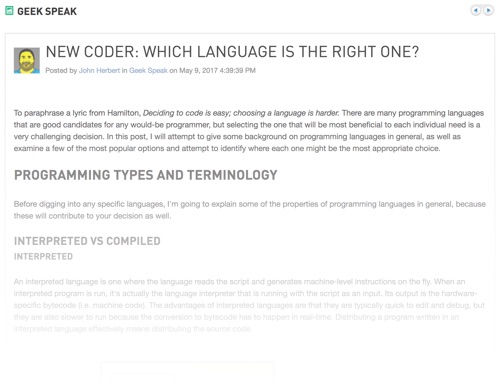
On the Solarwinds Thwack Geek Speak blog I explain what interpreted and compiled languages are, what strong and weak typing means, I evaluate some common languages and make some recomendations. Please do take a trip to Thwack and check out my post, “New Coder: Which Language Is The Right One?“.
Please see my Disclosures page for more information about my role as a Solarwinds Ambassador.
If you liked this post, please do click through to the source at New Coder: Which language is the right one? and give me a share/like. Thank you!
IPv6 Business drivers can be many and different businesses have different reasons to deploy IPv6 on their network. IPv6 is more commonly deployed in the Service Providers than Enterprises or Small Medium Businesses. Do you know why ? Main reason is IPv4 address space exhaustion. There is no available public IPv4 addresses in […]
The post IPv6 Business Drivers and PI/PA Address Space appeared first on Cisco Network Design and Architecture | CCDE Bootcamp | orhanergun.net.
How should somebody new to coding get started learning a language, writing code, and maybe even automating something? Where should they begin?
That’s the question I asked on the Solarwinds Thwack Geek Speak blog. In my post I look at what programming really is, and whether it’s going to be something that comes naturally, or will require a very conscious effort. Please do take a trip to Thwack and check out my post, “So you want to code? It’s only logical!“.

Please see my Disclosures page for more information about my role as a Solarwinds Ambassador.
If you liked this post, please do click through to the source at So You Want To Code? It’s Only Logical! (Thwack) and give me a share/like. Thank you!
 Cisco worked with the cloud titans, but it had to do most of the heavy lifting.
Moving from an outsourcing to an insourcing model helped boost agility and reduce operational costs.