PLUMgrid Serves Up 4.0 Software for OpenStack
 LBaaS and a Tunnel Heatmap highlight PLUMgrid's 4.0 release.
Juniper Networks Unveils Unite For Enterprise
 Juniper aims at enabling faster, better cloud services for enterprises with its new Unite platform.
Assigning DMVPN tunnel interface addresses with DHCP
I posted previously about some of the inner workings of DHCP. The three key points from that post are critical building blocks for this discussion:- DHCP requests get modified in flight by the DHCP relay.
- DHCP relay determines L2 destination by inspecting contents of relayed packets.
- DHCP clients, relays and (sometimes) servers use raw sockets because the end-to-end protocol stack isn't yet available.
- Configure a DHCP server. I'm using an external server1 in this example so that we can inspect the relayed packets while they're on the wire.
- Configure the hub router. There are some non-intuitive details we'll go over.
- Configure the spoke router. Ditto on the non-intuitive bits.
    1     no ip dhcp conflict logging
    2     ip dhcp excluded-address 172.16.1.1
    3     !
    4     ip dhcp pool DMVPN_POOL
    5      network 172.16.1.0 255.255.255.0
So, that's pretty straightforward.
The Hub Router has the following relevant configuration:
    1     ip dhcp support tunnel unicast
    2     interface Tunnel0
3 Continue readingDatadog Hunts Down Those Rogue Servers
 Using clustering algorithms, Datadog can spy cloud servers that aren't performing optimally.
Juniper Ex-CEO Shaygan Kheradpir Resurfaces at Coriant
 Kheradpir sticks to the telecom world after his adventure at Juniper.
And the winners of Docker Global Hack Day #3 are…
The quality of the Docker hacks and amount of participation from the Docker community was simply phenomenal! Over 2,000 community members attended events around the world and 50 meetup groups organized local editions of this Docker Hack Day #3. Kudos to the Docker community and … ContinuedPanel Discussion on Hot SDN Topics: Industry Experts Talk Intent Driven Networking
 Hurry up! It's your last chance to sign up for the ONF-sponsored panel discussion!
Sponsored Post: iStreamPlanet, Close.io, Instrumental, Location Labs, Enova, Surge, Redis Labs, Jut.io, VoltDB, Datadog, SignalFx, InMemory.Net, VividCortex, MemSQL, Scalyr, AiScaler, AppDynamics, ManageEngine, Site24x7

Who's Hiring?
- As a Networking & Systems Software Engineer at iStreamPlanet you’ll be driving the design and implementation of a high-throughput video distribution system. Our cloud-based approach to video streaming requires terabytes of high-definition video routed throughout the world. You will work in a highly-collaborative, agile environment that thrives on success and eats big challenges for lunch. Please apply here.
- As a Scalable Storage Software Engineer at iStreamPlanet you’ll be driving the design and implementation of numerous storage systems including software services, analytics and video archival. Our cloud-based approach to world-wide video streaming requires performant, scalable, and reliable storage and processing of data. You will work on small, collaborative teams to solve big problems, where you can see the impact of your work on the business. Please apply here.
- Close.io is a *profitable* fast-growing SaaS startup looking for a Lead DevOps/Infrastructure engineer to join our ~10 person team in Palo Alto or *remotely*. Come help us improve API performance, tune our databases, tighten up security, setup autoscaling, make deployments faster and safer, scale our MongoDB/Elasticsearch/MySQL/Redis data stores, setup centralized logging, instrument our app with metric collection, set up better monitoring, etc. Learn more and apply here.
- Location Labs is Continue reading
Bridging Between Cisco VIRL and GNS3 for L2 and Serial Support
One of the known issue for anyone preparing for a Cisco exam is that the solutions available today don’t support all the needed features. Cisco VIRL supports L2 switching out of the box, whereas GNS3 does not. GNS3 supports the configuration of serial interfaces on routers whereas Cisco VIRL does not. For someone starting out in this […]
The post Bridging Between Cisco VIRL and GNS3 for L2 and Serial Support appeared first on Packet Pushers.
Phantom Cyber Raises $6.5M To Automate Security
 Someone needs to unify all those enterprise security tools, the startup reckons.
Featured Guest Article: Your Retail Site Needs a Director
 The power behind a Shopping Director.
GRE Tunnel Between Cisco and Linux
Generic Routing Encapsulation - GRE is a tunneling protocol originally developed by Cisco that encapsulates various network protocolsGRE Tunnel Between Cisco and Linux
Generic Routing Encapsulation - GRE is a tunneling protocol originally developed by Cisco that encapsulates various network protocols inside virtual point-to-point tunnel. It transports multicast traffic via GRE tunnel so it allows passing of routing information between connected networks. As it lacks of security it is very often used in conjunction IP SEC VPN that on the other hand is not capable to pass multicast traffic.
The goal of the tutorial it to show configuration of GRE tunnel on a Cisco router and a device with OS Linux. I have created GNS3 lab consisting of two local networks - 192.168.1.0/24 and 192.168.2.0/24 connected via GRE tunnel. GRE tunnel interface is configured on router R1 (Cisco 7206VXR) and Core Router (Core Linux with Quagga routing daemon installed). The both routers have their outside interfaces connected to a router R3 that is located in the "Internet". To prove that GRE tunnel is working and transporting multicast traffic, the OSPF routing protocol is started on R1 and Core routers and configured on tunnel interfaces and interfaces pointing to local networks.
Note: The Core Linux vmdk image is available for download here.
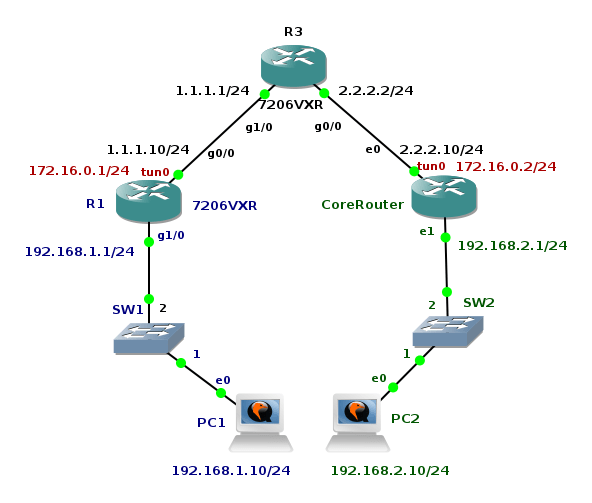 Picture 1 - Topology
1. Initial Configuration
First we assign hostnames and Continue reading
Reaction: Openstack, snowflakes, and complexity

For all those who think opensource is going to take over the world, cleaning up (and destroying) the mess open standards have made, there is a lesson in here.
It won’t.
The problem isn’t open standards. The problem isn’t open source. We have met the problem, and it is… us. We are the problem here. What we keep thinking is that we can “solve” complexity in some way. Each time a new unicorn comes on the scene, we think, “here, at least, is the magical unicorn that will make the physical world work the way I always wanted it to.” But like real life unicorns, you won’t find one in your rose garden. Or any other garden, for that matter. Unicorns don’t exist. Get over it.
Instead of looking for the next magical unicorn, we need to get to work figuring out which problems need to be solved, which ones Continue reading