Automatic host availability check
From version 0.9 on there is a option to automatically check statuses of configured hosts for selected subnets, and I received some related questions about it, so here is a short description and guide for it.
Firstly, pcntl support for php cli is advised so phpipam can do parallel icmp checks, this greatly reduces time required for checking status. You can check if your installation is ok with following command:
php -m | grep pcntl
1.) Configure the parameters for pinging
You should set required parameters for pinging, etc ping path etc under
functions/scan/config-scan.php
You can get your ping path by invoking “whereis ping” in terminal.
You can also set some optional parameters in script itself
functions/scripts/pingCheck.php
Also, set the time parameters for status under Administration > IPAM settings (Ping status intervals), phpipam will set host as down/up based on this values.
2.) Select which networks to check
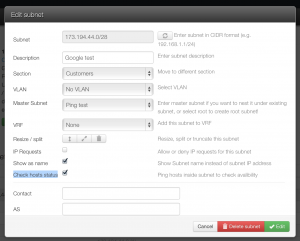
Now you have to select which subnets should scan for statuses for configured hosts. Go to edit subnet and check “Check hosts status”. This will tell the cron script to check the status of hosts inside this subnet.
3.) Add cron script
I suggest checking Continue reading



 This article is really just a quick documentation for something that I do almost each year, and each year I must google-search how I did the last time. So from now on I will have it in my own notes …. here!
 , but the base image is divided to 10 GB of system partition and another 20 GB of data partition. And as luck would have it, I needed 25 GB for data. One of the options was to buy more storage, but I have seen that my minimalistic debian hardly used more than 1,7 GB from the 10 GB system space and I wanted to make use of the remaining space.