Deploy Partially-Configured Training Labs with netlab

Imagine you want to use netlab to build training labs, like the free BGP labs I created. Sometimes, you want to give students a device to work on while the other lab devices are already configured, just waiting for the students to get their job done.

My BGP labs were designed for self-study. You might also want to listen to how Sander Steffann uses netlab in classroom training.

For example, in the initial BGP lab, I didn’t want any BGP-related configuration on RTR while X1 would already be fully configured – when the student configures BGP on RTR, everything just works.

Multicast IGMP – Internet Group Management Protocol (II)

Multicast IGMP - Internet Group Management Protocol (II)

In the previous post, we covered the basics of multicast. In this post, we will focus on IGMP, Internet Group Management Protocol.

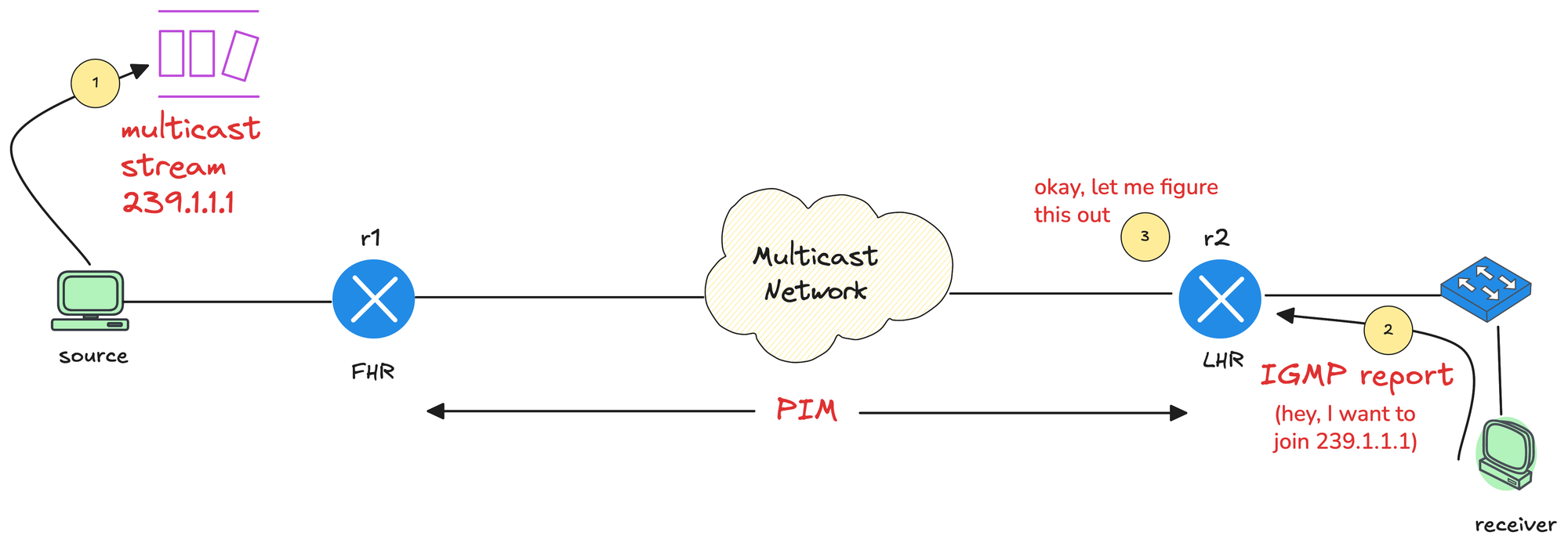
Just as a quick recap, in multicast, the source application (sender) sends multicast traffic to a multicast group address. Somewhere in the network, a receiver wants that traffic stream, so the receiver needs a way to signal that interest.

The router closest to the source is called the First Hop Router (FHR), and the router closest to the receiver is called the Last Hop Router (LHR). Between these two points, the multicast network, meaning all multicast-enabled routers, needs to build a loop-free tree that connects the sender to all interested receivers. IGMP plays a key role in making that happen.

Multicast Introduction (I)
With multicast, the source sends only a single copy of the traffic into the network. As that traffic moves through the network, it is replicated
Multicast IGMP - Internet Group Management Protocol (II)

IGMP Introduction

IGMP is the protocol used by receivers to signal their interest in multicast traffic. When a host wants to receive a multicast stream, it sends an IGMP Membership Report, also known as an IGMP join, to the multicast group address.

Multicast IGMP - Internet Group Management Protocol (II)
igmp diagram

Continue reading

Multicast Introduction (I)

Multicast Introduction (I)

Multicast is one of those topics I have been meaning to learn properly for a long time. When I did my JNCIS-ENT about eight years ago, I studied multicast, but I honestly do not remember much of it now.

I recently started doing some revision and decided to write a series of blog posts as I go through it again. I want something I can come back to in the future without having to relearn everything from scratch. Hopefully, as a reader, you will also find it useful and easy to follow. If you want to learn multicast, I am going to assume you are already familiar with unicast and broadcast.

As always, if you find this post helpful, press the ‘clap’ button. It means a lot to me and helps me know you enjoy this type of content. If I get enough claps for this series, I’ll make sure to write more on this specific topic.

Unicast

Unicast is the most common method of IP communication. It is simply a one-to-one conversation between two devices. One device sends traffic, and one specific device receives it. Most of what we do on a network every day is unicast. Continue reading

Intel Is Still Struggling In The Datacenter, But It Could Get Better

Intel has been pushing its two-core server CPU strategy for so long, in one form or another, that we have become accustomed to differentiating products the way Intel does and then try to figure out what workloads these chips might be useful for.

Intel Is Still Struggling In The Datacenter, But It Could Get Better was written by Timothy Prickett Morgan at The Next Platform.

Route leak incident on January 22, 2026

On January 22, 2026, an automated routing policy configuration error caused us to leak some Border Gateway Protocol (BGP) prefixes unintentionally from a router at our data center in Miami, Florida. While the route leak caused some impact to Cloudflare customers, multiple external parties were also affected because their traffic was accidentally funnelled through our Miami data center location.

The route leak lasted 25 minutes, causing congestion on some of our backbone infrastructure in Miami, elevated loss for some Cloudflare customer traffic, and higher latency for traffic across these links. Additionally, some traffic was discarded by firewall filters on our routers that are designed to only accept traffic for Cloudflare services and our customers.

While we’ve written about route leaks before, we rarely find ourselves causing them. This route leak was the result of an accidental misconfiguration on a router in Cloudflare’s network, and only affected IPv6 traffic. We sincerely apologize to the users, customers, and networks we impacted yesterday as a result of this BGP route leak.

BGP route leaks 

We have written multiple times about BGP route leaks, and we even record route leak events on Cloudflare Radar for anyone to view and learn from. To get Continue reading

IPB192: IPv6 Lab Update

Thinking of setting up an IPv6 lab this year? Our hosts dive into a major update on building and testing modern IPv6 networks, focusing on the game-changing “IPv6-mostly” architecture. They break down the essential components you need to get this working, including DHCP Option 108 and the nitty gritty of client support. In this episode,... Read more »

Ingress Security for AI Workloads in Kubernetes: Protecting AI Endpoints with WAF

AI Workloads Have a New Front Door

For years, AI and machine learning workloads lived in the lab. They ran as internal experiments, batch jobs in isolated clusters, or offline data pipelines. Security focused on internal access controls and protecting the data perimeter.

That model no longer holds.

Today, AI models are increasingly part of production traffic, which is driving new challenges around securing AI workloads in Kubernetes. Whether serving a large language model for a customer-facing chatbot or a computer vision model for real-time analysis, these models are exposed through APIs, typically REST or gRPC, running as microservices in Kubernetes.

From a platform engineering perspective, these AI inference endpoints are now Tier 1 services. They sit alongside login APIs and payment gateways in terms of criticality, but they introduce a different and more expensive risk profile than traditional web applications. For AI inference endpoints, ingress security increasingly means Layer 7 inspection and WAF (Web Application Firewall) level controls at the cluster edge. By analyzing the full request payload, a WAF can detect and block abusive or malicious traffic before it ever reaches expensive GPU resources or sensitive data. This sets the stage for protecting AI workloads from both operational Continue reading

Why Doesn’t netlab Use X for Device Configuration Templates?

Petr Ankudinov made an interesting remark when I complained about how much time I wasted waiting for Cisco 8000v to boot when developing netlab device configuration templates:

For Arista part - just use AVD with all templates included and ANTA for testing. I was always wondering why netlab is not doing that.

Like any other decent network automation platform, netlab uses a high-level data model (lab topology) to describe the network. That data model is then transformed into a device-level data model, and the device-level data structures are used to generate device configurations.

Upscale AI Nabs Cash To Forge “SkyHammer” Scale Up Fabric Switch

The first company that can make a UALink switch with high radix – meaning lots of ports – and high aggregate bandwidth across those ports that can compete toe-to-toe with Nvidia’s NVSwitch memory fabric and NVLink ports is going to make a lot of money.

Upscale AI Nabs Cash To Forge “SkyHammer” Scale Up Fabric Switch was written by Timothy Prickett Morgan at The Next Platform.

D2DO292: AI, Augmented Engineers, and the Timeless Principles of Software Architecture

Ned and Kyler sit down with industry analyst Jon Collins for a fun and free-ranging discussion that covers everything from the changing landscape of software engineering to the importance of good architecture (physical and digital). They tackle the pros and cons of “Vibe Coding” as well as the “Augmentation Gap”, the idea that AI tools... Read more »

NAN111: Automation, AI, and the Future of Branch Networking: Inside Cisco Unified Branch (Sponsored)

In this sponsored episode, Eric sits down with Lee Peterson, VP of Product Management for Secure WAN, at Cisco. Together they discuss how Cisco Unified Branch is helping organizations scale, automate, and secure their distributed environments. They also define the Branch Network, discuss the major challenges facing network teams, and walk through Cisco’s vision of... Read more »

Lab: Distributing Level-2 IS-IS Routes into Level-1 Areas

One of the major differences between OSPF and IS-IS is their handling of inter-area routes. Non-backbone OSPF intra-area routes are copied into the backbone area and later (after the backbone SPF run) copied into other areas. IS-IS does not copy level-2 routes into level-1 areas; level-1 areas (by default) behave like totally stubby OSPF areas with the level-1 routers using the Attached (ATT) bit of level-1-2 routers in the same area to generate the default route.

NGINX is Retiring: Your Step-by-Step Guide to Replacing Ingress NGINX

Your Curated Webinar & Blog Collection

The Ingress NGINX Controller is approaching retirement, and teams need a clear path forward to manage Kubernetes ingress traffic securely and reliably. To make this transition easier, we’ve created a single, curated hub with all the relevant blogs and webinars. This hub serves as your one-stop resource for understanding the migration to Kubernetes Gateway API with Calico Ingress Gateway.

This curated hub is designed to guide your team from understanding Ingress NGINX retirement, through evaluating options, learning the benefits of Calico Ingress Gateway, and ultimately seeing it in action with webinars and a demo.

Use This Collection to Help You Migrate Safely

  • ✅ One-stop resource: No need to hunt across the site for guidance.
  • ✅ Recommended reading order: Helps teams build knowledge progressively.
  • ✅ Actionable takeaways: Blogs explain why and how to migrate; webinars show it in practice.
  • ✅ Demo access: Direct link to schedule personalized support for your environment.

Recommended Reading

Step 1: Understand the Retirement of Ingress NGINX and the changing landscape

Step 2: Compare Approaches, including Ingress vs. Continue reading