Feedback: ipSpace.net Materials

Andy Lemin sent me such a wonderful review of ipSpace.net materials that I simply couldn’t resist publishing it ;)


ipSpace.net is probably my favorite networking resource out there. After spending years with other training content sites which are geared around certifications, ipspace.net provides a totally unique source of vendor neutral opinions, information, and anecdotes – the kind of information that is just not available anywhere else. And to top it off, is presented by a wonderful speaker who is passionate, smart and really knows his stuff!

The difference between an engineer who just has certs versus an engineer who has a rounded and wide view of the whole industry is massive. An engineer with certs can configure your network, but an engineer with all the knowledge this site provides, is someone who can question why and challenge how we can configure your network in a better way.
CyberFlood: Test Duration, Load Specification and Default Starter Tests

Okay so ORIGINALLY the idea was to do a YouTube video to explain the interaction and relationship between the “Test Duration” of a CyberFlood test and the “Load Specification”. However, in order to best explain “load specification” though it is... Read More ›

The post CyberFlood: Test Duration, Load Specification and Default Starter Tests appeared first on Networking with FISH.

Interop LDP and Segment Routing with IP infusion and MikroTik

Introduction

During networking field day service provider 1 there was a ton of talk about segment routing (SR) and ethernet virtual private networks (EVPN). One of the biggest questions was “how do we get there?” and while we won’t examine EVPN in this post (it’s coming in a future post don’t worry) we will look at how you can take advantage of SR while still having large portions of LDP in your network.

The team here at IP architechs works on a lot of MikroTik and whitebox gear so we’ll focus on a deployment using MikroTik and IP infusion.

MPLS and IGP setup

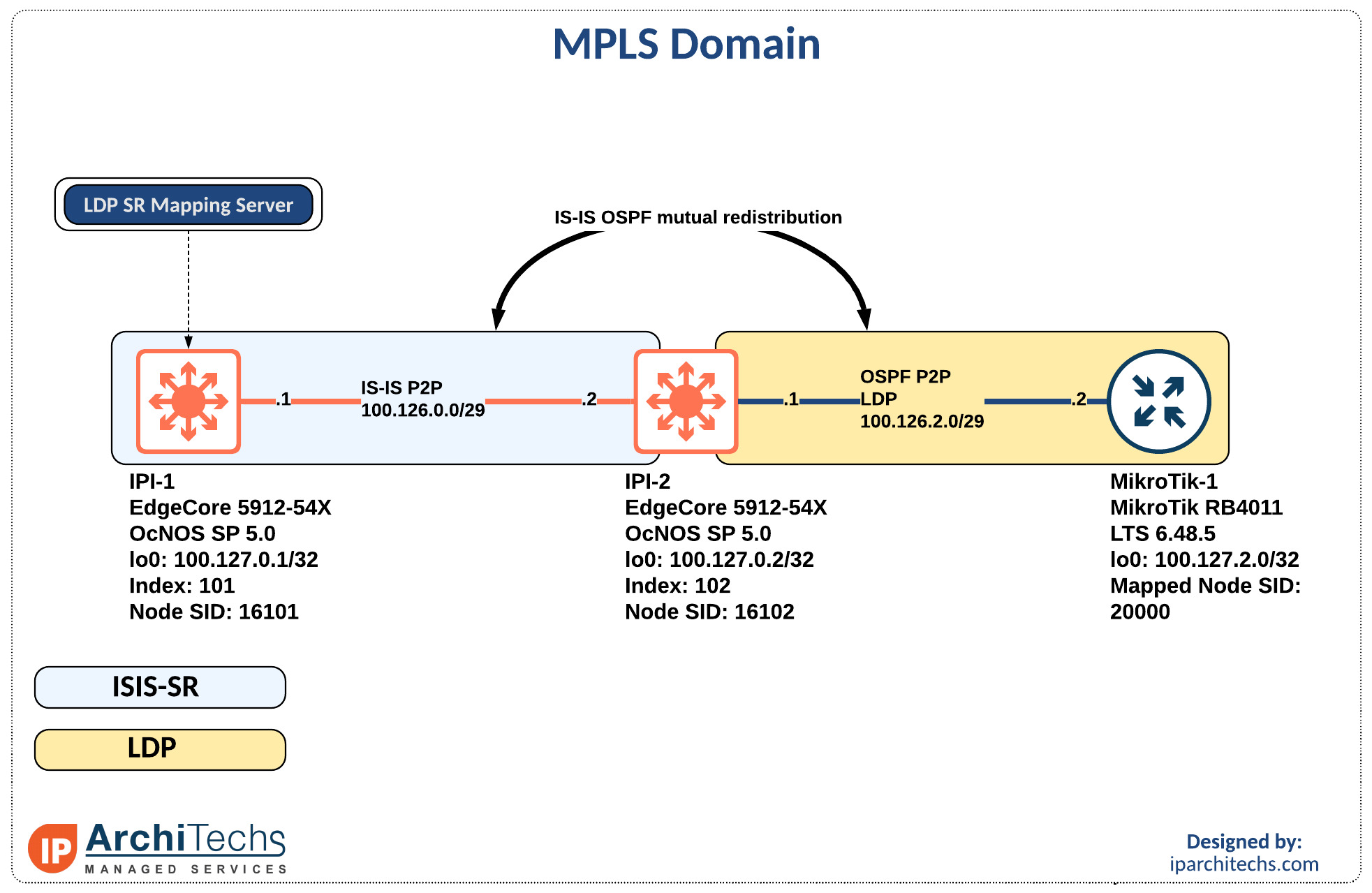
The first thing to accomplish is end to end reachability between the provider edge (PE) routers. MikroTik doesn’t support IS-IS so we will have to perform redistribution between the IS-IS segment and the OSPF segment as seen above.

MPLS only requires the /32s of the loopbacks for functionality so redistribution is limited to the /32 loopbacks of the PE routers.

ip prefix-list LDP-PE-LOOPBACKS
 seq 10 permit 100.127.2.0/24 eq 32
!
ip prefix-list SR-PE-LOOPBACKS
 seq 10 permit 100.127.0.0/24 eq 32
!
route-map REDIS-OSPF-TO-ISIS permit 10
 match ip address prefix-list LDP-PE-LOOPBACKS
!
route-map REDIS-ISIS-TO-OSPF permit  Continue reading

Juniper vQFX and Containerlab

In this post, we look at how Containerlab can be used to quickly spin up vQFX topologies for network validation and testing. We’ll walk through the entire process - how to build docker images from vQFX images, what happens behind the scenes when bringing these containers up and how to build/verify your topology.

Performance testing of Commercial BGP

1st Post Comparing Open Source BGP Stacks 2nd Post Follow-up Measuring BGP Stacks Performance 3rd Post Comparing Open Source BGP stacks with internet routes 4th Post Bird on Bird, Episode 4 of BGP Perf testing 5th Post BGP Performance 5 – 1000 full internet neighbors 6th Post BGP Performance testing...

Cloud Engineering For The Network Pro: Part 2 – Virtual Network Architecture (Video)

Part 2 of this cloud engineering series by Michael Levan digs into the basic network services available in Azure and AWS. You can subscribe to the Packet Pushers’ YouTube channel for more videos as they are published. It’s a diverse a mix of content from Ethan and Greg, plus selected videos from our events. It’s […]

The post Cloud Engineering For The Network Pro: Part 2 – Virtual Network Architecture (Video) appeared first on Packet Pushers.

Pluribus NOS upgrades target Kubernetes, cloud fabric management

Pluribus Networks has significantly upgraded its switch-fabric software to provide a better handle on distributed, containerized enterprise-cloud resources.The upgrades add three new fabric-monitoring capabilities—FlowTracker, KubeTracker, and Virtualized Packet Broker Service—to Netvisor One, the company’s virtualized Linux-based NOS that provides Layer 2 and Layer 3 networking and distributed fabric intelligence.The NOS virtualizes switch hardware and implements the company’s Adaptive Cloud Fabric software-defined networking package. Adaptive Cloud Fabric operates without a controller and can be deployed across a data center or targeted to specific racks, pods, server farms, or hyperconverged infrastructures, the company said.To read this article in full, please click here

Pluribus NOS upgrades target Kubernetes, cloud fabric management

Pluribus Networks has significantly upgraded its switch-fabric software to provide a better handle on distributed, containerized enterprise-cloud resources.The upgrades add three new fabric-monitoring capabilities—FlowTracker, KubeTracker, and Virtualized Packet Broker Service—to Netvisor One, the company’s virtualized Linux-based NOS that provides Layer 2 and Layer 3 networking and distributed fabric intelligence.The NOS virtualizes switch hardware and implements the company’s Adaptive Cloud Fabric software-defined networking package. Adaptive Cloud Fabric operates without a controller and can be deployed across a data center or targeted to specific racks, pods, server farms, or hyperconverged infrastructures, the company said.To read this article in full, please click here

Millions Pay AWS To Give Amazon An Insurmountable IT Advantage

What company has the lowest IT spending budget in the world, but has also paradoxically spent more money than any company in history investing in creating a new, modern, cloud-native system that is capable of running just about any application at just about any necessary scale?

Millions Pay AWS To Give Amazon An Insurmountable IT Advantage was written by Timothy Prickett Morgan at The Next Platform.

Heavy Networking 616: Do We Need An SMTP Alternative? TMTP And MNM Are Here To Find Out

The SMTP protocol isn't broken, but email kinda is. Spam, phishing, and other unwanted messages are easy to deliver and harder to stop. On today's Heavy Networking we discuss TMTP and mnm, a proposed new protocol and client that aim to preserve the benefits of email while eliminating vulnerabilities and offering a better experience. Our guest is Liam Breck, creator of TMTP and mnm.

Heavy Networking 616: Do We Need An SMTP Alternative? TMTP And MNM Are Here To Find Out

The SMTP protocol isn't broken, but email kinda is. Spam, phishing, and other unwanted messages are easy to deliver and harder to stop. On today's Heavy Networking we discuss TMTP and mnm, a proposed new protocol and client that aim to preserve the benefits of email while eliminating vulnerabilities and offering a better experience. Our guest is Liam Breck, creator of TMTP and mnm.

The post Heavy Networking 616: Do We Need An SMTP Alternative? TMTP And MNM Are Here To Find Out appeared first on Packet Pushers.

Could Open Base Station SoCs Unleash A New Era In Mobile Infrastructure?

This article was originally published in Packet Pushers Ignition on March 23, 2021. Just as nature abhors a vacuum and seeks to fill it with any available matter, business abhors a single-source solution to wide scale problems. Competitors rush to fill the vacuum of choice with alternative, interchangeable products. The IT market typically fosters competition […]

The post Could Open Base Station SoCs Unleash A New Era In Mobile Infrastructure? appeared first on Packet Pushers.

Arm CPUs To Take A Bite Out Of The HPC Market

Arm-based servers have had a somewhat checkered history that has seen many abortive attempts to challenge the X86 processor hegemony, but the firm appears bullish about its chances in the high performance computing (HPC) sector, where it believes its licensing model and the energy efficiency of its architecture give it an edge.

Arm CPUs To Take A Bite Out Of The HPC Market was written by Daniel Robinson at The Next Platform.