Upgrading the Cloudflare China Network: better performance and security through product innovation and partnership


Core to Cloudflare’s mission of helping build a better Internet is making it easy for our customers to improve the performance, security, and reliability of their digital properties, no matter where in the world they might be. This includes Mainland China. Cloudflare has had customers using our service in China since 2015 and recently, we expanded our China presence through a partnership with JD Cloud, the cloud division of Chinese Internet giant, JD.com. We’ve also had a local office in Beijing for several years, which has given us a deep understanding of the Chinese Internet landscape as well as local customers.
The new Cloudflare China Network built in partnership with JD Cloud has been live for several months, with significant performance and security improvements compared to the previous in-country network. Today, we’re excited to describe the improvements we made to our DNS and DDoS systems, and provide data demonstrating the performance gains customers are seeing. All customers licensed to operate in China can now benefit from these innovations, with the click of a button in the Cloudflare dashboard or via the API.
Serving DNS inside China
With over 14% of all domains on the Internet using Cloudflare’s nameservers we Continue reading
Risk analysis for DEF CON 2021
It's the second year of the pandemic and the DEF CON hacker conference wasn't canceled. However, the Delta variant is spreading. I thought I'd do a little bit of risk analysis. TL;DR: I'm not canceling my ticket, but changing my plans what I do in Vegas during the convention.
First, a note about risk analysis. For many people, "risk" means something to avoid. They work in a binary world, labeling things as either "risky" (to be avoided) or "not risky". But real risk analysis is about shades of gray, trying to quantify things.
The Delta variant is a mutation out of India that, at the moment, is particularly affecting the UK. Cases are nearly up to their pre-vaccination peaks in that country.
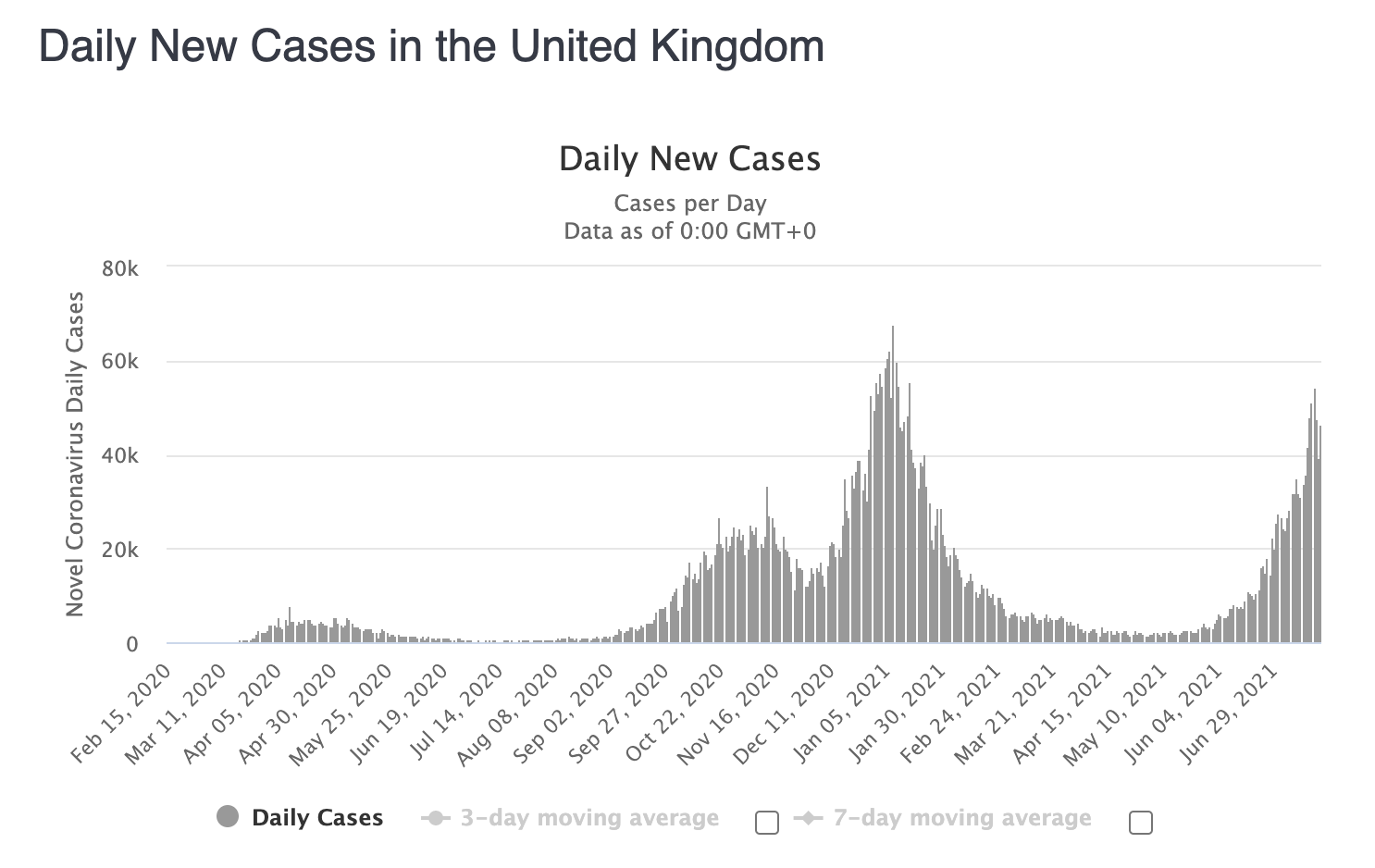
Note that the UK has already vaccinated nearly 70% of their population -- more than the United States. In both the UK and US there are few preventive measures in place (no lockdowns, no masks) other than vaccines.

Thus, the UK graph is somewhat predictive of what will happen in the United States. If we time things from when the latest wave hit the same levels as peak of the first wave, then it looks like the Continue reading
What Faster And Smarter HBM Memory Means For Systems
If the HPC and AI markets need anything right now, it is not more compute but rather more memory capacity at a very high bandwidth. …
What Faster And Smarter HBM Memory Means For Systems was written by Timothy Prickett Morgan at The Next Platform.
What Are Quantum Hardware Startups Thinking?
Atom Computing adds itself to a growing list of quantum systems makers with pedigreed founders, funding announcements, and a market that even the big players haven’t mastered. …
What Are Quantum Hardware Startups Thinking? was written by Nicole Hemsoth at The Next Platform.
Getting Industrial About The Hybrid Computing And AI Revolution
For oil and gas companies looking at drilling wells in a new field, the issue becomes one of return vs. …
Getting Industrial About The Hybrid Computing And AI Revolution was written by Jeffrey Burt at The Next Platform.
Hedge 92: The IETF isn’t the Standards Police
In most areas of life, where the are standards, there is some kind of enforcing agency. For instance, there are water standards, and there is a water department that enforces these standards. There are electrical standards, and there is an entire infrastructure of organizations that make certain the fewest number of people are electrocuted as possible each year. What about Internet standards? Most people are surprised when they realize there is no such thing as a “standards police” in the Internet.
Listen in as George Michaelson, Evyonne Sharp, Tom Ammon, and Russ White discuss the reality of standards enforcement in the Internet ecosystem.
Day Two Cloud 107: Making The Management Mistake
Today on the Day Two Cloud podcast, Ethan and Ned discuss two new AWS courses from Ned, and then tell stories about the time they took management jobs they shouldn't have. They share lessons learned about transitioning from technical to managerial roles and why it was the wrong move for them.Day Two Cloud 107: Making The Management Mistake
Today on the Day Two Cloud podcast, Ethan and Ned discuss two new AWS courses from Ned, and then tell stories about the time they took management jobs they shouldn't have. They share lessons learned about transitioning from technical to managerial roles and why it was the wrong move for them.
The post Day Two Cloud 107: Making The Management Mistake appeared first on Packet Pushers.
Automatic Reply: Working Remote Today
The hybrid work model embraced during the pandemic introduces new challenges and can lead to disruptions of our corporate networks.LISP – OMP – BGP EVPN Interoperability – Part II: VPNv4 Update from Control Plane to Border-PxTR
The previous chapter describes how Edge-xTR-11 used LISP Map-Register message to advertise EID-to-RLOC information to MapServ-22. It also explained how MapSrv-22, as a role of Mapping Server, stores the information into Mapping Data Base. MapSrv-22 is also Map-Resolver. This means that when it receives the LISP Map-Requestmessage from the xTR device, it will respond with a Map-Reply message. If MapSrv-22 knows the EID-to-RLOC mapping, it places this information into the Map-Reply message. If MapSrv-22 doesn’t have mapping information, it instructs requesting xTR to forward traffic to its Proxy-xTR. This, however, is not the case in our example. What we want to do is advertise the EP1 reachability information to Border-PxTR. In order to do that, we need to a) export EID-to-RLOC information from the Mapping Data Base to instance-specific VRF_100 RIB. Then we can advertise it by using BGP and because we want to include virtual network identifier into update we use MP-BGP VPNv4 because there we have Route Target Attribute. The next sections describe the process in detail.
Phase 1: Map-Server - RIB Update
LISP Map-Server doesn’t install EID-to-RLOC mapping information from the Mapping Database into a RIB by default. To do that we need to export the information from the LISP Mapping DataBase to RIB by using the LISP Instance-specific command route-export site-registrations. Example 1-6 illustrates the update process. Example 1-7 shows the RIB entry concerning EP1 IP address 172.16.100.10/32 in VRF 100_NWKT. Due to redistribution, the route is shown as directly connected, via Null0. If you take a look at the timestamps in example 1-6 and compare it to timestamps in example 1-3, you will see that the RIB update happens right after the unreliable EID-to-RLOC registration process.
Complete device configuration can be found in chapter 1 Appendix 1.

Figure 1-10: EID-to-RLOC information from LISP to RIB.
Continue reading
Expanding Cloudflare to 25+ Cities in Brazil


Today, we are excited to announce an expansion we’ve been working on behind the scenes for the last two years: a 25+ city partnership with one of the largest ISPs in Brazil. This is one of the largest simultaneous single-country expansions we’ve done so far.
With this partnership, Brazilians throughout the country will see significant improvement to their Internet experience. Already, the 25th-percentile latency of non-bot traffic (we use that measure as an approximation of physical distance from our servers to end users) has dropped from the mid-20 millisecond range to sub-10 milliseconds. This benefit extends not only to the 25 million Internet properties on our network, but to the entire Internet with Cloudflare services like 1.1.1.1 and WARP. We expect that as we approach 25 cities in Brazil, latency will continue to drop while throughput increases.
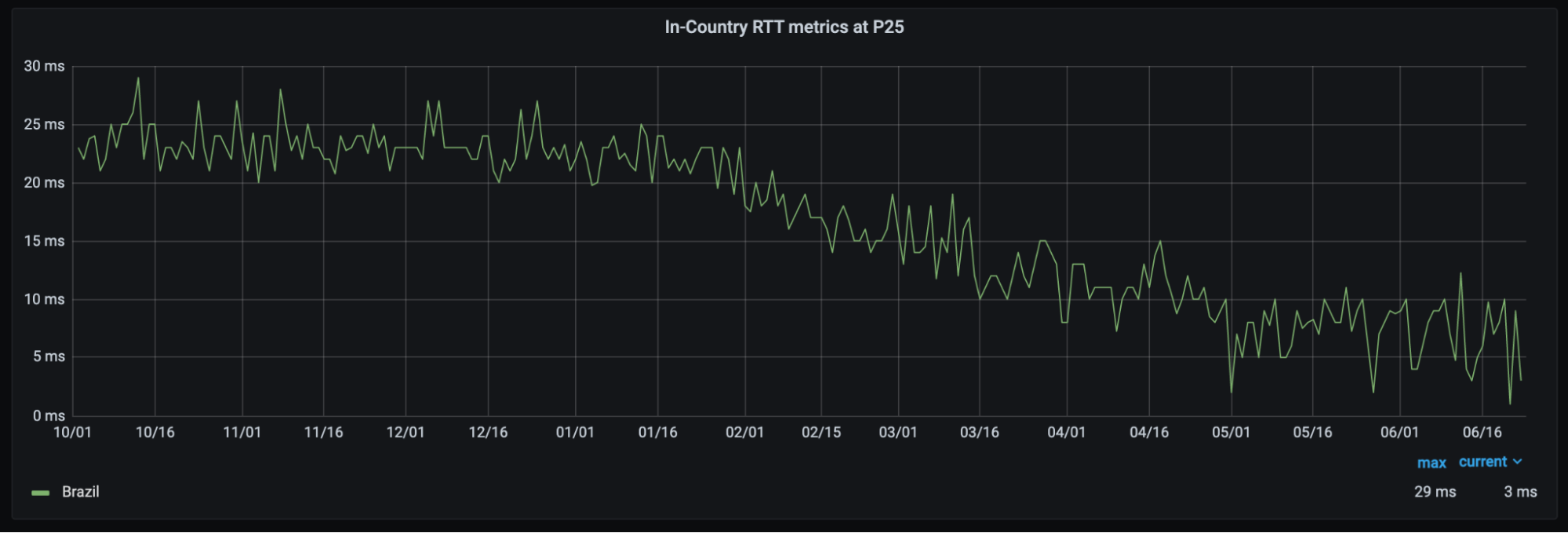
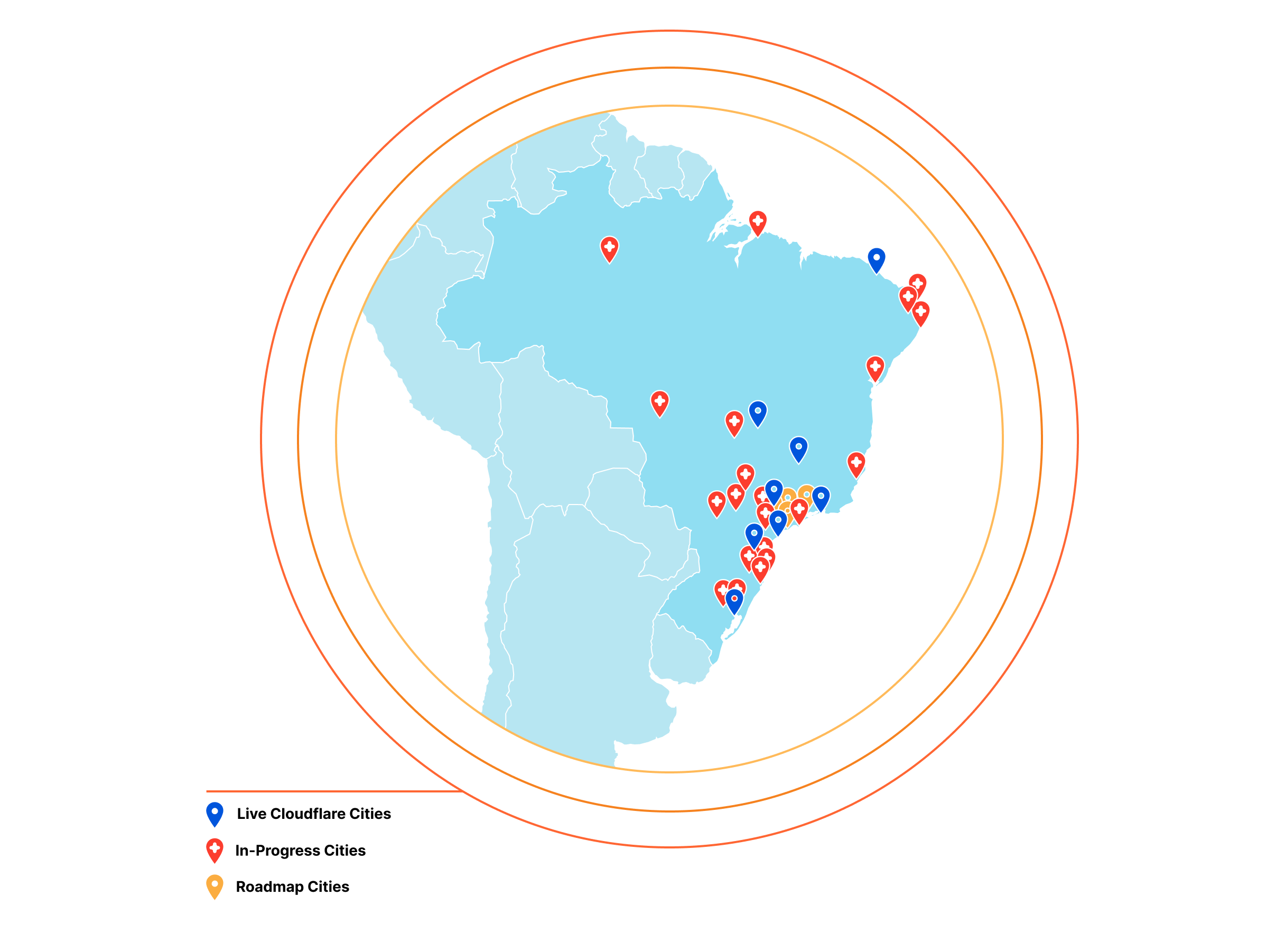
This partnership is part of our mission to help create a better Internet and the best development experience for all — not just those in major population centers or in Western markets — and we are excited to take this step on Continue reading
Cloud-based Communications Systems Offer Office Phone Alternative
Voice telephony and video conferencing combine to create the future of communication in the digital workplace.IBM Starts Showing A Little Hybrid Vigor
IBM may not be the biggest provider of systems in terms of the size of its customer base, but of the top 5,000 or so companies worldwide that are not hyperscalers and cloud builders in their own right, Big Blue does have a sizeable share of the system budget. …
IBM Starts Showing A Little Hybrid Vigor was written by Timothy Prickett Morgan at The Next Platform.