Hewlett Packard Enterprise announced several expansions of its managed GreenLake services during its HPE Discover conference this week.GreenLake is HPE’s consumption model for hardware and services. Rather than make an outright purchase, customers determine the configuration they will need and HPE installs it, with a slight overprovisioning just in case. If the customer ends up needing more hardware capacity, it’s just turned on. Until then, it just sits there, unused, and at no charge.To read this article in full, please click here
Hewlett Packard Enterprise announced several expansions of its managed GreenLake services during its HPE Discover conference this week.GreenLake is HPE’s consumption model for hardware and services. Rather than make an outright purchase, customers determine the configuration they will need and HPE installs it, with a slight overprovisioning just in case. If the customer ends up needing more hardware capacity, it’s just turned on. Until then, it just sits there, unused, and at no charge.To read this article in full, please click here
On today's Day Two Cloud podcast we talk storage with sponsor Scality about its ARTESCA platform, cloud-native object storage for modern workloads. It integrates with Kubernetes, serves as storage for your public cloud, and more. We dive into the product architecture, use cases, and hardware options via Scality's partnership with HPE.
On today's Day Two Cloud podcast we talk storage with sponsor Scality about its ARTESCA platform, cloud-native object storage for modern workloads. It integrates with Kubernetes, serves as storage for your public cloud, and more. We dive into the product architecture, use cases, and hardware options via Scality's partnership with HPE.
A couple of months ago, we announced the general availability of Cloudflare Pages: the easiest way to host and collaboratively develop websites on Cloudflare’s global network. It’s been amazing to see over 20,000 incredible sites built by users and hear your feedback. Since then, we’ve released user-requested features like URL redirects, web analytics, and Access integration.
We’ve been listening to your feedback and today we announce two new features: rollbacks and the Pages API. Deployment rollbacks allow you to host production-level code on Pages without needing to stress about broken builds resulting in website downtime. The API empowers you to create custom functionality and better integrate Pages with your development workflows. Now, it’s even easier to use Pages for production hosting.
Rollbacks
You can now rollback your production website to a previous working deployment with just a click of a button. This is especially useful when you want to quickly undo a new deployment for troubleshooting. Before, developers would have to push another deployment and then wait for the build to finish updating production. Now, you can restore a working version within a few moments by rolling back to a previous working build.
One of my readers sent me this interesting question:
I understand that an SDN controller needs network topology information to build traffic engineering paths with PCE/PCEP… but why would we use BGP-LS to extract the network topology information? Why can’t we run OSPF with controller by simulating a software based OSPF instance in every area to get topology view?
One of my readers sent me this interesting question:
I understand that an SDN controller needs network topology information to build traffic engineering paths with PCE/PCEP… but why would we use BGP-LS to extract the network topology information? Why can’t we run OSPF with controller by simulating a software based OSPF instance in every area to get topology view?
The technology sector like all other businesses in the world, has been very volatile lately. However there are still some tech stocks that can get you great results. There are many tech companies that have not only outperformed other tech companies in the world but other types of businesses as well. If you are looking for the most valuable tech stocks to invest in the market then we have gathered an amazing list for you.
Best Value tech stocks:
You always pick a stock that has the highest investing value and get those results by comparing the stock’s price with one or more fundamental basic metrics. The fundamental basic metric is the qualitative and quantitative study that tells the financial well-being of a company and its economic condition. A widely accepted price metric is the P/E ratio which is called price to earnings ratio. It is the ratio for valuing a company measuring its new share price relative to its per-sharing earnings. The investors believe that if a business is reasonable compared to its worth considering the P/E ratio, the stock value could rise quicker than the others because the value comes back in line with the price of the Continue reading
The era of vector supercomputing might sound like ancient history to some but it’s still deeply rooted in major commercial and government institutions. …
Today's Heavy Networking explores Crosswork Cloud Traffic Analysis from episode sponsor Cisco. This tool is designed to make you deeply knowledgeable about your BGP peering relationships and traffic flows throughout your infrastructure. It will also recommend the routing tweaks in your IGPs, BGP, RSVP-TE, and segment routing to eliminate those pesky congestion points. We also discuss the pros and cons of putting network management capabilities in the cloud.
Today's Heavy Networking explores Crosswork Cloud Traffic Analysis from episode sponsor Cisco. This tool is designed to make you deeply knowledgeable about your BGP peering relationships and traffic flows throughout your infrastructure. It will also recommend the routing tweaks in your IGPs, BGP, RSVP-TE, and segment routing to eliminate those pesky congestion points. We also discuss the pros and cons of putting network management capabilities in the cloud.
The hybrid cloud is convincing established players that they need to play on both sides of the net, in the cloud (as well as the edge) and on premises. …
The Fugaku supercomputer, based on the Arm-driven A64FX processor and custom Fujitsu Tofu-D fabric, has been proven architecturally on a number of HPC and large-scale AI benchmarks and has drawn considerable attention among the supercomputing set. …
After writing the post on using WireGuard on macOS (using the official WireGuard GUI app from the Mac App Store), I found the GUI app’s behavior to be less than ideal. For example, tunnels marked as on-demand would later show up as no longer configured as an on-demand tunnel. When I decided to set up WireGuard on my M1-based MacBook Pro (see my review of the M1 MacBook Pro), I didn’t want to use the GUI app. Fortunately, Homebrew has formulas for WireGuard. Unfortunately, the WireGuard tools as installed by Homebrew on an M1-based Mac won’t work. Here’s how to fix that.
The key issues with WireGuard as installed by Homebrew on an M1-based Mac are:
On an M1-based Mac, Homebrew installs (by default) to the /opt/homebrew prefix. By comparison, Homebrew uses /usr/local on Intel-based Macs. Some of the WireGuard-related scripts are hard-coded to use /usr/local as the Homebrew prefix. Because the prefix has changed, though, these scripts now don’t work on an M1-based Mac.
WireGuard has a dependency on Bash. Unfortunately, the version of Bash supplied by macOS isn’t supported by WireGuard (it’s too old). Without a very specific PATH configuration, even installing the Homebrew version of Bash—which isContinue reading
We are excited to announce a new look and new capabilities for Cloudflare Logs! Customers on our Enterprise plan can now configure Logpush for Firewall Events and Network Error Logs Reports directly from the dashboard. Additionally, it’s easier to send Logs directly to our analytics partners Microsoft Azure Sentinel, Splunk, Sumo Logic, and Datadog. This blog post discusses how customers use Cloudflare Logs, how we’ve made it easier to consume logs, and tours the new user interface.
New data sets for insight into more products
Cloudflare Logs are almost as old as Cloudflare itself, but we have a few big improvements: new datasets and new destinations.
Cloudflare has a large number of products, and nearly all of them can generate Logs in different data sets. We have “HTTP Request” Logs, or one log line for every L7 HTTP request that we handle (whether cached or not). We also provide connection Logs for Spectrum, our proxy for any TCP or UDP based application. Gateway, part of our Cloudflare for Teams suite, can provide Logs for HTTP and DNS traffic.
Today, we are introducing two new data sets:
Firewall Events gives insight into malicious traffic handled by Cloudflare. It provides detailed information Continue reading
VMware vCenter Server tags are labels that can be applied to objects like the system’s environment and usage, therefore it is a very useful method of asset management - also making tags a perfect fit in the Ansible world to organize systems in an Ansible inventory. Red Hat customers have regularly requested the ability to use vCenter Tags in Red Hat Ansible Tower. This is now possible with an Ansible Tower inventory source that supports tags and provides the vmware_vm_inventory plugin.
Ansible Automation Platform 1.2 brings completely native Ansible inventory plugin support to Ansible Tower 3.8. In previous versions, there were specific inventory plugin configurations based on the old inventory scripts where a specific set of parameters surfaced in Ansible Tower's user interface. For example: cloud region and a specific subset of variables you could pass to those inventory scripts surfaced as variables you could pass to the inventory source, which means that new configuration parameters that come with Ansible inventory plugins are not supported in order to maintain compatibility with the old inventory scripts.
The move to support native inventory plugins allows Red Hat Ansible Automation Platform customers to use all the configuration parameters available through Continue reading
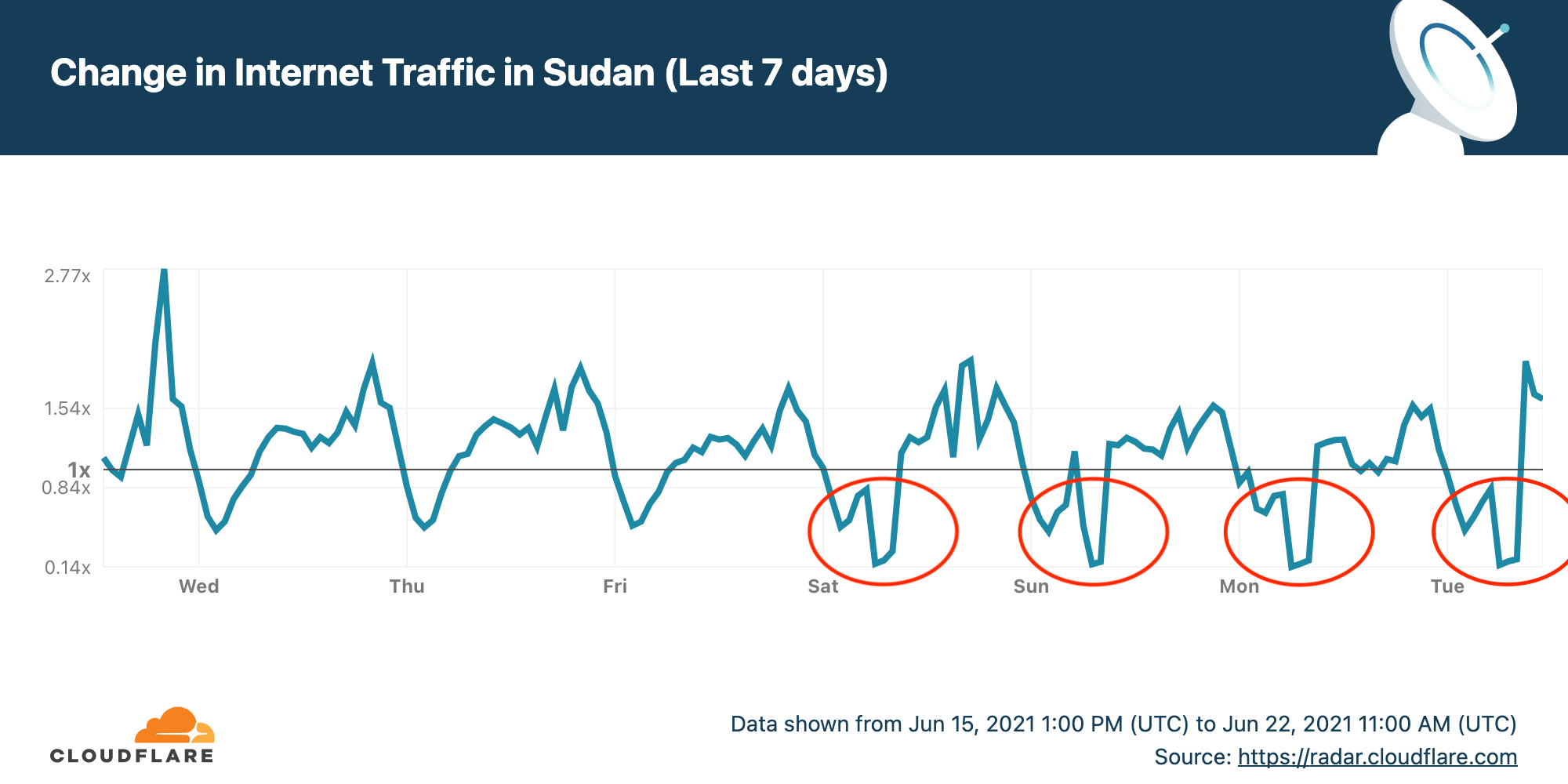
To prevent cheating in exams many countries restrict or even shut down Internet access during critical exam hours. I wrote two weeks ago about Syria having planned Internet shutdowns during June, for exams.
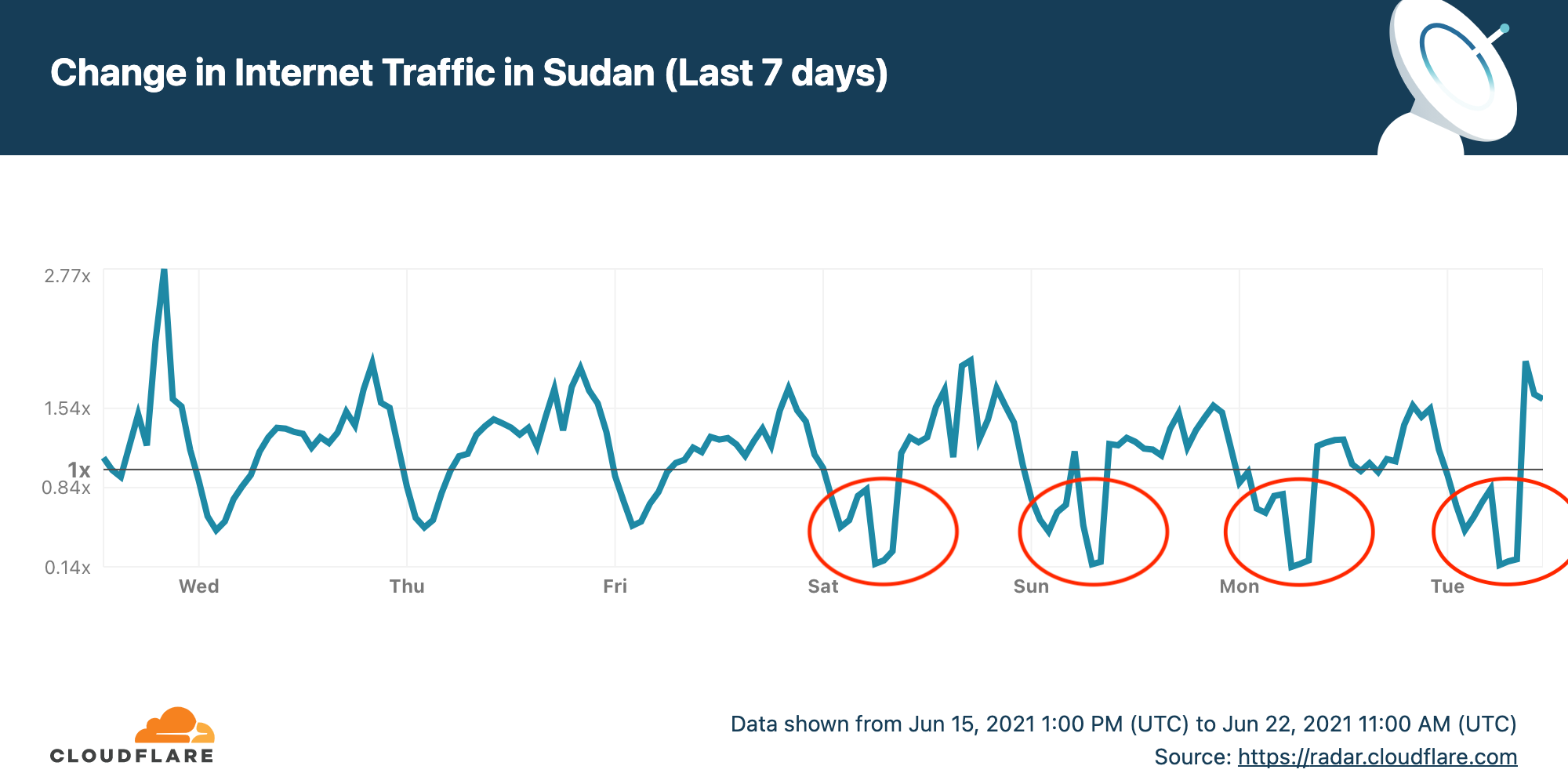
Sudan is doing the same thing and has had four shutdowns so far. Here's the Internet traffic pattern for Sudan over the last seven days. I've circled the shutdowns on Saturday, Sunday, Monday and Tuesday (today, June 22, 2021).
Cloudflare Radar allows anyone to track Internet traffic patterns around the world, and it has country-specific pages. The chart for the last seven days (shown above) came from the dedicated page for Sudan.
The Internet outages start at 0600 UTC (0800 local time) and end three hours later at 0900 UTC (1100 local time). This corresponds to the timings announced by the Sudanese Ministry of Education.
Further shutdowns are likely in Sudan on June 24, 26, 27, 29 and 30 (thanks to Twitter user _adonese for his assistance). Looking deeper into the data, the largest drop in use is for mobile Internet access in Sudan (the message above talks about mobile Internet use being restricted) while some non-mobile access appears to continue.