Citrix DemoFriday Q&A + Video: Automate Insertion of Layer 4-7 Network Services in SDN Environments with Nuage VSP & Citrix NetScaler
 Citrix's Michael Leonard & Nuage Networks' Hussein Khazaal answer DemoFriday questions. Read for more insights on demo on network services.
4 ways bimodal IT accelerates innovation
Innovation is the cornerstone for sustained business success, and given how much innovation relies on technology these days, IT has to play a vital role in making it happen. Even so, Brocade's 2015 Global CIO Study found that more than half of CIO respondents spent around 1,000 hours a year reacting to unexpected problems such as data loss, network downtime and application access. With that much time spent fighting fires, how is the average CIO supposed to find the time to innovate?
To read this article in full or to leave a comment, please click here
Copenhagen, Denmark: CloudFlare’s 65th data center

To get the week started it's our distinct pleasure to introduce CloudFlare's latest PoP (point of presence) in Copenhagen, Denmark. Our Copenhagen data center extends the CloudFlare network to 65 PoPs across 34 countries, with 17 in Europe alone. The CloudFlare network, including all of the Internet applications and content of our users, is now delivered with a median latency of under 40ms throughout the entire continent—by comparison, it takes 300-400ms to blink one's eyes!
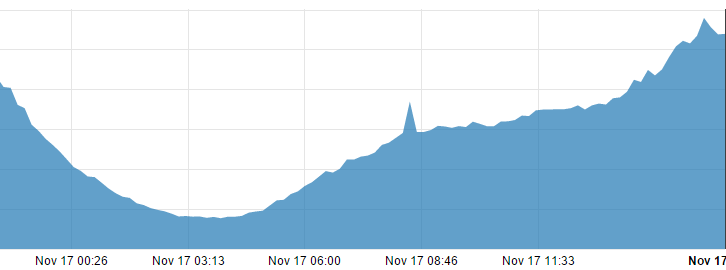
Danish traffic, previously served from Stockholm and Amsterdam, shifts into Copenhagen
As can be seen above, traffic has already started to reach Copenhagen, with steady increases over the course of the day (all times in UTC). The new site is also already mitigating cyber attacks launched against our customers. The spike in traffic around 08:46 UTC is a modest portion of a globally distributed denial of service (DDoS) attack targeted at CloudFlare. By distributing the attack across an ever growing footprint of data centers, mitigation is made easy (and our site reliability engineers can sleep soundly!).
The week's not over
In December 2014 we announced our intention to launch one data center per week throughout 2015. It's an ambitious goal, but we're well on Continue reading
Pluribus White Paper: 2015 Network Visibility & Monitoring Forecast
 451 Research projects the network visibility and monitoring market will grow to more than $1.6 billion by 2019. Check out an excerpt from its 2015 Network Visibility and Monitoring Forecast to learn more.
Worth Reading: Smarter than our tech

The post Worth Reading: Smarter than our tech appeared first on 'net work.
How to deal with the blind spots in your security created by SSL encrypted traffic
This vendor-written tech primer has been edited by Network World to eliminate product promotion, but readers should note it will likely favor the submitter’s approach.
SSL/TLS encryption is widely used to secure communications to internal and external servers, but can blind security mechanisms by preventing inspection of network traffic, increasing risk. In fact, Gartner predicts that in 2017 more than half of network attacks targeting enterprises will use encrypted traffic to bypass controls.
With attackers preying on the security gaps created by encrypted traffic, let’s examine the five most common network traffic inspection errors made today:
To read this article in full or to leave a comment, please click here
Reaction: Anonymity isn’t a bug

The problem with anonymity and the modern Internet is we tend to think of being anonymous as either “on” or “off” all the time. The only real reason we can think of to want to be anonymous is to do something evil, to hurt someone, to steal something, or to do something else considered anti-social or wrong.
But there’s a problem with this thinking — it’s much like pitting “the rich” against “the poor,” or any other time bound classification. There are times when I want to be anonymous, and there are times when I don’t care. It’s not a matter of doing that which is nefarious. It’s more about expressing opinions you know people won’t agree with, but which the expression of could cause you material harm, or about being able to investigate something without telling anyone about the situation. Continue reading
Book Review: Design For How People Learn
Design For How People Learn, by Julie Dirksen (ISBN 978-0321768438)

I saw the title for this book roll across my Twitter feed — can’t remember from who, sorry — from someone who had a blog and was advocating for other bloggers to check this book out. When I read the abstract for the book, I immediately added it to my reading list.
“Whether it’s giving a presentation, writing documentation, or creating a website or blog, we need and want to share our knowledge with other people. But if you’ve ever fallen asleep over a boring textbook, or fast-forwarded through a tedious e-learning exercise, you know that creating a great learning experience is harder than it seems.”