180 Gbps Software-Only Linux Router
Pim van Pelt built an x86/Linux-based using Vector Packet Processor that can forwarding IP traffic at 150 Mpps/180 Gbps forwarding rates on a 2-CPU Dell server with E5-2660 (8 core) CPU.
He described the whole thing in a 8-part series of blog posts and a conference talk. Enjoy!
180 Gbps Software-Only Linux Router
Pim van Pelt built an x86/Linux-based using Vector Packet Processor that can forwarding IP traffic at 150 Mpps/180 Gbps forwarding rates on a 2-CPU Dell server with E5-2660 (8 core) CPU.
He described the whole thing in a 8-part series of blog posts and a conference talk. Enjoy!
IPv6 Buzz 124: DHCPv6, SLAAC, And DNS – Getting IPv6 Addresses To Hosts
In this episode, Ed, Scott, and Tom discuss how hosts OSes such as Windows, Apple, and Android automatically obtain both IPv6 addresses and DNS server information.
The post IPv6 Buzz 124: DHCPv6, SLAAC, And DNS – Getting IPv6 Addresses To Hosts appeared first on Packet Pushers.
IPv6 Buzz 124: DHCPv6, SLAAC, And DNS – Getting IPv6 Addresses To Hosts
In this episode, Ed, Scott, and Tom discuss how hosts OSes such as Windows, Apple, and Android automatically obtain both IPv6 addresses and DNS server information.Heavy Networking 675: Enabling Self-Service Automation & NetDevOps With Itential (Sponsored)
Today’s Heavy Networking podcast explores the concept of NetDevOps with sponsor Itential. The idea behind NetDevOps is to advance your network to the point where it’s self-service; that is, the network you operate can be consumed the way public cloud services are consumed. Our guest is Itential co-founder & CTO Chris Wade.
The post Heavy Networking 675: Enabling Self-Service Automation & NetDevOps With Itential (Sponsored) appeared first on Packet Pushers.
Heavy Networking 675: Enabling Self-Service Automation & NetDevOps With Itential (Sponsored)
Today’s Heavy Networking podcast explores the concept of NetDevOps with sponsor Itential. The idea behind NetDevOps is to advance your network to the point where it’s self-service; that is, the network you operate can be consumed the way public cloud services are consumed. Our guest is Itential co-founder & CTO Chris Wade.Why I joined Cloudflare as Chief Security Officer


I am absolutely thrilled and feel incredibly blessed to have joined Cloudflare as Chief Security Officer (CSO). Cybersecurity has always been my passion and focus of my career. I am grateful to join such a dynamic and innovative team. Cloudflare is a cybersecurity industry leader and offers unmatched technology that is second to none.
A little about me
I have been a CSO for over 20 years in the financial and private sectors with SVB, HSBC, McAfee, Ameren, and Scottrade. I have been privileged to lead the security teams of some of the world's largest, most complex, and most innovative companies; however, my greatest honor has been working with and collaborating among some of the world's most amazing people. I have learned my dedication, expertise, and passion from my leaders, peers, and teams, which have taught me how to build and lead world-class security programs that protect organizations from the most sophisticated threats. Because security is constantly evolving, the key is, and always will be, to build an active, diverse community of highly empathetic people that will successfully protect the organization.
My charter
As I step into my new role as CSO at Cloudflare, I am excited to take on Continue reading
Running Large Language Models on CPU
Large language models (LLM) can be run on CPU. However, the performance of the model […]
The post Running Large Language Models on CPU first appeared on Brezular's Blog.
Video: SD-WAN CPE Architecture
Pradosh Mohapatra started the Typical SD-WAN Solution Architecture section of Software-Defined WAN (SD-WAN) Overview webinar with the backend architecture.
Next step: CPE architecture, the topic of today’s video.
You need at least free ipSpace.net subscription to watch videos in this webinar.
Video: SD-WAN CPE Architecture
Pradosh Mohapatra started the Typical SD-WAN Solution Architecture section of Software-Defined WAN (SD-WAN) Overview webinar with the backend architecture.
Next step: CPE architecture, the topic of today’s video.
You need at least free ipSpace.net subscription to watch videos in this webinar.
Fun in the Lab: Adding ASAs to an Existing ASA Cluster
So let’s start with the FP9300 chassis and the 3 node ASA cluster I already have up and running. If you are wondering what the devices are on the far left and far right, those are a Spirent Test Center... Read More ›
The post Fun in the Lab: Adding ASAs to an Existing ASA Cluster appeared first on Networking with FISH.
Hedge 175: Mike B on Personal Superpowers
When the economy starts contracting, career advisors start talking about the importance of “soft skills.” What are “soft skills,” exactly—and why are they “soft?” Mike Bushong joins Tom Amman and Russ White to talk about why these skills are important, why they are not “soft,” and how we should talk about people skills instead. They are superpowers,” and there isn’t anything “soft” about them.
Leveraging security policy recommender to tighten your cluster’s security posture
We’ve noticed that many of our customers are currently undergoing a significant transformation in their application architecture, transitioning from legacy vertical applications to distributed microservices running on Kubernetes. This shift brings along a range of benefits, such as improved scalability, resilience, and agility. However, it also creates a larger attack surface that needs to be managed effectively.
To minimize the attack surface, it is crucial to have a clear understanding of how each microservice communicates microservices within, and outside, the cluster to implement robust network configuration and security policies. This can be challenging, especially when dealing with re-architected applications that can consist of hundreds of microservices.
To make the life of the security and DevOps teams easier, there are a few things that can be done. Firstly, providing them with access to detailed information on how microservices communicate within and outside the cluster. Secondly, having automated policy recommendations to improve their configuration and security. Finally, providing visibility and audit reports to help identify vulnerabilities in the system and prevent potential breaches.
In this blog, we will discuss how to leverage the security policy recommender to rapidly create security policies to minimize the attack surface and improve the security posture.
Gathering Continue reading
San Francisco Giants Deploy Fully Wi-Fi 6E-Ready Network With Comcast, Extreme Networks
Baseball team’s CIO Bill Schlough tells Network Computing that, with a network bandwidth of up to 100GB, the San Francisco Giants plan to improve the fan experience with augmented reality, easier streaming, and fast mobile ticket entry at Oracle Park.Taking a Slice Out of Private Wireless Networks
Network slicing and microslicing are two new approaches to ensuring QoS over enterprise private cellular networks, but they come with some distinct differences.ChatGPT Privacy: Understanding the Compliance Risks
Learn about the privacy risks associated with ChatGPT and how to ensure compliance with data protection regulations and avoid unethical biases when using it.Secure by default: recommendations from the CISA’s newest guide, and how Cloudflare follows these principles to keep you secure


When you buy a new house, you shouldn’t have to worry that everyone in the city can unlock your front door with a universal key before you change the lock. You also shouldn’t have to walk around the house with a screwdriver and tighten the window locks and back door so that intruders can’t pry them open. And you really shouldn’t have to take your alarm system offline every few months to apply critical software updates that the alarm vendor could have fixed with better software practices before they installed it.
Similarly, you shouldn’t have to worry that when you buy a network discovery tool it can be accessed by any attacker until you change the password, or that your expensive hardware-based firewalls can be recruited to launch DDoS attacks or run arbitrary code without the need to authenticate.
This “default secure” posture is the focus of a recently published guide jointly authored by the Cybersecurity and Infrastructure Agency (CISA), NSA, FBI, and six other international agencies representing the United Kingdom, Australia, Canada, Germany, Netherlands, and New Zealand. In the guide, the authors implore technology vendors to follow Secure-by-Design and Secure-by-Default principles, shifting the burden of security as much Continue reading
Oxy: Fish/Bumblebee/Splicer subsystems to improve reliability


At Cloudflare, we are building proxy applications on top of Oxy that must be able to handle a huge amount of traffic. Besides high performance requirements, the applications must also be resilient against crashes or reloads. As the framework evolves, the complexity also increases. While migrating WARP to support soft-unicast (Cloudflare servers don't own IPs anymore), we needed to add different functionalities to our proxy framework. Those additions increased not only the code size but also resource usage and states required to be preserved between process upgrades.
To address those issues, we opted to split a big proxy process into smaller, specialized services. Following the Unix philosophy, each service should have a single responsibility, and it must do it well. In this blog post, we will talk about how our proxy interacts with three different services - Splicer (which pipes data between sockets), Bumblebee (which upgrades an IP flow to a TCP socket), and Fish (which handles layer 3 egress using soft-unicast IPs). Those three services help us to improve system reliability and efficiency as we migrated WARP to support soft-unicast.
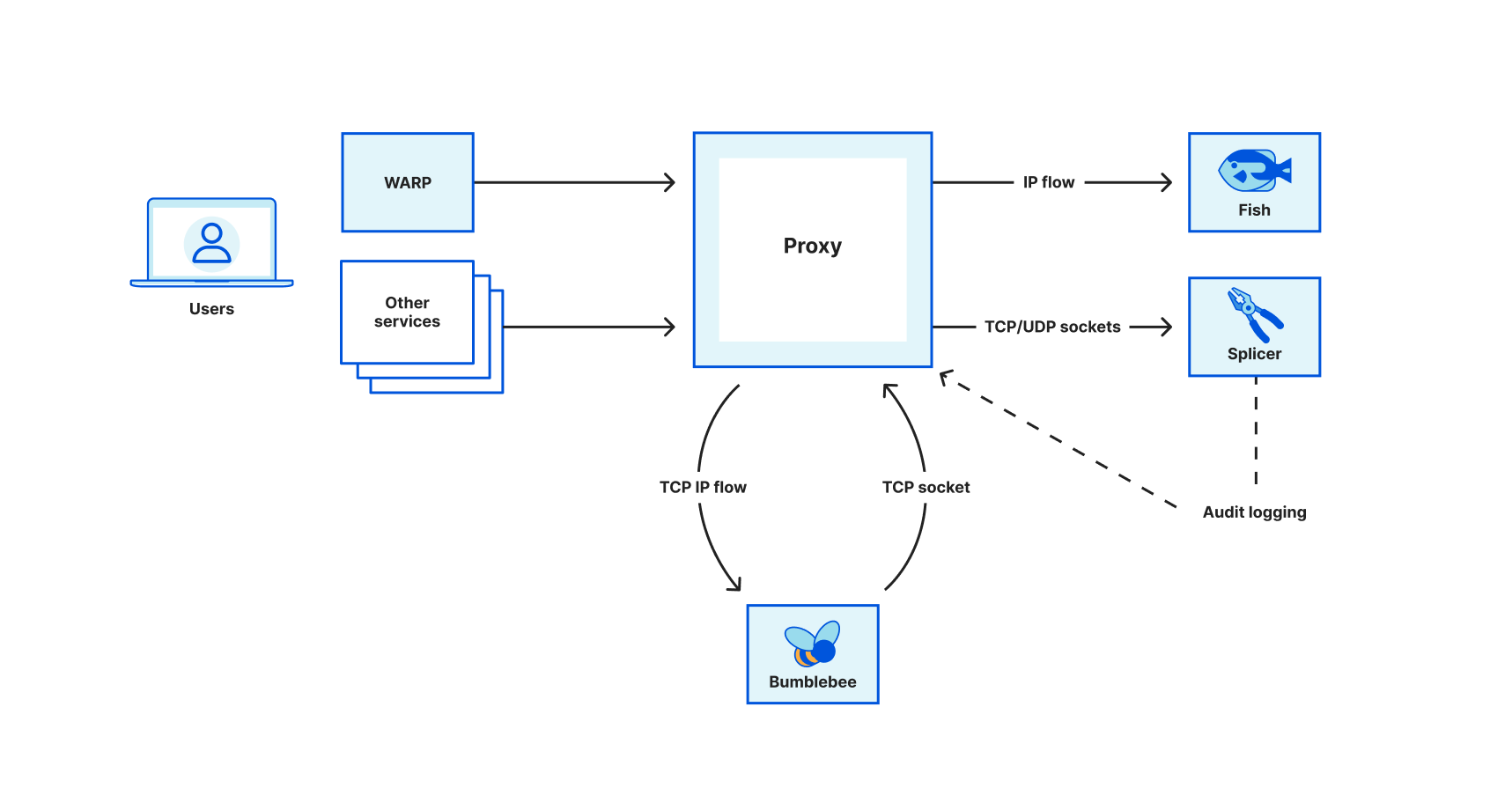
Splicer
Most transmission tunnels in our proxy forward packets without making any modifications. In other words, given Continue reading