Getting Started with the Rust Programming Language

A programming language that has begun picking up momentum in the community lately is Rust. This is a guide aimed at helping folks get started with the Rust Programming Language. Rust has been around for a while with a stable v1.0 shipping in 2015. Rust initially came from Mozilla who maintain the multi-million line C++ codebase in Firefox that has ... The post Getting Started with the Rust Programming Language appeared first on NetworkStatic | Brent Salisbury's Blog.

...

5G is poised to transform manufacturing

5G promises not just super-fast connections and more bandwidth than Wi-Fi and 4G LTE but also better connectivity, low latency, and support for thousands of devices in one location, all of which are attractive manufacturing facilities, but it will be a while before it becomes the norm there, experts say.According to Gartner, smart factories are major opportunities for 5G. While some use cases can be achieved with existing 4G LTE, most require the low latency and high reliability offered by 5G.To read this article in full, please click here

Returning to First Principles

I feel very strongly (and have for some time) that fundamentals are really important in a technical career. I didn’t start my career with a traditional CS degree, and while there were some fundamental knowledge to be picked up along the way, much of my education and early work experience bypassed a lot of the lower-level fundamentals and placed heavy emphasis on operating technology. This feeling of pulling levers and pushing buttons, rather than actually building things, in large part was responsible for me shifting back into software development full-time.

Looking Back: 2019 Project Report Card

As has been my custom over the last five years or so, in the early part of the year I like to share with my readers a list of personal projects for the upcoming year (here’s the 2019 list). Then, near the end of that same year or very early in the following year, I evaluate how I performed against that list of personal projects (for example, here’s my project report card for 2018). In this post, I’ll continue that pattern with an evaluation of my progress against my 2019 project list.

For reference, here’s the list of projects I set out for myself for 2019 (you can read the associated blog post, if you like, for additional context):

  1. Make at least one code contribution to an open source project. (Stretch goal: Make three code contributions to open source projects.)
  2. Add at least three new technology areas to my “learning-tools” repository. (Stretch goal: Add five new technology areas to the “learning-tools” repository.)
  3. Become more familiar with CI/CD solutions and patterns.
  4. Create at least three non-written content pieces. (Stretch goal: Create five pieces of non-written content.)
  5. Complete a “wildcard project” (if applicable).

Here’s how I Continue reading

SDxCentral’s Top 10 Articles — December 2019

Aviatrix CEO: SD-WAN is dead. AWS killed it; Fortinet leapfrogs Cisco with 21,000 SD-WAN customers;...

Read More »

© SDxCentral, LLC. Use of this feed is limited to personal, non-commercial use and is governed by SDxCentral's Terms of Use (https://www.sdxcentral.com/legal/terms-of-service/). Publishing this feed for public or commercial use and/or misrepresentation by a third party is prohibited.

2019 Docker Community Awards

The Docker Community is the heart of Docker’s success and a huge reason why Docker was named the most wanted and second most loved developer tool in the 2019 Stack Overflow Survey. This year, we honored the following members of the Docker Community for their exemplary contributions to Docker users around the globe. On behalf of Docker and developers everywhere, thank you for your passion and commitment to this community!

Ajeet Singh Raina, Bangalore, India

Ajeet is a Docker Captain and Docker Community Leader for Docker Bangalore, the largest Docker Meetup in the world with nearly 8,000 members. His meetups are more like mini-conferences, commonly exceeding hundreds of RSVPs and involving free hands on workshop and training content that he and his docker community have developed. Ajeet is also a prolific blogger, sharing docker and kubernetes content on his blog Collabnix, which had over a million views in 2019. Ajeet also helped to organize and/or speak at more than 30+ events over the past year. This year, Ajeet was recognized by his fellow Captains to receive the Tip of the Captains Hat Award for his tireless dedication to sharing his expertise with the broader tech community. Keep up with Ajeet Continue reading

5G Put Down International Roots in 2019

The United States, China, South Korea, and some European countries are effectively battling for 5G...

Read More »

© SDxCentral, LLC. Use of this feed is limited to personal, non-commercial use and is governed by SDxCentral's Terms of Use (https://www.sdxcentral.com/legal/terms-of-service/). Publishing this feed for public or commercial use and/or misrepresentation by a third party is prohibited.

Member News: Internet Society Highlights from 2019

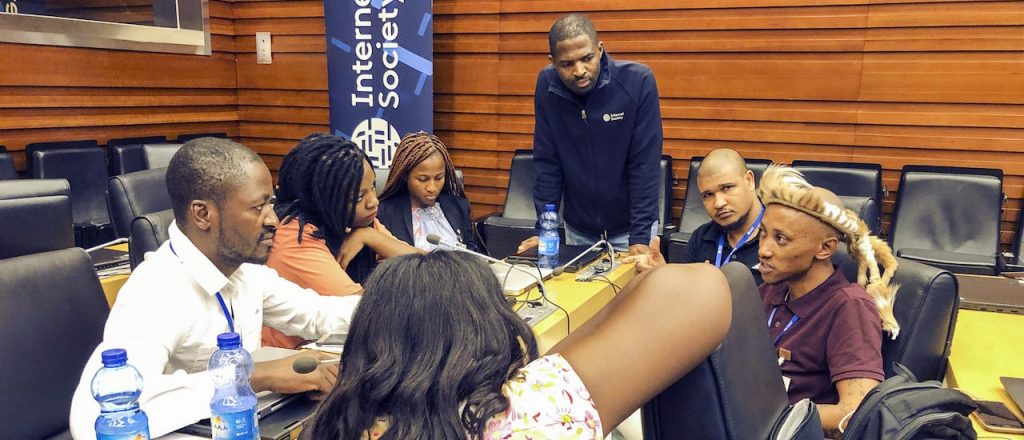
It’s been a busy year for Internet Society Chapters around the world, with members pushing to extend Internet connections to remote areas, involved in public policy, and focusing on cybersecurity. Here are some of the highlights in 2019:

Extending Internet connections

Community awareness: The Madagascar chapter provided awareness training on community-based broadband networks in the rural areas of Ambohimasina, Antambolo, and Morarano-Antongona during February and March. “Our main objective was to ensure that people using the Internet continue to be convinced of its usefulness,” the Chapter wrote. Another goal was for local leaders to have access to the Internet for the “purposes of innovation, creativity and economic opportunities for their municipality.”

Network planning: In Nigeria, the Internet Society Chapter began planning to set up a community network in Zaria, a city in the northern region of the country. The Internet Society provided startup funds of about 10 million naira, or “about the cost of a fairly used Toyota Corolla,” the Chapter noted. “By being very frugal and leveraging on existing infrastructure being contributed by community members, this will cover the cost of the initial wireless hardware required to connect at least 12 locations across Zaria.”

Connecting classrooms: Continue reading

Cisco’s 2019 was Flush With 5G, Security, and SD-WAN

The vendor used its clout over the past 12 months in continuing to bolster its position across...

Read More »

© SDxCentral, LLC. Use of this feed is limited to personal, non-commercial use and is governed by SDxCentral's Terms of Use (https://www.sdxcentral.com/legal/terms-of-service/). Publishing this feed for public or commercial use and/or misrepresentation by a third party is prohibited.

Related Stories

Juniper SD-WAN Demo Lets Customers Try Before They Buy

The virtual tour will, however, require users to sign up for a 30-day trial of Juniper's Contrail...

Read More »

© SDxCentral, LLC. Use of this feed is limited to personal, non-commercial use and is governed by SDxCentral's Terms of Use (https://www.sdxcentral.com/legal/terms-of-service/). Publishing this feed for public or commercial use and/or misrepresentation by a third party is prohibited.

Adopting a new approach to HTTP prioritization

Adopting a new approach to HTTP prioritization

Friday the 13th is a lucky day for Cloudflare for many reasons. On December 13, 2019 Tommy Pauly, co-chair of the IETF HTTP Working Group, announced the adoption of the "Extensible Prioritization Scheme for HTTP" - a new approach to HTTP prioritization.

Web pages are made up of many resources that must be downloaded before they can be presented to the user. The role of HTTP prioritization is to load the right bytes at the right time in order to achieve the best performance. This is a collaborative process between client and server, a client sends priority signals that the server can use to schedule the delivery of response data. In HTTP/1.1 the signal is basic, clients order requests smartly across a pool of about 6 connections. In HTTP/2 a single connection is used and clients send a signal per request, as a frame, which describes the relative dependency and weighting of the response. HTTP/3 tried to use the same approach but dependencies don't work well when signals can be delivered out of order.

HTTP/3 is being standardised as part of the QUIC effort. As a Working Group (WG) we've been trying to fix the problems that non-deterministic ordering Continue reading

Re-Imagining the Network for the Cloud Native Era

Vijoy Pandey Vijoy Pandey is the VP and CTO of Cloud at Cisco, having joined Cisco in August 2018. Vijoy was previously at Google where he has held various leadership roles in the architecture, engineering and operations of Google's global data center networking footprint, Cloud networking, and their two global WAN networks. He also led the development of software and systems for intent-driven zero-touch automation, diagnostic telemetry, data analytics and ML/AI and application-level awareness in the infrastructure. Prior to Google, Vijoy served in numerous CTO capacities including CTO of Networking at IBM Cloud and at IBM Systems and Software Group; CTO of Blade Network Technologies, and has led global engineering teams at Blade Network Technologies, Nortel and Alteon. Vijoy has led the industry’s automation and data analytics efforts for cloud-scale networks, and was instrumental in delivering many industry firsts — including the first intent-driven e2e automation framework at cloud scale, the first Open Source SDN controller; the first VM-aware switch, and the first low-latency HFT/HPC switch. He has a Ph.D. in Computer Science, and holds over 60 patents in distributed systems and networking. In the last few years, we have seen application architectures evolve dramatically and become cloud native. Continue reading

Cumulus content roundup: December 2019

We wrapped up December, and really 2019 with some pretty big news! Project DENT was officially announced and we’re excited for the possibilities will bring. Not sure what project DENT is? Luckily for you, we have all the coverage available for your reading pleasure in this month’s content roundup.

In addition to the DENT news, we also brought you another episode of our Kernel of Truth podcast and some great education blogs. Enjoy them all below!

From Cumulus Networks:

Announcing project DENT: We are now proud contributors to the DENT project! Premier members also include Amazon, Delta Electronics Inc, Marvell, Mellanox, and Wistron NeWeb (WNC). Launched by the Linux Foundation, DENT is networking software designed to simplify enterprise edge networking. Roopa Prabhu, our Chief Linux Architect, shares why the chance to enable networking hardware vendors to leverage the same benefits that all Linux hardware technologies do today has got us so excited to join the project.

Network inventory: what do you have, and should it be there?:How do you defend what you don’t know exists? Establishing & maintaining a network inventory is both a technological & a business process problem— we talk about how a modern Continue reading

New Year, New Adventure

I’ll skip the build-up and jump straight to the whole point of this post: a once-in-a-lifetime opportunity has come up and I’m embarking on a new adventure starting in early 2020. No, I’m not changing jobs…but I am changing time zones.

Sometime in the next month or two (dates are still being finalized), I’ll be temporarily relocating to Tokyo, Japan, to help build out VMware’s Cloud Native Field Engineering team to provide consulting and professional services around cloud-native technologies and modern application platforms for customers in Japan. Basically, my charter is to replicate the former Heptio Field Engineering team (now the Cloud Native Field Engineering Practice within VMware) in Japan.

Accomplishing this feat will involve a variety of responsibilities: a pretty fair amount of training/enablement, engaging customers on the pre-sales side, helping lead projects on the post-sales (delivery) side, mentoring team members, performing some project management, probably some people management, and the infamous “other duties as required.” All in about six months (the inital duration of my assignment), and all while learning Japanese! No big deal, right?

I’m both simultaneously excited and scared. I’m excited by the idea of living in Tokyo, but let’s be honest—the language barrier is Continue reading

MNJ Demo Lab Gives Customers an SD-WAN Speed Dating Experience

"Not all SD-WAN is created equal," said Ben Niernberg, EVP at MNJ Technologies. "They are all very...

Read More »

© SDxCentral, LLC. Use of this feed is limited to personal, non-commercial use and is governed by SDxCentral's Terms of Use (https://www.sdxcentral.com/legal/terms-of-service/). Publishing this feed for public or commercial use and/or misrepresentation by a third party is prohibited.

Vodafone Australia Blames 5G Delays on Huawei Ban

The deal marks the end of the operator's business with Huawei, which was effectively banned from...

Read More »

© SDxCentral, LLC. Use of this feed is limited to personal, non-commercial use and is governed by SDxCentral's Terms of Use (https://www.sdxcentral.com/legal/terms-of-service/). Publishing this feed for public or commercial use and/or misrepresentation by a third party is prohibited.

VMware Folds Pivotal Into New Modern App Biz Unit

Ray O’Farrell will lead the new unit as EVP and GM. O’Farrell previously served as EVP and...

Read More »

© SDxCentral, LLC. Use of this feed is limited to personal, non-commercial use and is governed by SDxCentral's Terms of Use (https://www.sdxcentral.com/legal/terms-of-service/). Publishing this feed for public or commercial use and/or misrepresentation by a third party is prohibited.