December 4 – NRE Labs Outage Post-Mortem
I awoke yesterday to a very crisp Tuesday morning in Portland, Oregon. I had just poured myself a nice glass of Stumptown Nitro cold brew coffee, and wandered upstairs to my office for an 8AM conference call. I joined the meeting, and started going through my usual routine - part of which includes looking at the day’s NRE Labs stats. Here’s what I saw: Well, that kind of sucks.AT&T’s White Box Cell-Site Routers Go Into Production Carrying Live Traffic
 In 2019 the company will deploy these routers at several thousand towers to support its mobile 5G network.
The Leading Edge Of Air-Cooled Servers Leads To The Edge
What if a hyperscale rack designer decided not to locally optimize legacy form factors for thermal management, but instead to start over and design a rack based on optimizing thermal efficiency? …
The Leading Edge Of Air-Cooled Servers Leads To The Edge was written by Paul Teich at .
Container Adoption Has Nearly Doubled in Last Year, Says Portworx Survey
 IT professionals list Microsoft Azure as the best cloud provider in terms of cost effectiveness, having the most advanced tools, reliability, and having the best support for container environments.
Microsoft Resellers Including Dell Win $3.2B Deal With US Navy
 Almost 900 vendors competed for the 10-year award. The Navy selected six.
The Benin Chapter Wins Chapterthon 2018
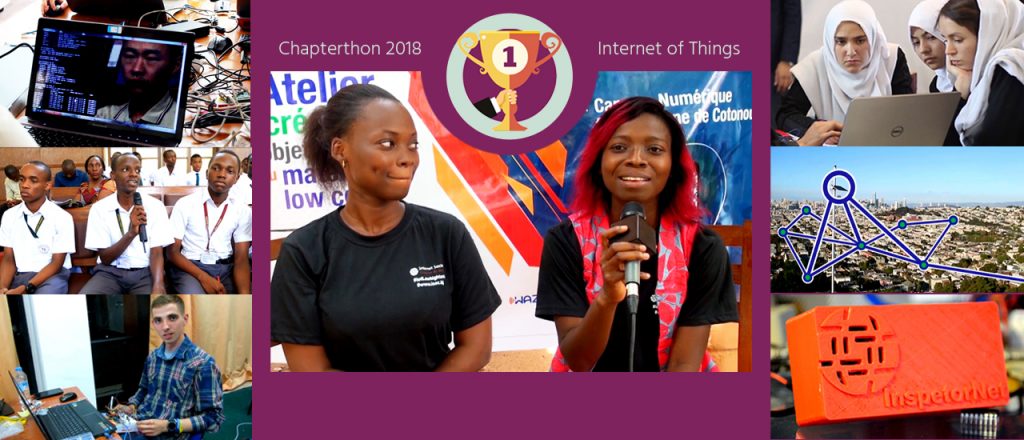
The winner of this year’s Chapterthon was announced this Tuesday, 4 December during InterCommunity 2018.
Chapterthon is a global Internet Society (ISOC) Chapters and Special Interest Groups (SIGs) marathon, where all the Internet Society members can participate by developing a project within a timeline and budget to achieve a common goal. The project winner is selected by the community through online vote.
This year our community worked on the Internet of Things (IoT) – The future is ours to shape.
Every year, the Chapterthon brings enthusiasm and excitement amongst our community. During two and half months, 43 Chapters and Special Interest Groups (SIGs) from across the globe worked alongside to bring awareness on the Internet of Things (IoT) to their communities. They ran over 200 training sessions and workshops, engaging students, entrepreneurs, and local governments. They organized national campaigns, their projects were mentioned in local newspapers, and their message was brought to the most remote places. The Chapters also developed IoT applications that may in the future improve the lives of people in their communities, and amongst some of the projects are improved transport systems, agriculture, energy management, home protection, and healthcare.
The projects that received the highest number Continue reading
Sponsored Post: InMemory.Net, Triplebyte, Etleap, Stream, Scalyr

Who's Hiring?
- Triplebyte lets exceptional software engineers skip screening steps at hundreds of top tech companies like Apple, Dropbox, Mixpanel, and Instacart. Make your job search O(1), not O(n). Apply here.
- Need excellent people? Advertise your job here!
Fun and Informative Events
- Advertise your event here!
Cool Products and Services
- InMemory.Net provides a Dot Net native in memory database for analysing large amounts of data. It runs natively on .Net, and provides a native .Net, COM & ODBC apis for integration. It also has an easy to use language for importing data, and supports standard SQL for querying data. http://InMemory.Net
- For heads of IT/Engineering responsible for building an analytics infrastructure, Etleap is an ETL solution for creating perfect data pipelines from day one. Unlike older enterprise solutions, Etleap doesn’t require extensive engineering work to set up, maintain, and scale. It automates most ETL setup and maintenance work, and simplifies the rest into 10-minute tasks that analysts can own. Read stories from customers like Okta and PagerDuty, or try Etleap yourself.
- Build, scale and personalize your news feeds and activity streams with getstream.io. Try the API now in this Continue reading
VodafoneZiggo Deploys Cisco SON With RAN Automation for 5G
 Cisco’s SON technology works in multi-vendor deployments based on any combination of cellular technologies. It supports RAN nodes from any major vendor as well as multiple data-source vendors.
Barefoot Networks Debuts Tofino 2, Using 7nm Technology
 This is Barefoot’s second generation release of its P4-programmable Tofino Ethernet switch ASIC family.
ONAP Casablanca Shows Up in ‘All the Gin Joints’
 A bunch of service providers from around the world are starting to implement ONAP code into their networks.
EU Terrorist Content Online proposal – political haste and unintended consequences


In September, the European Commission presented a legislative proposal to address the removal of terrorist content online. There has been significant political pressure, particularly as the EU elections of 2019 approach, towards internet companies taking on increased responsibility in the area of terrorist propaganda online. This proposal would be a marked move from various voluntary initiatives taken up by some social media companies in recent times towards a legal responsibility framework for many.
While appreciating the concerns around terrorism, Cloudflare is not only troubled by the late presentation of this proposal – which leaves inadequate time for a thorough review before this EU legislative term expires – but also much of the substance. Along with others such as CDT, GSMA/ETNO and Mozilla, we have significant concerns around the legal implications, practical application and possible unintended consequences of the proposal, some of which we outline below. Furthermore, we believe that little evidence has been presented as to the necessity of the proposed measures.
Concerns and shortcomings
The Commission’s proposal does not account for the complexity and range of information society services having a storage component - not all services have the same Continue reading
South Korea Launches 5G, But Only for Enterprise Users Initially
 South Korea is the first nation in Asia to launch commercial 5G networks as KT, LG UPlus, and SK Telecom, switch on services.
Nokia Threat Report: IoT Botnets Skyrocketed in 2018 and 5G Will Make It Worse
 “If you have an IoT device and it has any vulnerability and it’s visible from the Internet, it will be attacked in a number of minutes,” said Kevin McNamee, director of Nokia’s Threat Intelligence Lab and lead author of the report.
Join Us to Discuss Attack Response at Internet Scale
How do we coordinate responses to attacks against Internet infrastructure and users? Internet technology has to scale or it won’t survive for long as the network of networks grows ever larger. But it’s not just the technology, it’s also the people, processes and organisations involved in developing, operating and evolving the Internet that need ways to scale up to the challenges that a growing global network can create.
One such challenge is unwanted traffic, ranging from spam and other forms of messaging-related abuse to multi-gigabit distributed denial of service attacks. Numerous incident response efforts exist to mitigate the effects of these attacks. Some are focused on specific attack types, while others are closed analysis and sharing groups spanning many attack types.
We are helping to bring together operators, researchers, CSIRT team members, service providers, vendors, information sharing and analysis centre members to discuss approaches to coordinating attack response at Internet scale. The Internet Society is sponsoring a two-day “Coordinating Attack Response at Internet Scale (CARIS) Workshop” intended to help build bridges between the many communities working on attack response on the Internet and to foster dialogue about how we can better collaborate.
The workshop will take place on February 28 Continue reading
Virtual Design Clinic 3 at Packet Pushers

Attending conferences has always been expensive, time consuming and tiring. Most people don’t talk about this but prefer to highlight the positives of meeting people, sitting in high quality sessions and enjoy some time off from the repetitive activities of the $dayjob. If you have questions that you want answered but can’t attend, head over […]
The post Virtual Design Clinic 3 at Packet Pushers appeared first on EtherealMind.
