Real World Serverless: Serverless Use Cases and Best Practices
Cloudflare Workers has had a very busy 2018. Throughout the year, Workers moved from beta to general availability, continued to expand its footprint as Cloudflare grew to 155 locations, and added new features and services to help developers create increasingly advanced applications.
To cap off 2018 we decided hit the road (and then head to the airport) with our Real World Serverless event series in San Francisco, Austin, London, Singapore, Sydney, and Melbourne. It was a great time sharing serverless application development insights we’ve discovered over the past year as well as demonstrating how to build applications with new services like our key value store, Cloudflare Workers KV.
Below is a recording from our Singapore Real World Serverless event. It included three talks about Serverless technology featuring Tim Obezuk, Stanley Tan, and Remy Guercio from Cloudflare. They spoke about the fundamentals of serverless technology, twelve factors of serverless application development, and achieving no ops at scale with network-based serverless.
If you’d like to join us in person to talk about serverless, we’ll be announcing 2019 event locations starting in the new year.
About the talks
Fundamentals of Serverless Technology - Tim Obezuk (0:00-13:56)
Tim explores the anatomy of Continue reading
GE Spins Off Its Digital Business, Including Predix, Into a Separate Company
 GE Digital CEO Bill Ruh departs the company "to pursue other opportunities."
AT&T’s Extensive SDN Plans Pave Way for 5G
 AT&T CTO Andre Fuetsch said the carrier is at 63 percent SDN control of its network operations that can be virtualized, pushing toward its goal of 65 percent control by year-end.
Empowering Moroccan Cooperatives to Participate in the Digital Economy

KASBUY is a web platform to help Moroccan cooperatives, especially ones from women, to promote their handicrafts on international online markets. It will allow any registered cooperative, after following a well-defined and transparent process, to have its own online space to sell its products and manage its business and inventory management activities.
The project is supported by the Internet Society Beyond the Net Funding Programme and developed by the Internet Society Morocco Chapter in partnership with the public organization ODCO (Office du Développement de Coopération) and the private IT company Maghreb-SI.
Through the KASBUY platform, we aim to build an international community around Moroccan crafts and local products. The platform targets small women’s cooperatives that produce handicrafts and wish to reach a large audience through the Internet. In general, these cooperatives find it very difficult to sell their products either because of lack of visibility of their products, or because of the lack of competence in the digital payment process. The platform will provide more opportunities to sell their products.
The project aims to:
- Help cooperatives to overcome the difficulties of selling their local products
- Ensure stable salaries for cooperative members
- Develop the cooperatives in a sustainable way, and support Continue reading
Helping Rural Libraries in Armenia to Embrace the Digital Age
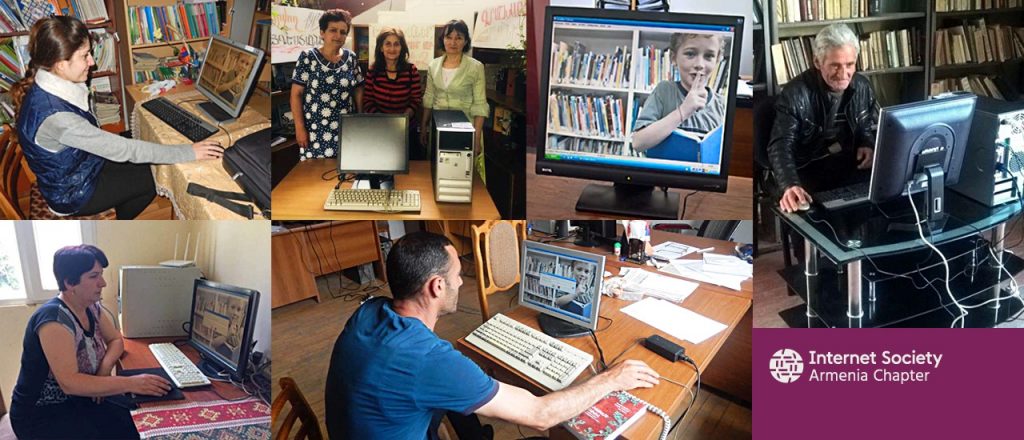
Although there are a large number of rural libraries in Armenia, the majority of them do not have computers or Internet access. Librarians are forced to deal with manual book circulation and lack of management programs. Residents are mostly unaware of the resources housed in the libraries. It became evident that libraries needed a technological shift to break from their current working routines and embrace change.
In 2015, The Internet Society Armenia Chapter started a pilot project to provide rural libraries with computers, software and training. The project team installed 20 computers with library management programs and estimated that, in order to cover all libraries, they needed to reach the number of about 1,000 computers.
In 2017, the Chapter started Computers, services and Wi-Fi Internet for rural libraries, a project supported by the Internet Society Beyond the Net Funding Programme, that aimed to install more computers to improve the librarians operation and provide lightweight library management programs as well as WiFi access for visitors. The project was presented at the national IGF on October 10, 2018.
 Igor Mkrtumyan, President of the Armenia Chapter, explains how their project is helping to address the needs of rural communities within the Continue reading
Tech Bytes: How Silver Peak’s SD-WAN Helped Gentherm Beat Global MPLS Hassles
Today's Tech Bytes, sponsored by Silver Peak, discusses how SD-WAN can give you more leverage over your MPLS providers and improve performance for users. Our guest is Bruce Jarrett, Infrastructure Team Lead and Network Architect at Gentherm.
The post Tech Bytes: How Silver Peak’s SD-WAN Helped Gentherm Beat Global MPLS Hassles appeared first on Packet Pushers.
VMware Helps Make-a-Wish Foundation Save Millions on IT
 On average, it takes $10,500 for a wish. And the Foundation must balance the need to grant wishes with the need to update its IT infrastructure.
QAA: How Important is it to Understand Hardware Architecture?

This question on reddit For example, I’m going through a Cisco Live presentation on troubleshooting ASR routers, and the first 50 slides or so are completely dedicated to describing the Route Processors, Packet Engines, ASICs, Buffers, etc., and the different paths that packets can take through the hardware. While that’s all obviously important to the […]
The post QAA: How Important is it to Understand Hardware Architecture? appeared first on EtherealMind.

Network Break 215: Dell Buys Its Way To Wall Street; Arista Inks Container Partnerships
On today's Network Break we analyze Dell's move back onto the public market, Arista's partnerships for container networking, startup funding, new products, and more of what's happening in IT.
The post Network Break 215: Dell Buys Its Way To Wall Street; Arista Inks Container Partnerships appeared first on Packet Pushers.
3GPP Delays ‘Second Wave’ of 5G Specs
 The standards body insists there is no need for panic, as it announces a three-month delay in the completion of the Release 15 standard.
The Week in Internet News: Fallout from Australia’s Anti-Encryption Law

A lack of support: Australia’s new law requiring technology companies to give law enforcement agencies access to customers’ encrypted communications isn’t so popular with the public, The Economist reports. The government there received 343 public comments leading up to the vote in favor of the law, and only one person expressed support.
Minor offenses: Meanwhile, critics of the Australian law say it may be used to target suspects of minor crimes, The Guardian says. The law is neither “appropriate or proportionate,” one lawyer says. One of Australia’s spy chiefs is defending the law, however, saying it will be used to target terrorists, pedophiles, and other criminals, not law-abiding citizens, ABC News Australia reports.
Getting tough: The Russian parliament is planning to vote on a package of bills intended to increase penalties for spreading fake news, Euronews reports. One of the bills would allow for fines and a short jail sentence for people “expressing obvious disrespect” for society and state officials. The Dutch government is taking a different approach to fake news, by planning an online campaign to make voters aware of disinformation and help them recognize it, NLTimes says.
China vs. trolls: The Chinese government has detained 30 members of Continue reading
Top 5 Principles in Becoming ‘Agile’ During Digital Transformation
Organizations embarking on a digital transformation utilizing Agile concepts should give close consideration to these principles and the accompanying Do's and Don'ts.
Webinars in 2018
2018 was our busiest year ever… we created or updated 19 webinars, for a total of 32 live webinar sessions.
We wrapped up the 2018 webinars with Storage December featuring Hyper-Converged Infrastructure with Howard Marks and NVMe-over-Fabrics with J Metz (I never thought I would enjoy storage technology discussions, but Howard and J were brilliant)… and this is what we’ve been doing the rest of the year:
Read more ...Applied machine learning at Facebook: a datacenter infrastructure perspective
Applied machine learning at Facebook: a datacenter infrastructure perspective Hazelwood et al., _HPCA’18 _
This is a wonderful glimpse into what it’s like when machine learning comes to pervade nearly every part of a business, with implications top-to-bottom through the whole stack. It’s amazing to step back and think just how fundamentally software systems have changed over the last decade in this regard.
Just how pervasive is machine learning at Facebook?
- “At Facebook, machine learning provides key capabilities in driving nearly all aspects of user experience… Machine learning is applied pervasively across nearly all services.”
- “Facebook funnels a large fraction of all stored data through machine learning pipelines, and this fraction is increasing over time to improve model quality.”
- “Looking forward, Facebook expects rapid growth in machine learning across existing and new services…. Over time, most services indicate a trend toward leveraging increased amounts of user data.. the training data sets are trending towards continued and sometimes dramatic growth.”
The modern user-experience is increasingly powered by machine learning models, and the quality of those models depends directly on the volume and quality of the data powering them: “For many machine learning models Continue reading