Battle Scars from OpenStack Are Just Cloud Problems
Cloud scars are the same everywhere, not just OpenStack.
For several years there has been the ongoing debate about ARM and its future in the datacenter. That debate goes on, but the talk is changing.
At the beginning of the decade, ARM Holdings, the company behind the ARM chip architecture that is now owned by Japanese high-tech conglomerate Softbank, said its low-power system-on-a-chip (SoC) designs were a good alternative to Intel’s dominant Xeon and derivative processors for servers and other hardware at a time when energy efficiency in systems was becoming increasingly important.
Over the years that has been speculation about when ARM-based chips would find a foothold …
Computing Is Bigger Than The Datacenter was written by Jeffrey Burt at The Next Platform.
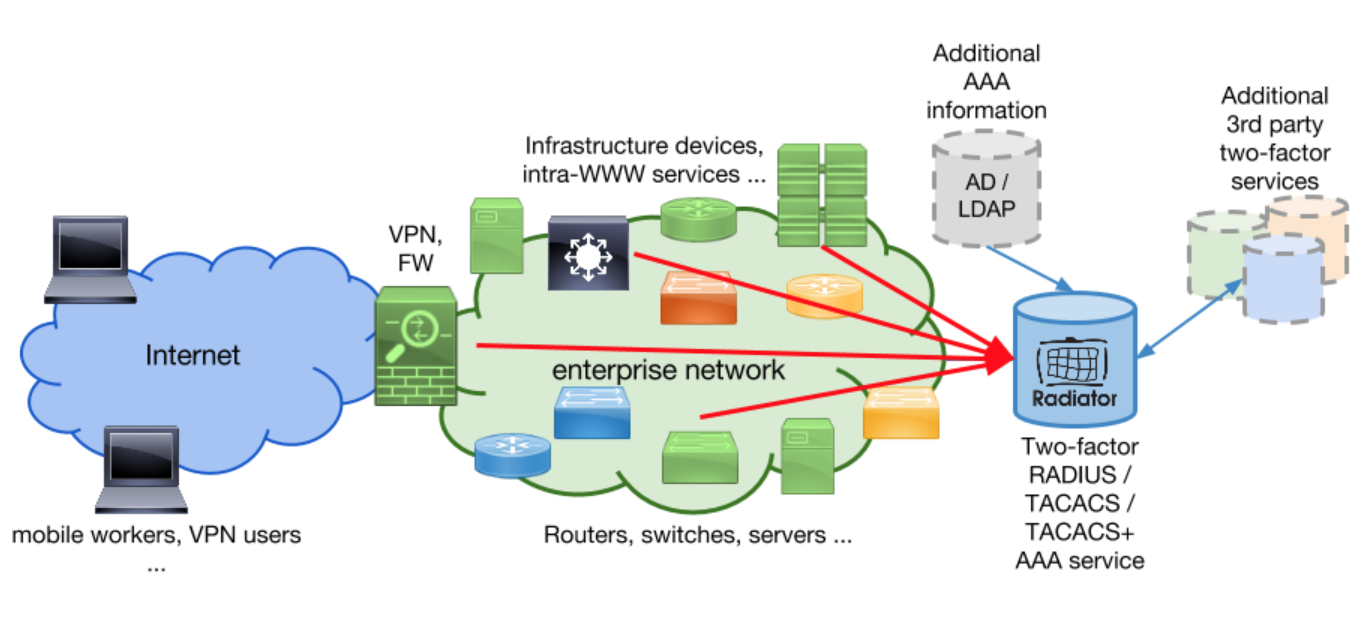 |
| Fig 1.1- TACACS and TACACS+ Server |
I’ve recently been working on a very simple Flask application that can be used as a demo application in containerized environments (here’s the GitHub repo). It’s nothing special, but it’s been useful for me as a learning exercise—both from a Docker image creation perspective as well as getting some additional Python knowledge. Along the way, I wanted to be able to track versions of the Docker image (and the Dockerfile used to create those images), and link those versions back to specific Git commits in the source repository. In this article, I’ll share a way I’ve found to tag Docker images with Git commit information.
Before I proceed any further, I’ll provide the disclaimer that this information isn’t unique; I’m building on the work of others. Other articles sharing similar information include this one; no doubt there are countless more I haven’t yet seen. I’m presenting this information here simply to show one way (not the only way) of including Git commit information with a Docker image.
Getting the necessary information from Git is actually far easier than one might think. This variation of the git log command will print only the full hash of the last commit Continue reading
These apps can help network administrators troubleshoot and optimize their networks.
One of my readers sent me this question:
I'm having an internal debate whether to use firewall-based VPNs or DMVPN to connect several sites if our MPLS connection goes down. How would you handle it? Do you have specific courses answering this question?
As always, the correct answer is it depends, in this case on:
Read more ... The services allow Nutanix to better compete against VMware's hybrid cloud offerings.
 |
| Fig 1.1- ACI Multi-Site and Multi-Pod Deployments |
In this post for the Internet Society Rough Guide to IETF 100, I’m reviewing what’ll be happening at IETF 100 in Singapore next week.
IPv6 global adoption rates passed 20% shortly after IETF 99, with a number of countries making substantial strides in IPv6 deployment in the past few months. Belgium still leads the way at over 60%, but India has shot up to over 50% which is extremely encouraging in such a large market. Adoption rates also exceed 40% in the United States and Germany, and with most major content and cloud providers now supporting IPv6, there’s a substantial amount of IPv6-related work happening in Singapore. In fact, there’s no less than five IPv6-related working groups on the first day alone.
The IPv6 Operations (v6ops) Working Group is always one of the key groups, and since the last meeting has published two RFCs on Host Address Availability Recommendations (https://tools.ietf.org/html/rfc7934) and Local-Use IPv4/IPv6 Translation Prefix (https://tools.ietf.org/html/rfc8215). The meeting kicks off on Monday afternoon and continues on Thursday morning, starting with a case study on IPv6-only deployment at Cisco.
There are also seven drafts being discussed including 464XLAT Deployment Guidelines for Operator Continue reading
Organizations are turning to artificial intelligence and deep learning in hopes of being able to more quickly make the right business decisions, to remake their business models and become more efficient, and to improve the experience of their customers. The fast-emerging technologies will let enterprises gain more insight into the massive amounts of data they are generating and find the trends that normally would have been hidden from them. And enterprises are quickly moving in that direction.
A Gartner survey found that 59 percent of organizations are gathering information to help them build out their AI strategies, while the rest …
Easing The Pain Of Prepping Data For AI was written by Jeffrey Burt at The Next Platform.
The global server market is increasingly driven by the hyperscalers, and the trendsetter for all of them is Amazon Web Services. The massive company dominates the fast-growing public cloud space, outpacing rivals like Microsoft Azure, Google Cloud Platform, and IBM Cloud, and is the top consumer of servers among a group of hyperscalers that are becoming the most powerful buyers of systems and new components, such as processors.
This can be seen in the numbers. According to IDC analysts, hyperscalers in the first and second quarters this year made a significant push to deploy servers, with AWS accounting for more …
New AWS Instances Sport Customized Intel Skylakes, KVM Hypervisor was written by Jeffrey Burt at The Next Platform.
This is a liveblog of my last session at the Sydney OpenStack Summit. The session title is “OpenStack images that fit your imagination: deep dive into container images in Kolla.” The presenters are Vikram Hosakote and Rich Wellum, from Cisco and Lenovo, respectively.
Hosakote starts with an overview of Kolla. Kolla is a project to deploy OpenStack services into Docker containers. There are two ways to use Kolla: using Ansible (referred to as Kolla-Ansible) or using Kubernetes (referred to as Kolla-Kubernetes). Hosakote mentions that Kolla-Kubernetes also uses Helm and Helm charts; this makes me question the relationship between Kolla-Kubernetes and OpenStack-Helm.
Why Kolla? Some of the benefits of Kolla, as outlined by Hosakote, include:
Hosakote briefly mentions his preference for Kolla over other tools, including Juju, DevStack, PackStack, Fuel, OpenStack-Ansible, TripleO, OpenStack-Puppet, and OpenStack-Chef.
Other benefits of using containers for OpenStack:
 In the year 2017, news comes at you fast.

In the year 2017, news comes at you fast. So, it’s easy to miss the important or informational items that just weren’t on your radar when they first arrived. While we believe VMware NSX should be firmly on everyone’s virtualization radar, we understand that you may miss a few items from time to time. That’s why we’re putting together this VMware NSX news round-up.
This news round-up recaps the latest NSX-related material you may have missed over the past few months for you peruse at your leisure. We’ll compile these posts again from time to time, so be sure to keep your eye on this space for more VMware NSX news rounds-ups and informational posts!
From the post: Pivotal Cloud Foundry (PCF) is the leading PaaS solution for enterprise customers today, providing a fast way to convert their ideas from conception to production. This is achieved by providing a platform to run their code in any cloud and any language taking care of all the infrastructure “stuff” for them.
From building the container image, compiling it with the required runtime, deploying it in a highly available mode and connecting Continue reading