AI and machine learning are being more widely used in IT and elsewhere. Today's episode opens the AI magic box to better understand what's inside, including software and hardware. We discuss essentials such as training models and parameters, software components, GPUs, networking, and storage. We also discuss using cloud-based AI platforms vs. building your own in-house, and what to consider when assembling your own AI infrastructure.
As businesses increasingly migrate mission-critical applications or services to colo facilities and the public cloud, the lack of visibility into their cloud infrastructure must be addressed to avoid blind spots.
Because they are in the front of the line for acquiring Nvidia datacenter GPUs, the hyperscalers and cloud builders are going to be the ones who benefit mightily from shortages of matrix math engines that can train AI models and run inference against them. …
The speed at which shadow IT can set up cloud environments is cause for concern for IT and security teams. Looking for security blind spots can help put some of the issues into focus.
The Full Stack Journey is coming to an end. After five years and more than 80 episodes of deeply technical conversations about technologies, tools, and career journeys, this is the final episode of the series. I reflect on my time hosting the podcast, the challenges and pleasures of putting together a show, lessons and insights from all the conversations I've had, thoughts on the state of IT and technology, and what comes next.
The Full Stack Journey is coming to an end. After five years and more than 80 episodes of deeply technical conversations about technologies, tools, and career journeys, this is the final episode of the series. I reflect on my time hosting the podcast, the challenges and pleasures of putting together a show, lessons and insights from all the conversations I've had, thoughts on the state of IT and technology, and what comes next.
In this episode, Sandra Henry-Stocker, author of the "Unix as a Second Language" blog on NetworkWorld, explores the use of the "nohup" (no hangup) command in Linux.
The data circulatory system Data is the lifeblood of enterprise, flowing vital information through a network of IT veins and arteries to deliver resources exactly where they are needed. Like how innovations in medicine and nutrition have changed the way we live, advanced technologies like IoT, AI, machine learning, and increasingly sophisticated applications are necessitating change in where and how data lives and is processed. To read this article in full, please click here
Cisco is teaming with Aviz Networks to offer an enterprise-grade SONiC offering for large customers interested in deploying the open-source network operating system.Under the partnership, Cisco’s 8000 series routers will be available with Aviz Networks’ SONiC management software and 24/7 support. The support aspect of the agreement may be the most significant portion of the partnership, as both companies attempt to assuage customers’ anxiety about supporting an open-source NOS.While SONiC (Software for Open Networking in the Cloud) is starting to attract the attention of some large enterprises, deployments today are still mainly seen in the largest hyperscalers. With this announcement, Cisco and Aviz are making SONiC more viable for smaller cloud providers, service providers, and those very large enterprises that own and operate their own data centers, said Kevin Wollenweber, senior vice president and general manager with Cisco networking, data center and provider connectivity.To read this article in full, please click here
Cisco is teaming with Aviz Networks to offer an enterprise-grade SONiC offering for large customers interested in deploying the open-source network operating system.Under the partnership, Cisco’s 8000 series routers will be available with Aviz Networks’ SONiC management software and 24/7 support. The support aspect of the agreement may be the most significant portion of the partnership, as both companies attempt to assuage customers’ anxiety about supporting an open-source NOS.While SONiC (Software for Open Networking in the Cloud) is starting to attract the attention of some large enterprises, deployments today are still mainly seen in the largest hyperscalers. With this announcement, Cisco and Aviz are making SONiC more viable for smaller cloud providers, service providers, and those very large enterprises that own and operate their own data centers, said Kevin Wollenweber, senior vice president and general manager with Cisco networking, data center and provider connectivity.To read this article in full, please click here
When it comes to managing Internet properties, the difference between a small technical hiccup and major incident is often a matter of speed. Proactive alerting plays a crucial role, which is why we were excited when we released HTTP Error Rate notifications — giving administrators visibility into when end users are experiencing errors.
But what if there are issues that don't show up as errors, like a sudden drop in traffic, or a spike?
Today, we're excited to announce Traffic Anomalies notifications, available to enterprise customers. These notifications trigger when Cloudflare detects unexpected changes in traffic, giving another valuable perspective into the health of your systems.
Unexpected changes in traffic could be indicative of many things. If you run an ecommerce site and see a spike in traffic that could be great news — maybe customers are flocking to your sale, or you just had an ad run on a popular TV show. However, it could also mean that something is going wrong: maybe someone accidentally turned off a firewall rule, and now you’re seeing more malicious traffic. Either way, you might want to know that something has changed.
Similarly, a sudden drop in traffic could mean many things. Perhaps Continue reading
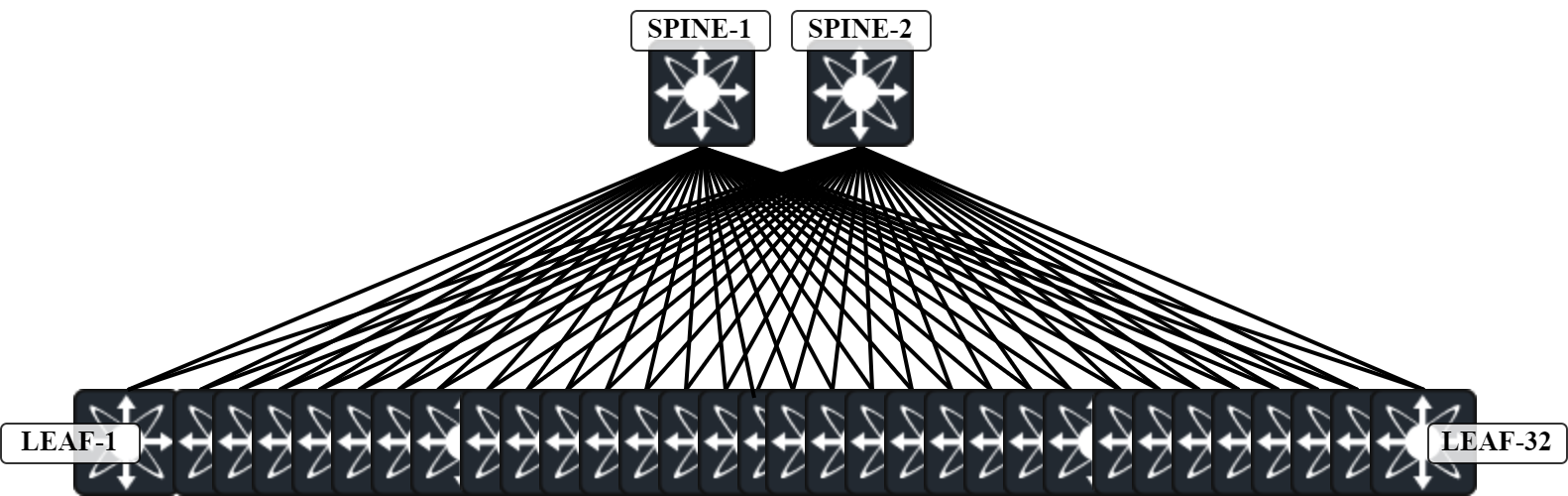
In the last post we used multicast to forward BUM frames. In this post, static ingress replication is used which removes the requirement for multicast in the underlay. Before setting this up, let’s do a comparison of multicast vs ingress replication. To make this interesting, let’s use a larger topology consisting of 2 Spines and 32 Leafs:
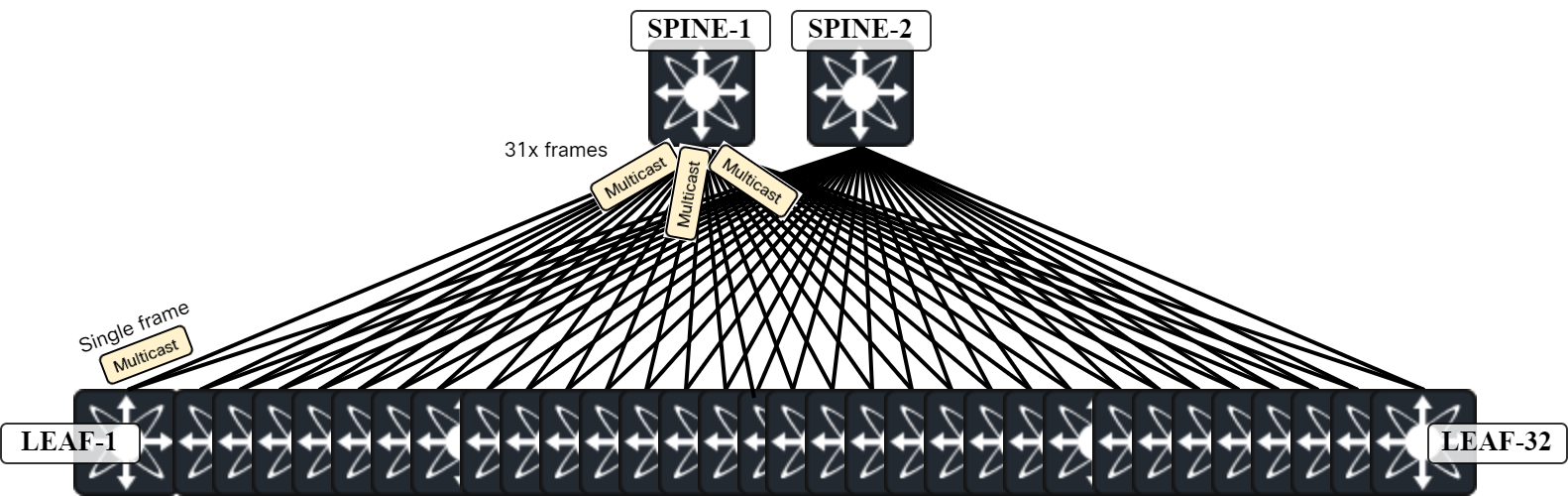
Assume that all Leafs have the same VNIs. In a scenario with multicast, Leaf-1 sends for example an ARP request encapsulated in multicast towards Spine-1. This is a single frame. Spine-1 then replicates this frame and sends it on all its links towards the Leafs:
This is very efficient as a single frame is sent by Leaf-1 and then 31 copies are sent on the other links to the Leafs. If the ARP request is 110 bytes, then a total of 32 x 110 = 3520 bytes have been consumed to send this ARP request. This is optimal forwarding from a resource consumption perspective and one of the strengths of multicast. Now let’s compare that to ingress replication. With ingress replication, Leaf-1 sends 31x copies of the frame (with different destination IP) towards Spine-1. Spine-1 then forwards those frames on each link towards Continue reading
AI is making its way into network operations, and on today’s episode, sponsored by Nokia, we talk about how Nokia has developed a ChatGPT-based application that runs on its SR Linux network OS. Network engineers can use this app to query about network state, ask troubleshooting questions, check configurations, search logs, and quickly sort through reams of documentation.
AI is making its way into network operations, and on today’s episode, sponsored by Nokia, we talk about how Nokia has developed a ChatGPT-based application that runs on its SR Linux network OS. Network engineers can use this app to query about network state, ask troubleshooting questions, check configurations, search logs, and quickly sort through reams of documentation.
Today's episode includes Cisco patching a critical vulnerability affecting IOS-XE gear, startup Prosimo releasing a cost calculator to help network engineers track their public cloud networking costs, and Juniper integrating its SD-WAN to the AWS cloud WAN. We also cover Cisco's investment in a quantum networking startup, growing DPU sales, and Intel divesting from pluggable optical modules.