Worth Reading: What’s the deal with online journalism?


The post Worth Reading: What’s the deal with online journalism? appeared first on 'net work.
The post Worth Reading: What’s the deal with online journalism? appeared first on 'net work.
The Datanauts talk about why and how operations folks can take advantage of Git and GitHub, share tips, and explore why they arent just for developers. The post Datanauts 041: The Value Of GitHub For Operations appeared first on Packet Pushers.

The supercomputing industry is as insatiable as it is dreamy. We have not even reached our ambitions of hitting the exascale level of performance in a single system by the end of this decade, and we are stretching our vision out to the far future and wondering how the capacity of our largest machines will scale by many orders of magnitude more.
Dreaming is the foundation of the technology industry, and supercomputing has always been where the most REM action takes place among the best and brightest minds in computing, storage, and networking – as it should be. But to …
Dreaming Of 100 Exaflops In 2030 was written by Timothy Prickett Morgan at The Next Platform.
It was going to be a long evening, anyway—the flight check bird was coming in, and both Instrument Landing Systems (ILSs) needed to be tuned up and ready for the test. So we took some downtime, split into two teams, and worked our way through each piece of equipment—Localizer, Glide Slope, each marker in turn, VOR, TACAN—to make certain each was, as far as we could measure, sending the right signals to the right places. If flight check found even the smallest variance off what the ILS systems were supposed to be providing, they could shut the airfield down “until further notice.”
The team I was on was driving across one of the many roads out on the airfield, trying to catch up with the other half of the shop to find out what they had done, and what needed to be done. Off in the distance, we noted someone standing in the middle of a field between the roads, waving vigorously. We changed direction, driving across the bumpy field, through grass as high as the top of the hood (Base Ops was planning a burn, so they’d left the grass to grow a bit higher than normal). As Continue reading
As supercomputers expand in terms of processing, storage, and network capabilities, the size and scope of simulations is also expanding outward. While this is great news for scientific progress, this naturally creates some new bottlenecks, particularly on the analysis and visualization fronts.
Historically, most large-scale simulations would dump time step and other data at defined intervals onto disk for post-processing and visualization, but as the petabyte scale of that process adds more weight, that is becoming less practical. Further, for those who know what they want to find in that data, using an in situ approach to finding the answer …
In Situ Analysis to Push Supercomputing Efficiency was written by Nicole Hemsoth at The Next Platform.
Johnny Britt has started blogging over at route-spf.net (I guess he’s just going to write about link state…  ). He’s just put his first post up, linked below. This one is worth watching for good material.
The post New Blog: Route-SPF appeared first on 'net work.
We are excited to share the videos and slides from the Docker, Docker, Docker track at DockerCon 2016!
Note that the following sessions videos from the Docker, Docker, Docker track have already been published in previous blog post:
Check out the videos (and slides) from the remaining sessions below!
The post Worth Reading: The great 21st century data rush appeared first on 'net work.
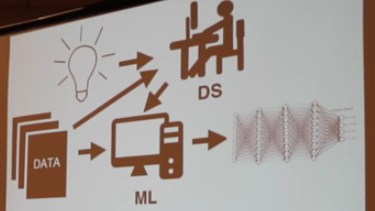
If Google were created from scratch today, much of it would be learned, not coded. Around 10% of Google's 25,000 developers are proficient in ML; it should be 100% -- Jeff Dean
Like the weather, everybody complains about programming, but nobody does anything about it. That’s changing and like an unexpected storm the change comes from an unexpected direction: Machine Learning / Deep Learning.
I know, you are tired of hearing about Deep Learning. Who isn’t by now? But programming has been stuck in a rut for a very long time and it's time we do something about it.
Lots of silly little programming wars continue to be fought that decide nothing. Functions vs objects; this language vs that language; this public cloud vs that public cloud vs this private cloud vs that ‘fill in the blank’; REST vs unrest; this byte level encoding vs some different one; this framework vs that framework; this methodology vs that methodology; bare metal vs containers vs VMs vs unikernels; monoliths vs microservices vs nanoservices; eventually consistent vs transactional; mutable vs immutable; DevOps vs NoOps vs SysOps; scale-up vs scale-out; centralized vs decentralized; single threaded vs massively parallel; sync vs async. And so Continue reading