Ansible Chicago Meetup Recap
If you don't follow Ansible's VP of Community, Greg DeKoenigsberg, on Twitter you may have missed his recap of the Ansible Chicago Meetup.
Dean Strelau and Rick Pollak of Trunk Club invited us to host our inaugural Ansible Chicago meetup at their headquarters in downtown Chicago. This is often how it happens: a company that uses Ansible volunteers to host a meetup, and gets the benefit of being seen as a technology leader in their community; we get to show the local community how a prominent user puts Ansible to best use. Everybody wins! We’ve done similar meetups in New York, San Francisco, London, and many other cities.
Trunk Club, though, was one of the most fascinating yet. For those who aren’t familiar with the business model,check out their site for a detailed description. The short version: they talk to you about what you like, they use business intelligence to help their stylists pick out the best clothes for you, and then they send you a trunk full of clothes they think you’ll like. And then you keep what you like, send back what you don’t, and they charge you appropriately. Great model, Continue reading



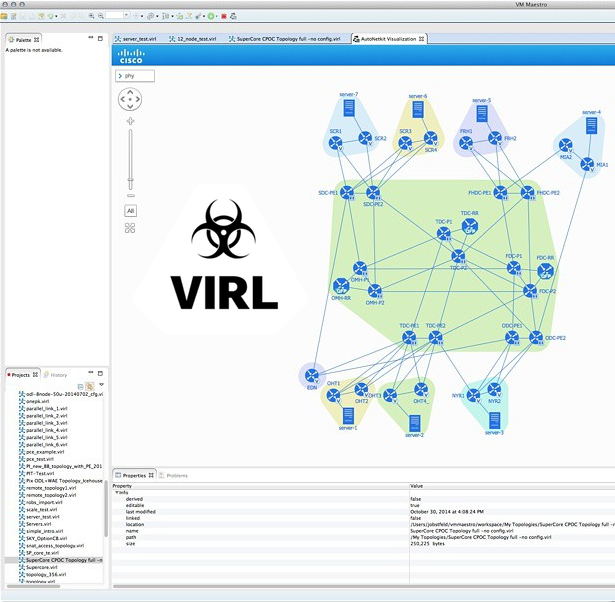 After much waiting from all of us, Cisco has released, on “cyber Monday” no less, VIRL. As you may remember, VIRL was the talk of CLUS 2013, and many of us have been eagerly waiting for this tool ever since. For those of you out of the loop, VIRL enabled users to rapidly design, configure and simulate Cisco network topologies. With this we can run IOSv (IOS Virtual) IOS XRv, CSR1000v (Which runs IOS-XE), and NX-OSv (ala the previously leaked Titanium). The cool factor really starts to come into play when you look at how fast you can deploy the base network configurations. Cisco has leveraged OpenStack, KVM, and AutoNetkit along with their VM Maestro GUI to allow you to quickly create network topologies, and have the base configurations built automagically. The downside is we are missing some features that some of us are rather used to including, Serial interfaces, Cisco ASA, and L2 Support. Hopefully these will arrive in the future, although I’ve heard no rumors of such as of yet….