Welcome to Technology Short Take #123, the first of 2020! I hope that everyone had a wonderful holiday season, but now it’s time to jump back into the fray with a collection of technical articles from around the Internet. Here’s hoping that I found something useful for you!
Networking
Eric Sloof mentions the NSX-T load balancing encyclopedia (found here), which intends to be an authoritative resource to NSX-T load balancing configuration and management.
David Gee has an interesting set of articles exploring service function chaining in service mesh environments (part 1, part 2, part 3, and part 4).
Guiliano Bertello introduces PowerVCF, a PowerCLI module aimed at interacting with the SDDC Manager and VMware Cloud Foundation (VCF) stack. (If you’re not familiar with VCF, see here.)
On January 13, Brian Krebs discussed the critical flaw (a vulnerability in crypt32.dll, a core Windows cryptographic component) that was rumored Continue reading
It is known from prior work that such [functional] languages offer natural advantages in program synthesis.
That certainly caught my interest. The context for the quote is synthesis of programs by machines, but when I’m programming, I’m also engaged in the activity of program synthesis! So a work that shows functional languages have an advantage for programmatic synthesis might also contain the basis for an argument for natural advantages to the functional style of programming. I didn’t find that here. We can however say that this paper shows “functional languages are well suited to program synthesis.”
Never mind, because the ideas in the paper are still very connected to a question I’m fascinated by at the moment: “how will we be developing software systems over this coming decade?”. There are some major themes to be grappled with: system complexity, the consequences of increasing automation and societal integration, privacy, ethics, security, trust (especially in supply chains), interpretability vs black box models, Continue reading
Yes, your container infrastructure needs some type of backup. Kubernetes and Docker will not magically build themselves after a disaster. As discussed in a separate article, you don’t need to back up the running state of each container, but you will need to back up the configuration used to run and manage your containers.Here’s a quick reminder of what you’ll need to back up.[Get regularly scheduled insights by signing up for Network World newsletters.]
Configuration and desired-state information
The Dockerfiles used to build your images and all versions of those files
The images created from the Dockerfile and used to run each container
Kubernetes etcd & other - K8s databases that info on cluster state
Deployments - YAML files describing each deployment
Persistent data created or changed by containers
Persistent volumes
Databases
Dockerfiles
Docker containers are run from images, and images are built from Dockerfiles. A proper Docker configuration would first use some kind of repository such as GitHub as a version-control system for all Dockerfiles. Do not create ad hoc containers using ad hoc images built from ad hoc Dockerfiles. All Dockerfiles should be stored in a repository that allows you to pull historical Continue reading
The gap between the performance of processors, broadly defined, and the performance of DRAM main memory, also broadly defined, has been an issue for at least three decades when the gap really started to open up. …
If you are administering a Linux system, there will likely be times that you need to lock an account. Maybe someone is changing positions and their continued need for the account is under question; maybe there’s reason to believe that access to the account has been compromised. In any event, knowing how to lock an account and how to unlock it should it be needed again is something you need to be able to do.One important thing to keep in mind is that there are multiple ways to lock an account, and they don't all have the same effect. If the account user is accessing an account using public/private keys instead of a password, some commands you might use to block access to an account will not be effective.To read this article in full, please click here
After a decade of vendor consolidation that saw some of the world’s biggest IT firms acquire first-class HPC providers such as SGI, Cray, and Sun Microsystems, as well as smaller players like Penguin Computing, WhamCloud, Appro, and Isilon, it is natural to wonder who is next. …
It’s hard to believe that it’s been eight years since I wrote my most controversial post ever. I get all kinds of comments on my NAT66 post even to this day. I’ve been told I’m a moron, an elitist, and someone that doesn’t understand how the Internet works. I’ve also had some good comments that highlight a specific need for tools like NAT66. I wanted to catch up with everything and ask a very important question.
WHY?
Every Tool Has A Purpose
APNIC had a great post about NAT66 back in 2018. You should totally read it. I consider it a fair review of the questions surrounding NAT’s use in 2020. Again, NAT has a purpose and when used properly and sparingly for that purpose it works well. In the case of the article, Marco Cilloni (@MCilloni) lays out the need to use NAT66 to use IPv6 at his house due to ISP insanity and the latency overhead of using tunnels with Hurricane Electric. In this specific case, NAT66 was a good tool for him to use to translate his /128 address to something useable in his network.
If you’re brave, you should delve into the comments. A Continue reading
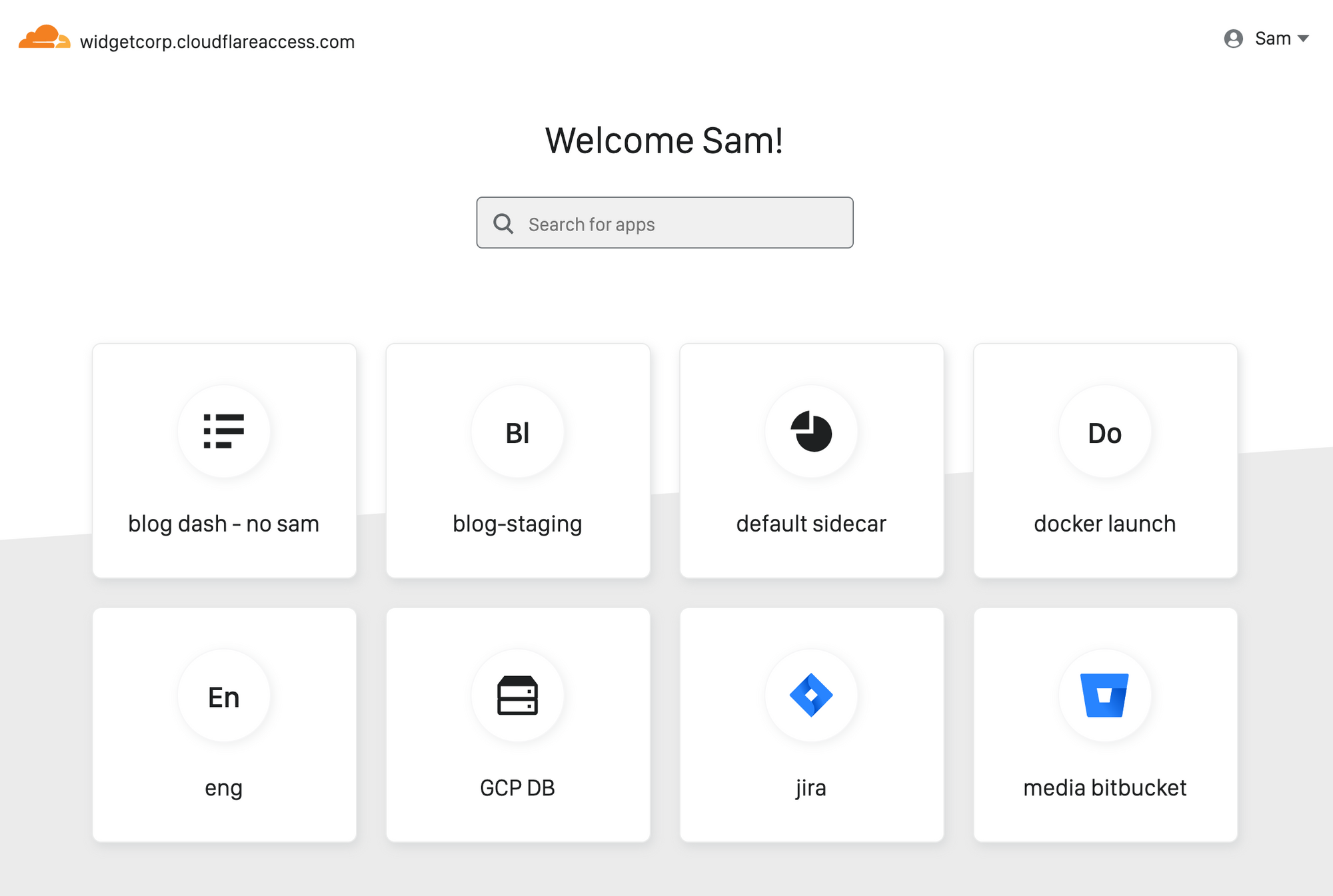
Every person joining your team has the same question on Day One: how do I find and connect to the applications I need to do my job?
Since launch, Cloudflare Access has helped improve how users connect to those applications. When you protect an application with Access, users never have to connect to a private network and never have to deal with a clunky VPN client. Instead, they reach on-premise apps as if they were SaaS tools. Behind the scenes, Access evaluates and logs every request to those apps for identity, giving administrators more visibility and security than a traditional VPN.
Administrators need about an hour to deploy Access. End user logins take about 20 ms, and that response time is consistent globally. Unlike VPN appliances, Access runs in every data center in Cloudflare’s network in 200 cities around the world. When Access works well, it should be easy for administrators and invisible to the end user.
However, users still need to locate the applications behind Access, and for internally managed applications, traditional dashboards require constant upkeep. As organizations grow, that roster of links keeps expanding. Department leads and IT administrators can create and publish manual lists, but those become Continue reading
Companies deploy an average of three to five different cloud services. With an increased emphasis on security and regulatory compliance, the capability to manage these disparate systems is crucial.