Harry Quackenboss is long time veteran of infrastructure technology. In networking he was a VP of Sales of Crescendo for FDDI networking (to the desktop) which was acquired by Cisco. He later founded Woven Systems as a high speed Ethernet company of the time and more lately CEO of cPlane, a SDN company now relaunched […]
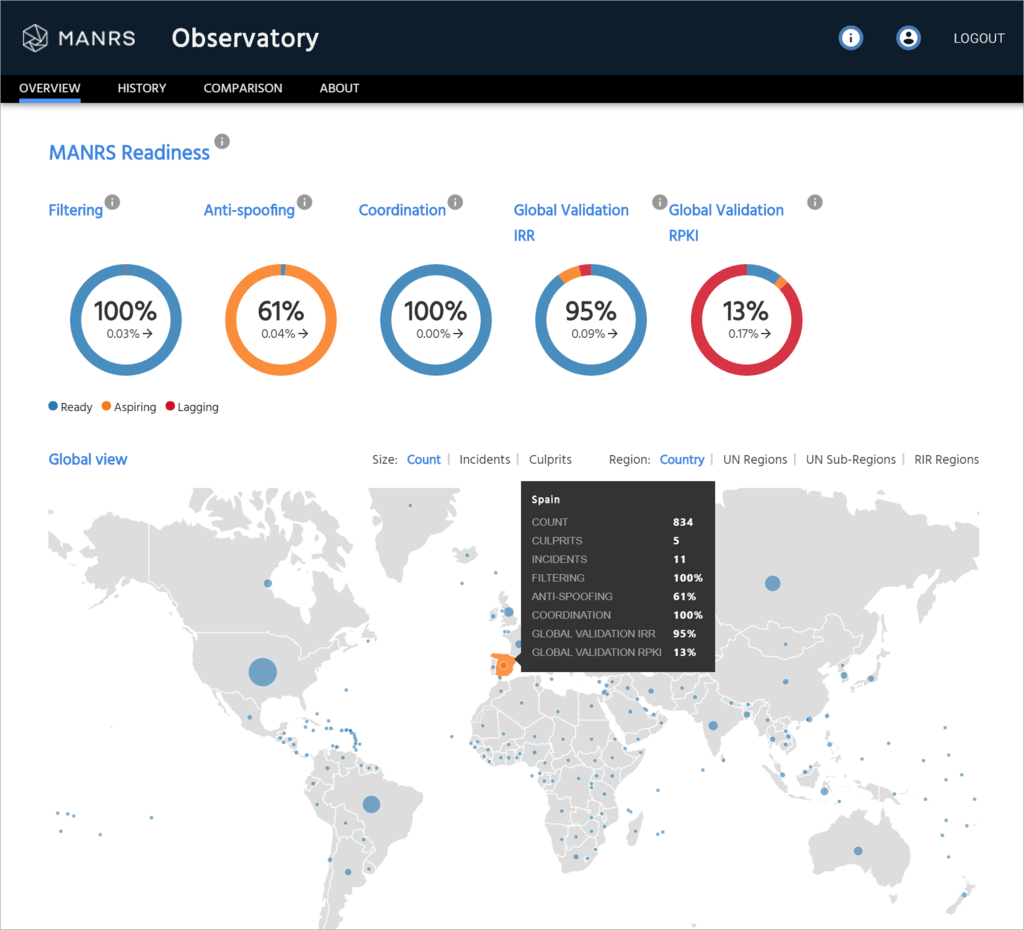
Routing security is vital to the future and stability of the Internet, but it’s under constant threat. Which is why we’ve launched a free online tool so that network operators can see how they’re doing, and what they can improve, while anyone can see the health of the Internet at a glance. The MANRS Observatory measures networks’ adherence to MANRS – their “MANRS readiness” – a key indicator of the state of routing security and resiliency of the Internet.
Here’s what the MANRS Observatory is in a nutshell:
Performance Barometer: MANRS participants can easily monitor how well they adhere to the requirements of this initiative and make any necessary adjustments to their security controls.
Business Development: Participants can see how they and their peers are performing. They can leverage the MANRS Observatory to determine whether potential partners’ security practices are up to par.
Government: Policymakers can better understand the state of routing security and resilience and help improve it by calling for MANRS best practices.
Social Responsibility: MANRS implementation is simple, voluntary, and non-disruptive. The Observatory can help participants ensure they and their peers are keeping their networks secure, which helps improve routing security of the Internet as a whole.
Today we’re excited to announce Cloudflare Magic Transit. Magic Transit provides secure, performant, and reliable IP connectivity to the Internet. Out-of-the-box, Magic Transit deployed in front of your on-premise network protects it from DDoS attack and enables provisioning of a full suite of virtual network functions, including advanced packet filtering, load balancing, and traffic management tools.
Magic Transit is built on the standards and networking primitives you are familiar with, but delivered from Cloudflare’s global edge network as a service. Traffic is ingested by the Cloudflare Network with anycast and BGP, announcing your company’s IP address space and extending your network presence globally. Today, our anycast edge network spans 193 cities in more than 90 countries around the world.
Once packets hit our network, traffic is inspected for attacks, filtered, steered, accelerated, and sent onward to the origin. Magic Transit will connect back to your origin infrastructure over Generic Routing Encapsulation (GRE) tunnels, private network interconnects (PNI), or other forms of peering.
Enterprises are often forced to pick between performance and security when deploying IP network services. Magic Transit is designed from the ground up to minimize these trade-offs: performance and security are better together. Magic Transit deploys IP security Continue reading
After a long wait, now we know. All three of the initial exascale-class supercomputer systems being funded by the US Department of Energy through its CORAL-2 procurement are going to be built by Cray, with that venerable maker of supercomputers being the prime contractor on two of them. …
Today we announced Cloudflare Magic Transit, which makes Cloudflare’s network available to any IP traffic on the Internet. Up until now, Cloudflare has primarily operated proxy services: our servers terminate HTTP, TCP, and UDP sessions with Internet users and pass that data through new sessions they create with origin servers. With Magic Transit, we are now also operating at the IP layer: in addition to terminating sessions, our servers are applying a suite of network functions (DoS mitigation, firewalling, routing, and so on) on a packet-by-packet basis.
Over the past nine years, we’ve built a robust, scalable global network that currently spans 193 cities in over 90 countries and is ever growing. All Cloudflare customers benefit from this scale thanks to two important techniques. The first is anycast networking. Cloudflare was an early adopter of anycast, using this routing technique to distribute Internet traffic across our data centers. It means that any data center can handle any customer’s traffic, and we can spin up new data centers without needing to acquire and provision new IP addresses. The second technique is homogeneous server architecture. Every server in each of our edge data centers is capable of running every task. We Continue reading
Improved network security is a top business driver of SD-WAN adoption, as a previous blog in this series revealed. However, SD-WAN isn’t necessarily an off-the-shelf panacea for all your network security challenges. While the typical SD-WAN products include some native security capabilities, an enterprise must take an approach that combines native SD-WAN security with integrated, on-premises, and cloud-based security solutions.Some early adopters of SD-WAN have failed to take this comprehensive approach. For instance, EMA’s WAN Transformation research found that enterprises that have completed a production deployment of an SD-WAN solution are 1.3 times more likely than the average enterprise to have experienced a security breach in a remote site over the last year. EMA suspects that these particular enterprises have been oversold on the native security capabilities of their chosen vendors.To read this article in full, please click here
Not everything is broken this week although some things definitely are looking grim. We consider how really dead data centers are according to Gartner, Cisco gobbles some more AI for Webex while HPE gets more AI-ish for Bluedata. GTT Communications is in trouble while ATT Bribery case highlights that big companies are dumb. Snark and virtual donuts all round this week.
The concept of instant recovery is relatively simple – the ability to run a virtual machine directly from a backup of that VM – but the possibilities offered by such a simple concept are virtually limitless, which explains why it’s considered one of the most important advances in backup and recovery for many years.Before the advent of instant recovery all restores were basically the same, starting with how backups were stored – in some type of container or image. Prior to commercial backup-and-recovery software, backups were stored in formats such as tar, cpio, or dump.
More about backup and recovery:To read this article in full, please click here
Under two unrelated US Department of Defense procurements, Cray has been awarded a total of $71 million to supply the Air Force and Army with a trio of HPC systems. …
Accelerators of many kinds, but particularly those with GPUs and FPGAs, can be pretty hefty compute engines that meet or exceed the power, thermal, and spatial envelopes of modern processors. …
Secure software-defined WAN (SD-WAN) has become one of the hottest new technologies, with some reports claiming that 85% of companies are actively considering SD-WAN to improve cloud-based application performance, replace expensive and inflexible fixed WAN connections, and increase security.But now the industry is shifting to software-defined branch (SD-Branch), which is broader than SD-WAN but introduced several new things for organizations to consider, including better security for new digital technologies. To understand what's required in this new solution set, I recently sat down with John Maddison, Fortinet’s executive vice president of products and solutions.To read this article in full, please click here
Secure software-defined WAN (SD-WAN) has become one of the hottest new technologies, with some reports claiming that 85% of companies are actively considering SD-WAN to improve cloud-based application performance, replace expensive and inflexible fixed WAN connections, and increase security.But now the industry is shifting to software-defined branch (SD-Branch), which is broader than SD-WAN but introduced several new things for organizations to consider, including better security for new digital technologies. To understand what's required in this new solution set, I recently sat down with John Maddison, Fortinet’s executive vice president of products and solutions.To read this article in full, please click here
Xilinx has launched a new FPGA card, the Alveo U50, that it claims can match the performance of a GPU in areas of artificial intelligence (AI) and machine learning.The company claims the card is the industry’s first low-profile adaptable accelerator with PCIe Gen 4 support, which offers double the throughput over PCIe Gen3. It was finalized in 2017, but cards and motherboards to support it have been slow to come to market.The Alveo U50 provides customers with a programmable low-profile and low-power accelerator platform built for scale-out architectures and domain-specific acceleration of any server deployment, on premises, in the cloud, and at the edge.To read this article in full, please click here
Xilinx has launched a new FPGA card, the Alveo U50, that it claims can match the performance of a GPU in areas of artificial intelligence (AI) and machine learning.The company claims the card is the industry’s first low-profile adaptable accelerator with PCIe Gen 4 support, which offers double the throughput over PCIe Gen3. It was finalized in 2017, but cards and motherboards to support it have been slow to come to market.The Alveo U50 provides customers with a programmable low-profile and low-power accelerator platform built for scale-out architectures and domain-specific acceleration of any server deployment, on premises, in the cloud, and at the edge.To read this article in full, please click here