Matt Oswalt – Portfolio
Short Bio Matt Oswalt hails from Portland, OR, and focuses on the intersection of network infrastructure, automation, systems, and software engineering. He’s passionate about enabling engineers to evolve their careers to the next level, and sharing the bright spots that exist within the technology industry with the masses. You can often find him speaking at conferences or meetups about these topics, as well as writing about them on his blog (https://keepingitclassless.LF Edge Sharpens Its Focus With Baetyl, Fledge
China's Baidu donated the Baetyl seed code, while Dianomic contributed Fledge.
© SDxCentral, LLC. Use of this feed is limited to personal, non-commercial use and is governed by SDxCentral's Terms of Use (https://www.sdxcentral.com/legal/terms-of-service/). Publishing this feed for public or commercial use and/or misrepresentation by a third party is prohibited.
EVPN-PIM: Anycast VTEPs
This is the second of the two part EVPN-PIM blog series exploring the feature and network deployment choices. If you missed part one, learn about BUM optimization using PIM-SM here.
Anycast VTEPs
Servers in a data-center Clos are typically dual connected to a pair of Top-of-Rack switches for redundancy purposes. These TOR switches are setup as a MLAG (Multichassis Link Aggregation) pair i.e. the server sees them as a single switch with two or more bonded links. Really there are two distinct switches with an ISL/peerlink between them syncing databases and pretending to be one.

The MLAG switches (L11, L12 in the sample setup) use a single VTEP IP address i.e. appear as an anycast-VTEP or virtual-VTEP.
Additional procedures involved in EVPN-PIM with anycast VTEPs are discussed in this blog.
EVPN-PIM in a MLAG setup vs. PIM-MLAG
Friend: “So you are working on PIM-MLAG?”
Me: “No, I am implementing EVPN-PIM in a MLAG setup”
Friend: “Yup, same difference”
Me: “No, it is not!”
Friend: “OK, OK, so you are implementing PIM-EVPN with MLAG?”
Me: “Yes!”
Friend: “i.e. PIM-MLAG?”
Me: “Well, now that you put it like that….……..NO, I AM NOT!! Continue reading
Oracle Slashes Data Cloud Workforce
Oracle reportedly cut 10% to 15% of its Data Cloud business unit this week amid its ongoing...
© SDxCentral, LLC. Use of this feed is limited to personal, non-commercial use and is governed by SDxCentral's Terms of Use (https://www.sdxcentral.com/legal/terms-of-service/). Publishing this feed for public or commercial use and/or misrepresentation by a third party is prohibited.
Why Every Size IT Team Should Strive to Implement a Software-Defined Data Center (SDDC)
Part One of a Five-Part Series on Software-Defined Data Centers in a Multi-Cloud World Business of all shapes and sizes...Alibaba Unsheaths AI Chip, Goes Head-to-Head With AWS, Google
Alibaba said it developed a new chip for AI inference that speeds up machine learning tasks on its...
© SDxCentral, LLC. Use of this feed is limited to personal, non-commercial use and is governed by SDxCentral's Terms of Use (https://www.sdxcentral.com/legal/terms-of-service/). Publishing this feed for public or commercial use and/or misrepresentation by a third party is prohibited.
CloudGenix SD-WAN Arrives On Hypercore Networks
In a win for CloudGenix, Hypercore Networks today announced a partnership with the SD-WAN vendor to...
© SDxCentral, LLC. Use of this feed is limited to personal, non-commercial use and is governed by SDxCentral's Terms of Use (https://www.sdxcentral.com/legal/terms-of-service/). Publishing this feed for public or commercial use and/or misrepresentation by a third party is prohibited.
Follow the Yellowbrick Data Road to Cloud Warehousing and DR
With the addition of its cloud offerings, Yellowbrick offers enterprise customers a platform to run...
© SDxCentral, LLC. Use of this feed is limited to personal, non-commercial use and is governed by SDxCentral's Terms of Use (https://www.sdxcentral.com/legal/terms-of-service/). Publishing this feed for public or commercial use and/or misrepresentation by a third party is prohibited.
Qualcomm Waxes 5G Vision, Downplays Early Challenges
Qualcomm showcased its long history of innovation in wireless technology and contends that it’s...
© SDxCentral, LLC. Use of this feed is limited to personal, non-commercial use and is governed by SDxCentral's Terms of Use (https://www.sdxcentral.com/legal/terms-of-service/). Publishing this feed for public or commercial use and/or misrepresentation by a third party is prohibited.
Network Outages and Idiots With Guns

As told to me:
The post Network Outages and Idiots With Guns appeared first on EtherealMind.
Designing Your First Application in Kubernetes, Part 3: Communicating via Services

I reviewed the basic setup for building applications in Kubernetes in part 1 of this blog series, and discussed processes as pods and controllers in part 2. In this post, I’ll explain how to configure networking services in Kubernetes to allow pods to communicate reliably with each other.
Setting up Communication via Services
At this point, we’ve deployed our workloads as pods managed by controllers, but there’s no reliable, practical way for pods to communicate with each other, nor is there any way for us to visit any network-facing pod from outside the cluster. Kubernetes networking model says that any pod can reach any other pod at the target pod’s IP by default, but discovering those IPs and maintaining that list while pods are potentially being rescheduled — resulting in them getting an entirely new IP — by hand would be a lot of tedious, fragile work.
Instead, we need to think about Kubernetes services when we’re ready to start building the networking part of our application. Kubernetes services provide reliable, simple networking endpoints for routing traffic to pods via the fixed metadata defined in the controller that created them, rather than via unreliable pod IPs. For simple applications, Continue reading
Quantum Annealing Advances Woven Into Next-Gen D-Wave System
D-Wave Systems is getting ready to roll out its next quantum annealing computer, a system that will encompass more than 5,000 low-noise qubits, as well as a new topology to connect them. …
Quantum Annealing Advances Woven Into Next-Gen D-Wave System was written by Michael Feldman at The Next Platform.
HPC Eases Its Way Into The Cloud
The ongoing journey to bring more enterprise high-performance computing (HPC) workloads into the cloud has been a bumpy one with its share of roadblocks and setbacks. …
HPC Eases Its Way Into The Cloud was written by Jeffrey Burt at The Next Platform.
AMD Rome Epyc Processor Shatters Numeric Benchmarks
Good news is continuing to gather around AMD’s second-generation “Rome” Epyc processors. …
AMD Rome Epyc Processor Shatters Numeric Benchmarks was written by Michael Feldman at The Next Platform.
Network Neighborhood: Corporate Communications And The IT Community With Dana Iskoldski
On today's Network Neighborhood we talk with Dana Iskoldski, Corporate Communications Manager at BlueCat Networks. We discuss the role of corporate comms in tech, how the position straddles marketing and community engagement, and how Dana grapples with the natural skepticism of engineers.
The post Network Neighborhood: Corporate Communications And The IT Community With Dana Iskoldski appeared first on Packet Pushers.


Host, Docker, Swarm and Kubernetes monitoring
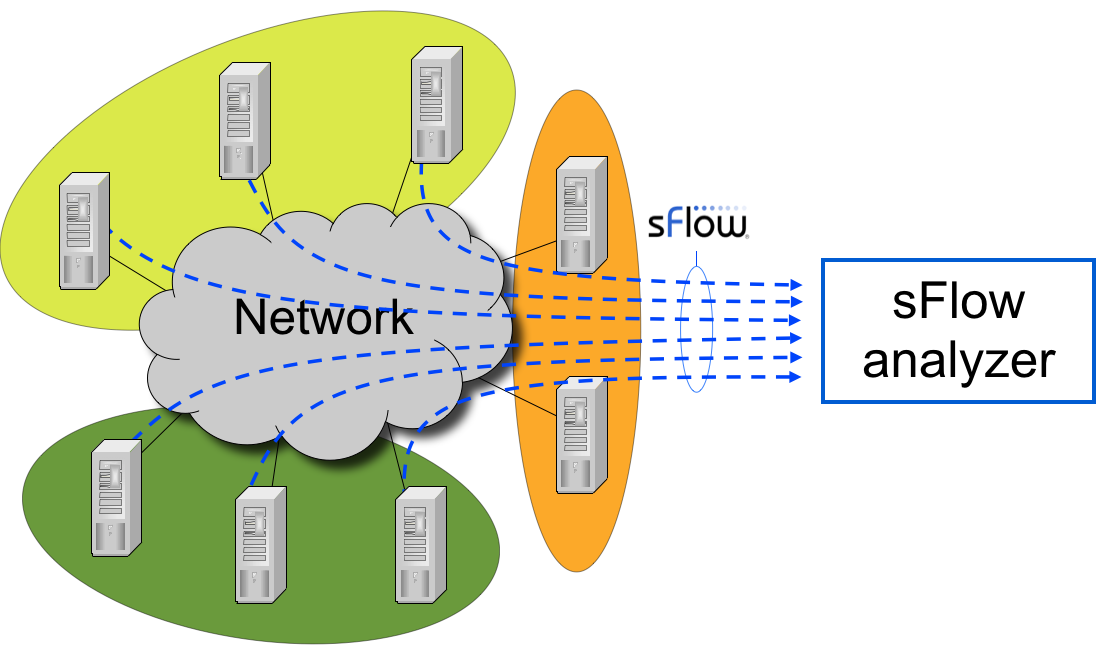
The Host sFlow agent is available as pre-packaged rpm/deb files that can be downloaded and installed on each node in a cluster.
sflow {
  collector { ip=10.0.0.70 }
  docker { }
  pcap { dev=docker0 }
  pcap { dev=docker_gwbridge }
}
The above /etc/hsflowd.conf file, see Configuring Host sFlow for Linux via /etc/hsflowd.conf, enables the docker {} and pcap {} modules for detailed visibility into container metrics and network traffic flows, and streams telemetry to an sFlow collector (10.0.0.70). The configuration is the same for every node making it simple to install and configure Host sFlow on all nodes using orchestration software such as Puppet, Chef, Ansible, etc.The agent is also available as the pre-build sflow/host-sflow image, Continue reading
Empowering More Gretas: Introducing the 2019 IGF Youth Ambassadors

When 16-year-old Swedish environmental activist Greta Thunberg burst onto the global scene a few months ago, people underestimated the power this young girl would have to raise awareness and rally the world around climate change. Today, she has become a fearless advocate, boldly speaking out and holding politicians to account for their lack of action on the climate crisis. We need more Gretas.
And they’re out there.
We’re proud to introduce 30 young changemakers who make up the 2019 cohort of the Internet Society’s IGF Youth Ambassadors Program. The group is made up of 15 women and 15 men from 21 countries. This cadre of young leaders are working on many of the pressing issues affecting the Internet globally.
In November, they’ll bring their drive for change to Berlin, Germany, to take part in the Internet Governance Forum (IGF). This is an annual multistakeholder forum for inclusive policy dialogue on shared principles, procedures, and programs that shape the evolution and use of the Internet. Although not an official decision-making body, the IGF remains an important forum. Many of the world’s experts in and advocates for the Internet gather there for discussion, networking, research sharing, and best practices from around the Continue reading