Certificate Transparency Monitoring is now generally available
Since we launched Certificate Transparency Monitoring in public beta in 2019, we've been emailing subscribers whenever a new TLS certificate appears in a public Certificate Transparency (CT) log for one of their domains. Today, it's turned on for more than 650,000 customer domains. It's an early warning that someone, somewhere, has issued a certificate for a hostname in your zone, giving you a chance to spot a mis-issued certificate early.
It's a useful signal, but it had a noise problem, and we felt it ourselves. Cloudflare issues a large volume of certificates on your behalf: Universal SSL renewals, certificates from Advanced Certificate Manager, and backup certificates. All of them are logged to public CT logs by design, because a certificate that isn't logged won't be trusted by major browsers like Google Chrome and Apple's Safari. So the same transparency that lets you monitor for mis-issuance also surfaces every certificate we issue for you.
And issuance isn't a one-time event. Certificates are short-lived and renew automatically: a single Universal SSL certificate can renew as often as every 60 days, up to about six times a year. That cadence is set to increase, with the CA/Browser Forum having voted to cut Continue reading
MTU Path Test — Find Where a Path Silently Fragments, Hop by Hop
MTU problems are some of the most annoying things to troubleshoot in networking, because they’re usually silent. Small packets sail through fine, everything looks healthy, and then someone complains that a specific app is slow or hanging — and it turns out one link in the path, three hops in, has an MTU 8 bytes smaller than everyone assumed. GRE, IPsec, PPPoE, a VPN overlay, a jumbo-frame config that only got applied to half the path, a VLAN tag quietly adding 4 bytes nobody accounted for, or just two vendors defining and displaying “MTU” differently (L2 vs. L3, tagged vs. untagged) — any of these can quietly clip your effective MTU, and standard ping/traceroute won’t tell you where.
Worth Reading: LLM Prompts for Network Engineers
Tony Mattke put together a long list of recommendations that might help you get more out of your LLM tokens.
Definitely worth reading instead of yelling at the stupid AI.
Powering the AI Revolution: Efficient Strategies for High-Density Data Center Environments
Artificial intelligence (AI) is here. From machine learning to new capabilities like generative AI (GenAI) powered by deep learning neural networks,D2DO310: Developing Efficient AI Workflows
Tyler Lynch, Outbound CTO at IBM, joins the show to discuss shifting from “tokenmaxxing” to “valuemaxxing” by optimizing AI agent workflows for efficiency. They explore using Obsidian for persistent agent memory to combat context bloat, the critical importance of secure sandboxing practices, and the strategic use of parallel verification to ensure your agents are performing... Read more »Compress netlab Lab Topologies with Dot Notation
netlab is using the Python Box library to make the code easier to read1. When I started the project, I hated the way you fetch values from Python dictionaries with stuff like node['ospf']['area']; Python Box lets you write node.ospf.area. Even better2, you can tell Python Box to create intermediate dictionaries as needed. node.ospf.area = 1 will automatically create the node.ospf dictionary.
But wait, there’s more (yes, we’re getting to the topic of today’s blog post): Box lets you use the same dotted notation in YAML files.
Who’s Watching The Machines? An Effective Strategy for Managing Machine Identities
Take control of your non-human identities today with a comprehensive machine identity security solution that protects your organization's assetsHW085: Designing Wi-Fi for High-Density Events
Keith is joined by Ferney Muñoz and Tom Hildebrand to break down the complexities of designing high-density Wi-Fi for large-scale events. They dig into the strategic use of directional antennas, channel reuse techniques, and the necessity of on-site verification to ensure network reliability. They also share practical tips on device roaming, troubleshooting, and cross-team collaboration.... Read more »PP121: How CYBR.SEC.CON Builds Community for Learning and Professional Development
Today we’re doing a crossover episode with the folks at Cybr.Sec.Media to talk about CYBR.SEC.CON, a community-driven security conference that JJ and Drew will be attending in Houston, TX September 15 and 16 2026. We talk with conference founders Michael Farnum and Sam Van Ryder about the origins of the event, and get into our... Read more »Cloudflare DDoS Threat Report H1 2026: 1 Tbps attacks soar as DNS floods and geopolitical tensions drive a new wave
Welcome to the 25th edition of Cloudflare's DDoS Threat Report. This is the first half-year edition in the series: rather than publishing separate reports for the first and second quarters of 2026, we have combined our coverage of Q1 and Q2 into a single volume covering January through June 2026. The analysis is produced by Cloudforce One, Cloudflare’s Threat Intelligence organization, providing a comprehensive analysis of the evolving threat landscape of Distributed Denial of Service (DDoS) attacks based on data from the Cloudflare network.
Key insights
- The 1 Tbps club grew. Cloudflare mitigated a combined 935 network-layer DDoS attacks exceeding 1 Tbps in the first half of 2026 and a +519% quarter-over-quarter surge between Q1 and Q2.
- The attack-vector center of gravity shifted from botnet floods to reflection and amplification. DNS-based attacks accounted for 34.3% of all network-layer activity in the first half of 2026, with DNS Floods alone climbing from 25.7% to 40.0% of network-layer attacks quarter-over-quarter. CLDAP Floods surged +580% quarter-over-quarter to become the #3 vector in Q2.
- Geopolitics and global events influence the landscape. Media, Production & Publishing held the #1 most-attacked industry crown in both quarters at 14.2% of all Continue reading
SONiC Deep Dive: Interface State Change Pipeline
Enable Interface Ethernet0
After creating VLAN 10, the next step is to enable interface Ethernet0. The baseline configuration for Ethernet0 already exists in the PORT table of CONFIG_DB. This configuration is populated during the SONiC switch startup process using the platform configuration and configuration files, including config_db.json. When the switch boots, the configuration from config_db.json is loaded into CONFIG_DB, which is implemented as a Redis database.
GONFIG_DB and APPL_DB
The SONiC command config interface startup Ethernet0
does not create the complete PORT|Ethernet0 entry to the CONFIG_DB. Instead, it
changes the administrative state of the existing port configuration. In this
example, the admin_status field of PORT|Ethernet0 is changed to up (1).
After admin_status is changed, Redis generates a notification for applications subscribed to the PORT table in CONFIG_DB (2). The Redis notification indicates that the configuration entry has changed. It identifies the affected key and the operation that occurred rather than containing the complete PORT|Ethernet0 configuration. portmgrd, running in the SWSS container, is one of the SONiC components involved in processing port configuration. portmgrd uses the notification to identify the changed key and retrieves the current field/value data from CONFIG_DB. It then processes the configuration and prepares Continue reading
On ACLs and AI-Generated Device Configurations
Last Friday, I had a lovely chat with Steinn Bjarnarson and Urs Baumann, resulting in the NetworkAutoMagic episode 11. We couldn’t avoid mentioning netlab, the seven layers of ACL hell (which is still balmy compared to the QoS hell), and the gotchas of AI-generated device configurations.
Fortunately, I don’t have to go into more details; Steinn published extensive notes, and if you don’t feel like listening to us while driving, you can waste time watching us on YouTube.
You’ve Been Running a Kubernetes Security Model in NSX and Didn’t Even Know It
One of the blockers to moving VMs off vSphere and onto Kubernetes is losing NSX and the protection it provides. Security teams that have spent years building out distributed firewall policy look at Kubernetes and are, quite understandably, alarmed by the flat network and the fact that any workload can reach any other by default.
How will they enforce east-west traffic controls? Will they be able to replicate NSX distributed firewall rules with the same granularity? What about security groups, tiered policy, and rules that travel with the workload when it moves? These are important questions that must be answered before migration can begin.
Migrate vSphere to Kubernetes with microsegmentation intact
Calico addresses vSphere to Kubernetes security concerns with a network policy model that maps directly to key features of the NSX distributed firewall (NSX DFW). Every property NSX DFW users rely on has a direct Calico equivalent: tiered governance, workload-identity enforcement, distributed kernel-level inspection, and dynamic workload grouping. Teams coming from vSphere will recognise the pattern quickly.
Let’s walk through each one in detail.
Distributed Enforcement
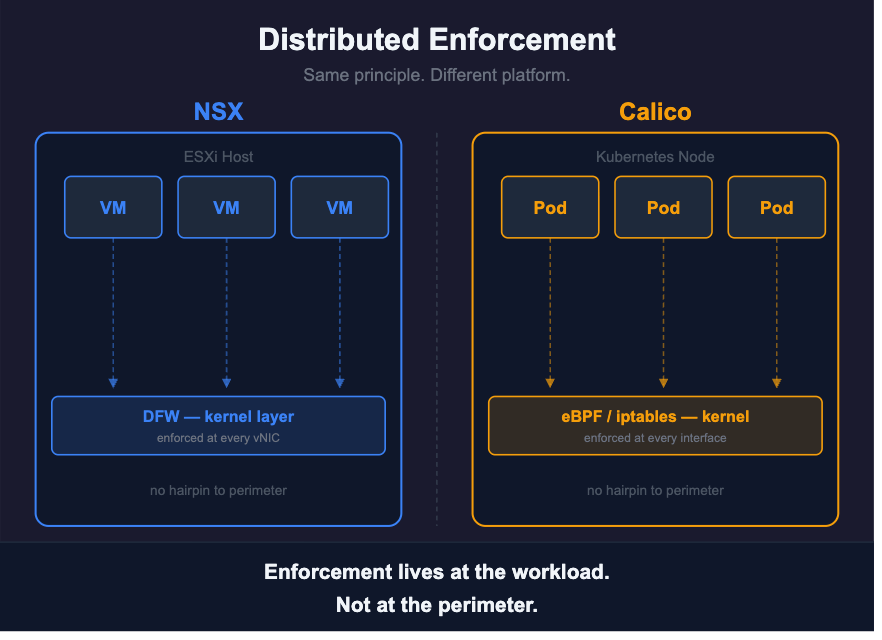
Traditional firewalls sit at the edge of the network. Traffic between workloads inside Continue reading
Everything we launched during Agents Week
At the beginning of Agents Week, Rita shared that agents represent the next evolution of computing: not only as a new application of AI but also as a new class of software that’s shaping how people interact with technology, and how software interacts with the Internet. Over the last year or so, we set out to explore what this shift means for developers and customers building AI-native apps and the infrastructure needed to support them. As agents become more capable and autonomous, the challenges extend beyond the models themselves — to identity, communication, orchestration, memory, observability, and security.
Over the past week we’ve shared how we’re bringing those pieces together across the Cloudflare platform to serve an Agentic Internet. Each day we presented new tools, products, and ideas toward building for an Internet where humans and agents cooperate instead of collide.
Monday, August 3
Monday focused on the foundations for building and running intelligent, autonomous apps — the runtime and infrastructure agents rely on.
Tuesday, August 4
Tuesday introduced the Agent Development Lifecycle (ADLC) and the primitives that take agentic software from prototype to production.
Wednesday, August 5
Wednesday extended Zero Trust from users and devices to agents themselves — Continue reading