N4N061: Your First Wi-Fi Network Part 2
This week, Ethan and Holly continue their conversation around Wi-Fi. They go deeper into the benefits of Wi-Fi 7, look at what’s coming in Wi-Fi 8, and cover the differences among Multiple Input Multiple Output (MIMO), Orthogonal Frequency-Division Multiple Access (OFDMA), and Multi-Link Operation (MLO). AdSpot Sponsor: Megaport If you’re supporting cloud projects, managing growing... Read more »Cloudflare AI Search: give your agents a search engine for your data
Today, we’re excited to announce a few developer experience improvements to Cloudflare AI Search to make it easy to manage a search solution out of the box. Previously, you had to stitch together components of the Cloudflare primitives (Workers AI, AI Gateway, Vectorize, R2, Browser Run) but now, AI Search can do this automatically — and better. Our goal is to give your agents their own search engine, where they can easily find data to provide better answers for themselves and their humans.
We’re also sharing an early preview of pricing for customers of AI Search so you can learn how this scales. We modeled pricing in a way that makes it predictable and scalable: embedding and reranking are free when you use the default models, so no need to worry about predicting token count.
In AI Search, users can now:
- Index a collection of data for your agent: Make structured and unstructured data easily accessible for your agent to build with, from individual files to websites you own. (Today, it must be a zone on your Cloudflare account, but with more ways to verify ownership coming soon.)
- Skip the sitemap for your websites: Previously, AI Search required Continue reading
From ranking to recommended: get your site ready to thrive in the age of AI agents
Your next customer may not find you through a search engine. Instead, they'll ask an AI assistant: "how do I do X?"; "which option is best for someone like me?"; "just handle it for me" and an agent will find the answer, weigh the options, and act on their behalf. Increasingly, the moment that determines whether a customer chooses you happens inside a model's response — before a human ever sees your homepage.
This agentic audience is already here: by our count, fewer than half of all HTML page requests now come from a human. Not all of those machines are agents acting for a person, but that share is growing fast, and answer engines, shopping assistants, and research tools will shape which businesses are found and recommended. Discoverability used to mean ranking on a results page. Now it means being found, read, and confidently recommended by the agents that guide your customers.
The old metrics, human clicks and page views, no longer paint the full picture. We spent time talking to site owners who were staring at access logs full of AI bots, completely blind to whether those bots were capable of using their site or recommending Continue reading
Building an open Agentic Internet: readable, discoverable, callable, and payable
Our data shows that a lot of traffic from well-behaved bots is re-fetching pages that have not changed. Billions of requests. An enormous amount of machine effort, attached to no outcome at all. That's the signature of a web built for humans being visited by something else.
Agents are here - not as a new kind of software, but as a new kind of visitor to the web.
The web reshaped around this new visitor is what we call the Agentic Internet. We see its future as readable, discoverable, callable, and payable. To realize that future, it needs its own tools and protocols.
Cloudflare's developer platform gave agents a place to run, and the first tools to build them. What's missing are the ones that let agents and domain owners cooperate instead of collide — on the open Internet, not just inside a single platform.
Every browser has always identified itself to the web with a header called User-Agent. The name only made sense once you realized the browser was acting on your behalf. Now a user agent is truly a user's agent: a program that fetches the web on a person's behalf. Today its most mature form is the Continue reading
Introducing Kitesurf: The agent-first browser that runs in V8 isolates on Cloudflare Workers
Should we build our own browser? This is one of those questions that has come up every few months internally at Cloudflare for years. Unsurprisingly, it’s the kind that triggers long threads with multiple reasons and persuasive arguments on why we should do it. The browser is obviously the most important software we use every day on our computers; it’s arguably the operating system of the Internet. We’re a company on a mission to build a better Internet — who wouldn’t want to take on the challenge of building a new browser?
But we never quite found the balance between the technical difficulty of such an endeavour and the unique problems we’d be solving by doing it. And so, the idea was shelved, over and over again. Until now.
Something magical happened: we reached a tipping point where a series of powerful technical advancements in our Developer Platform became a reality, while the advent of AI agents and the demand for a new kind of browser became critical at the same time.
Running WebAssembly (Wasm) in Workers is now very mature. Primitives like dynamic workers, SQLite-based Durable Objects, Worker-to-worker RPC, service bindings, higher NodeJS compatibility and Continue reading
The next generation of MCP
Over the last year and a half, the Model Context Protocol (MCP) has become the universal standard for how agents interact with external services.
But one of the main criticisms of MCP was that the protocol required a stateful connection between Client and Server. This evolved from MCP’s origins and the first STDIO transport, designed for local applications. When MCP Servers went remote, it translated the stateful connection that worked so well locally and transposed it onto web infrastructure. Building a well-behaved MCP Server meant managing request routing to sticky sessions, holding open streams, message replay, and generally more overhead and complexity than a traditional web server. This changes now.
The latest MCP 2026-07-28 specification was released last week, together with updated TypeScript, Python, Go, and C# SDKs. MCP is now a fully stateless protocol. The specification, interaction model and SDKs have all been rewritten to leverage this new protocol and simplify usage. This means that MCP servers can now run in just a Worker, no stateful infrastructure needed, and customers benefit from the operational simplicity and reduced cost of less moving parts.
A new MCP
At Cloudflare, our journey with MCP goes back to the very beginning. Continue reading
Give any website a WebMCP interface
Today we are launching a developer preview of WebMCP on Cloudflare. Switch it on and browser agents can start working with your site, with no code and nothing changed at your origin. Cloudflare adds a small bridge to your pages, which registers a set of tools for a visitor’s agent to use.
The web was built on the assumption that there is a person on the other end: someone to read the page, click buttons, and fill in the forms. But now more and more visits come from AI agents instead, to an Internet made for humans. The usual approach has been crawlers, which copy content back to a server and, too often, give the original site none of the traffic and little of the credit. There is a better way, and it does not involve scraping.
WebMCP is a new browser standard, shipping experimentally in Chrome 146, that shows up in the page as document.modelContext. A site can choose to expose a set of tools for agents running in the browser, meaning agents no longer have to guess their way through a page built for humans. This enables agents to have a different browsing experience from the user Continue reading
What’s New in NFA v26.03: Automated Threat Mitigation, Advanced Filtering, and Entra SSO
Network Anomaly and DDoS Detection with FlowSpec Mitigation
NFA now supports network threat and DDoS detection using multiple attack detection algorithms. Users can configure anomaly detection rules, review current anomaly feeds and historical activity, and exclude selected IP addresses through a whitelist. Detected threats can be addressed using FlowSpec mitigation actions for traffic dropping, rate limiting, and IPv4/IPv6 traffic redirection. NFA supports detection of the following anomaly types: DNS, NTP, SNMP, and memcached amplification attacks; SSH, UDP, TCP SYN, TCP ACK, and TCP ACK PUSH floods; HTTP/HTTPS, smurf, CLDAP, and SSDP flood attacks. Read the documentation →
Noction Flow Analyzer v26.03 introduces Network Anomaly and DDoS detection, automated FlowSpec mitigation options, Microsoft Entra single sign-on, and additional controls for sharing and analyzing network data. Continue reading
Assess your storage strategy for the AI era
Assess your readiness to scale AI and build a data-centric storage strategy that turns infrastructure into strategic advantage.Cloudflare is the only vendor named a Visionary in 2026 SASE and SSE reports
We're honored to announce that Cloudflare is the only vendor that has been recognized as a Visionary in both the 2026 Gartner® Magic Quadrant™ for SASE Platforms and the 2026 Gartner® Magic Quadrant™ for Security Service Edge reports. To us, this validates our architectural choices and, more importantly, reflects the trust our customers place in us to navigate an increasingly complex security landscape.
To every customer who shared feedback with Gartner, discussed your roadmap challenges with our team, and pushed us to build better solutions: thank you. This recognition belongs to you as much as it does to us.
The SASE (Secure Access Service Edge) and SSE (Security Service Edge) markets are at an inflection point. Many organizations started with the SSE as the “security half” of SASE to tackle their remote work challenges during the pandemic. More recently, SASE has grown more prominent given the rise in return-to-office work mandates. Now, as AI agents, post-quantum threats, and the sprawl of shadow apps reshape enterprise security, organizations need platforms that can adapt at the speed of change, not vendors locked into yesterday's architecture. That’s exactly where Cloudflare One, our agile SASE platform, comes in.
The market gap and where SASE Continue reading
VM Migration – What Happens to Your NSX Segments in Kubernetes?
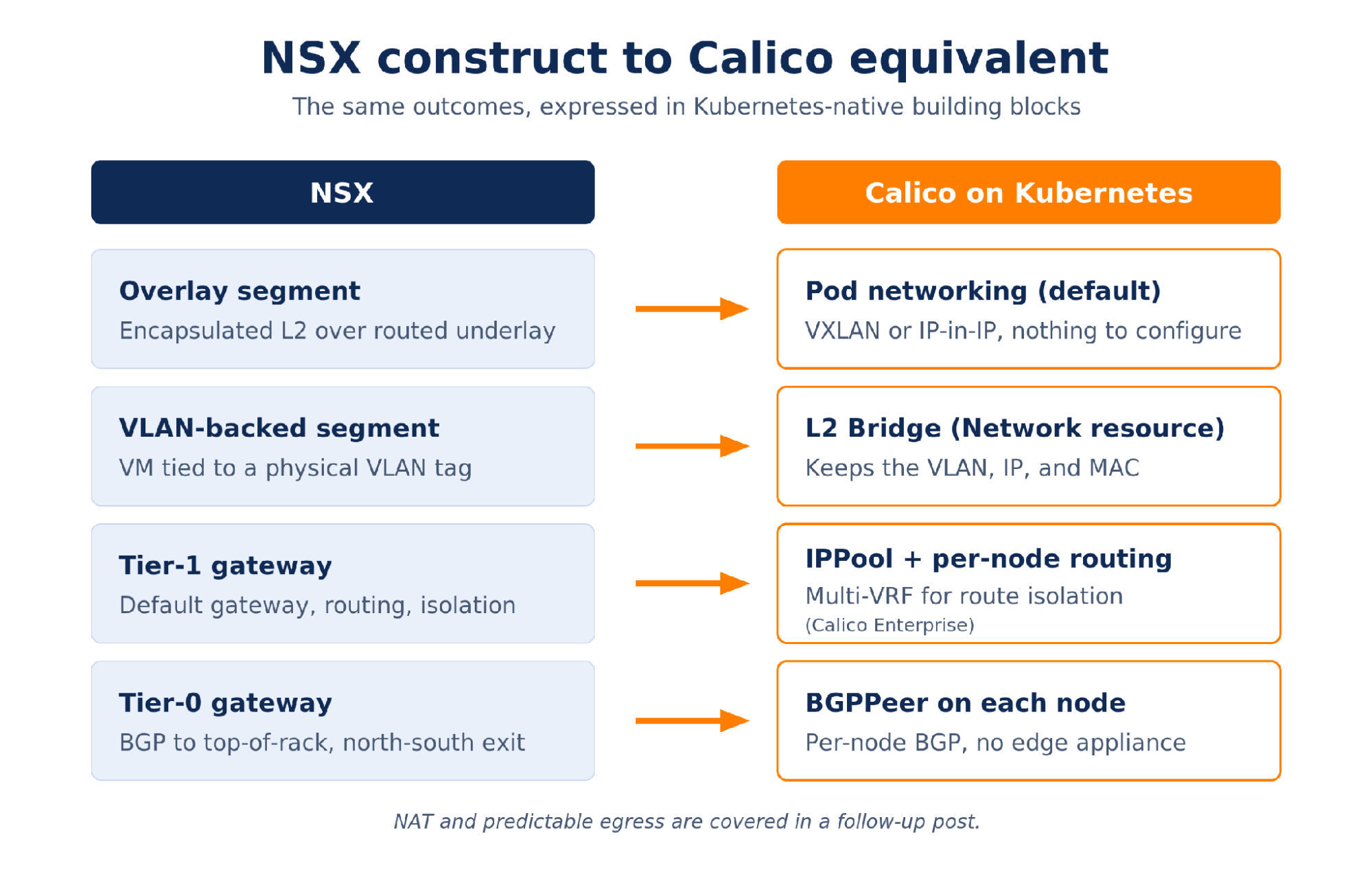
Planning a migration off NSX usually starts with a networking conversation. Segments, VLANs, routing topology and BGP peering are not things that map cleanly to Kubernetes-native constructs the way the NSX distributed firewall maps to Calico’s tiered microsegmentation. NSX virtualizes the network layer in ways that Kubernetes doesn’t replicate by default. There is no native concept of a Layer 2 segment or VLAN, for instance. Pods simply receive IP addresses on a flat, routed network, with no built-in way to give a workload L2 adjacency to external devices or attach it to a specific broadcast domain.
This is usually where teams start to worry. They can see exactly what NSX is doing for them, but they have no obvious Kubernetes equivalent to point at. The natural question becomes how they will run the networking they depend on once their VMs live in a cluster.
Achieving the same routing, isolation, and connectivity outcomes, however, is well within reach. It just requires a bit of a mental shift.
The rest of this blog will cover the details of what that mental shift entails.
How NSX handles segments
Before we Continue reading
TCG081: Network Automation Forum: From Simple Survey to Global Community
William Collins is joined by guest co-host Eric Chou as well as Network Automation Forum founders Scott Robohn and Chris Grundemann to discuss how their community emerged from a simple question: Why haven’t we seen full adoption of network automation, yet? They discuss the growth of AutoCon and how its practitioner-focused, vendor-neutral approach has fostered... Read more »NAN128: Beyond RAG: Making Network AI Truly Agentic
Eric Chou welcomes Juulia Santala, a Solutions Engineer at Cisco, to discuss her transition from traditional network programmability to cutting-edge AI research. They explore how she moved beyond simple RAG to make AI truly agentic, while solving some hallucination problems in production configurations. They also cover the number one skill network engineers need by 2027,... Read more »The Agent Access Model
For the last twelve years, enterprise security has moved away from trusting the network. BeyondCorp made the case that a request's origin, inside the corporate perimeter or on the open Internet, should not decide whether it is allowed. Identity and device health should. That model won: it now underpins much of Zero Trust.
Google’s BeyondCorp assumed a specific principal: a human at a device, acting at human speed. Organizations are now deploying agents, software principals that reason, act, and reach into systems on our behalf. A task-scoped agent run is ephemeral. It ends when its work is done. A long-lived agent service may handle many such tasks and move data far faster than a person.
The controls we built for humans do not fail loudly when we point them at agents. They fail quietly, by granting too much, seeing too little, and trusting for too long.
This paper proposes an access model for agents: the Agent Access Model (AAM). We describe the model and show how its components can be built. We then walk through a concrete example and separate the single-principal controls available today from the harder problem of multiplayer access control.
Much of the current work tries Continue reading
How we’re rethinking work at Cloudflare with Cloudflare OS
Sam Rhea is Cloudflare’s Chief Information Officer.
I knew we had a problem about six months ago when a member of our sales organization reached out to me asking for API keys. Keys plural. They used AI to build what they described as a SuperApp that would transform our go-to-market teams. All they needed was production access to about a dozen systems of record at Cloudflare and admin permissions to a deployment pipeline to make it work.
We had taken a fairly cautious approach to rolling out AI at Cloudflare during 2025. We deployed informational chat applications and tinkered with using AI to help write some boilerplate code, but we felt that the technology was not ready to change how we work.
And then, over the course of a few days at the end of last year, better models and more powerful harnesses changed that calculus. AI agents could do things, and they could do them well. Hundreds of team members across Cloudflare, in technical and non-technical roles, spent the quieter weeks around the New Year experimenting with new tools that made it easier than ever to build.
That sales team member building their SuperApp was just the first in Continue reading
Cloudflare OS: an open platform for agents, apps, and work
Every organization has a mission, a reason for being. Organizations pass that mission — along with their terminology, procedures, systems, standards, and ways of working — to their people. People, in turn, take this context together with their own experience and work towards the mission.
Work can take many forms, from code, to documents and slides, to relationships, to outcomes in the physical world.
Some of these are straightforward: code either runs or it doesn’t. Agents have been using this feedback loop to produce code that “works” for developers over the last couple of years. But what about the rest of us?
Bringing the same leverage to the rest of the organization is a harder problem. Agents need to understand the context of the company and be able to reach the systems people use to do their jobs. They need to turn that context and access into work that moves the organization towards its mission.
That’s why we created Cloudflare OS. It gives every person an agent and workspace built around their company: how it works, what it knows, and the systems it relies on.
In May of this year, we gave every person at Cloudflare access to the first Continue reading
WriteGuard: fine-grained controls for MCP Servers
Let’s imagine the Case of the Endlessly Closing Tickets.
The bug tickets start closing at noon. Nobody thinks much of it. Joe moved a few tickets to Done, and Joe is having a productive afternoon. Then the pace picks up. By 4 p.m., thousands of tickets have been closed, all by Joe.
Joe is a good engineer. Joe is not a thousand-tickets-an-hour engineer.
We learn that he has several background agents running across three concurrent sessions. It takes half an hour to find the one at fault: a cleanup task with a prompt that was a little too broad.
Once we’ve stopped the agent, we need to repair the state of the ticketing system. Joe has also been legitimately closing tickets by hand that afternoon. The system records all those changes under Joe regardless of whether it was him or his agent, and the network logs do not distinguish one agent session from another. From the outside, the actions look identical.
The example above is relatively low-stakes, but we can all imagine, or read about, much more destructive cases. An agent with access to contract software could amend an agreement. An agent wreaking havoc in a Continue reading