Noction releases IRP 3.9
The post Noction releases IRP 3.9 appeared first on Noction.
A Sample Makefile for Creating Blog Articles
In October of this year, I published a blog post talking about a sample Makefile for publishing blog articles. That post focused on the use of make and a Makefile for automating the process of a publishing a blog post. This post is a companion to that post, and focuses on the use of a Makefile for automating the creation of blog posts.
Since early 2015, this site has been running as a static site with the content created using Markdown. In its first iteration as a static site, the HTML was generated using Jekyll and hosted on GitHub Pages. In the current iteration, the HTML is generated using Hugo, hosted on Amazon S3, and served via Amazon CloudFront. In both cases, the use of Markdown as the content format also required specific front-matter to instruct the static site generator how to create the HTML. For Hugo, the front-matter looks something like this (I use YAML, but other formats are supported):
---
author: slowe
categories: Explanation
date: 2017-11-27T12:00:00Z
tags:
- Writing
- Blogging
- Productivity
title: Sample Blog Post title
url: /2017/11/27/sample-blog-post-title/
---
There are obviously a lot of different ways to automate the creation of this front-matter Continue reading
9 Significant Infrastructure Mergers of 2017
Tech M&A this year includes hyperconvergence and software-defined WAN deals.
It’s Bash Scripts All the Way Down (more on CLI versus API)
Netfortius made an interesting comment to my Ansible playbook as a bash script blog post:
Ivan - aren't we now moving the "CLI"[-like] approach, upstream (the one we are just trying to depart, via the more structured and robust approach of RESTAPI).
As I explained several times, I don’t know where the we must get rid of CLI ideas are coming from; the CLI is root of all evil mantra is just hype generated by startups selling alternative approaches (the best part: one of them was actually demonstrating their product using CLI).
Read more ...Rapid Spanning Tree Protocol and Configurations – RSTP
 |
| Fig 1.1- STP Topology |
 |
| Fig 1.2- STP and RSTP Port States |
Helping Resolvers to help the DNS
Here, I'd like to look at ways that recursive resolvers in the DNS can take some further steps that assist other parts of the DNS, notably the set of authoritative name servers, including root zone servers, to function more efficiently, and to mitigate some of the negative consequences if these authoritative name servers are exposed to damaging DOS attacks.Hiding the DNS
I’d like to look in a little more detail at the efforts to hide the DNS behind HTTPS, and put the work in the IETF's DOH Working Group into a broader perspective. There are a number of possible approaches here, and they can be classified according to the level of interaction between the DNS application and the underlying HTTPS encrypted session.DNS and DDOS
It took some hundreds of years, but Europe eventually reacted to the introduction of gunpowder and artillery by recognising that they simply could not build castles large enough to defend against any conceivable attack. So they stopped. I hope it does not take us the same amount of time to understand that building ever more massively fortified and over-provisioned DNS servers is simply a tactic for today, not a strategy for tomorrow.Mainstreaming HPC Codes Will Drive The Next GPU Wave
All the shiny and zippy hardware in the world is meaningless without software, and that software can only go mainstream if it is easy to use. It has taken Linux two decades to get enterprise features and polish, and Windows Server took as long, too. So did a raft of open source middleware applications for storing data and interfacing back-end databases and datastores with Web front ends.
Now, it is time for HPC and AI applications, and hopefully, it won’t take this long.
As readers of The Next Platform know full well, HPC applications are not new. In fact, they …
Mainstreaming HPC Codes Will Drive The Next GPU Wave was written by Timothy Prickett Morgan at The Next Platform.
VyOS 1.1.8 Released

More than one year after publishing a previous VyOS version, the new VyOS 1.1.8 is finally released. VyOS is an open source network operating system that can be installed on physical hardware or as a virtual machine. It is based on GNU/Linux and joins multiple applications such as Quagga, ISC DHCPD, OpenVPN, StrongS/WAN and others under a single management interface. VyOS is a cheap and effective solution for those who want to learn Junos like CLI.
Linux user can use my installation scripts for zero-touch VyOS deployment. Scripts download the newest stable VyOS x86-64 Live ISO image from web, create VMware VMDK disk and install VyOS from ISO on the disk. The scripts are available here (part 1.1).
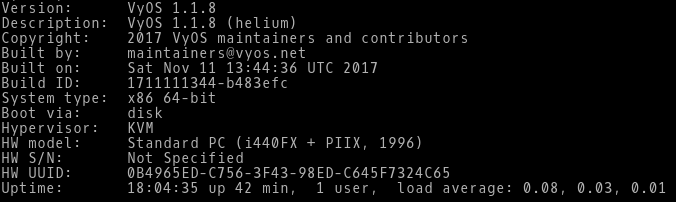
Picture 1 - VyOS Version 1.1.8
Note: The scripts are tested on Linux with installed Qemu, KVM and Expect. First, run the Bash script deploy vyos.sh. The script downloads the latest VyOS ISO image. Then run the Expect script install vyos.exp that install on VyOS Live CD.
New Video: Whitespace Handling in Jinja2
Whitespace handling is one of the most confusing aspects of Jinja2, thoroughly frustrating many attendees of my Ansible and Network Automation online courses.
I decided to fix that, ran a few well-controlled experiments, and documented the findings and common caveats in Whitespace Handling in Jinja2 video.
vCentre in Azure
A recent project I was working on involved the need to join a new office to our existing Data Centres and OSPF core using a Gig circuit over the Internet. To flesh out this idea and test its viability I thought I would try and solve an ESX capacity problem I have at home by moving vCentre into the cloud.