Brocade Featured White Paper: Top Ten Benefits of the New IP
 What does a “New IP” network look like? Why does your business need one to stay competitive? A new white paper gives you the top ten reasons.
CCIE at 50k: Software Defined? Or Hardware Driven?

Congratulations to Ryan Booth (@That1Guy_15) on becoming CCIE #50117. It’s a huge accomplishment for him and the networking community. Ryan has put in a lot of study time so this is just the payoff for hard work and a job well done. Ryan has done something many dream of and few can achieve. But where is the CCIE program today? And where will it be in the future?
Who Wants To Be A CCIE?
A lot of virtual ink has been committed to opinions in the past couple of years about how the CCIE is become increasingly irrelevant in a world of software defined DevOps focused non-traditional networking teams. It has been said that the CCIE doesn’t teach modern networking concepts like programming or building networks in a world with no CLI access. While this is all true, I don’t think it diminishes the value of getting a CCIE.
The CCIE has never been about building a modern network. It has never been focused on creating anything other than a medium-sized enterprise network in the case of the routing and switching exam. It is not a test of best practices or of greenfield deployment scenarios. Instead, it has Continue reading
Network Break 52: From AI To Ashley Madison Bots
Network Break 52 offers a reality check on VMware's prediction of AI for IT, covers VMworld news, speculates on the Cisco/Apple partnership, and delves into Ashley Madison bots.
The post Network Break 52: From AI To Ashley Madison Bots appeared first on Packet Pushers.
Evaluating my own books…

This is a bit of a slow week in the US, and I’ve been deeply imbibing philosophy and theology this weekend (getting ready for the first two PhD classes), so I’m going to do something a little different this week. A lot of folks email me asking about which of my books are worth buying, or asking me if they should buy this or that specific book I’ve written across the years. So, herewith, an honest appraisal of my own books.
This book is based on single question—what have we learned from working on failed networks from the perspective of TAC and Escalation in terms of good network design? It’s hard to believe, but this was (AFAIK) the second book published by Cisco Press, in 1999 (that’s 16 years, 10 books, and two degrees ago!). While I have a fond place in my heart for this book, all the material here is generally updated and improved in Optimal Routing Design, below.
This started life as the EIGRP white paper, written based on a thorough reading of the EIGRP code base as it existing in 2000, along with many hours spent with GDB, Continue reading
Worth Reading: Big Changes in Storage Networking

The post Worth Reading: Big Changes in Storage Networking appeared first on 'net work.
Fortinet Declares an SDN Framework for Security
 It's the orchestration that makes software-defined security possible, Fortinet says.
The Need For Network Code Reviews
Network automation and orchestration will require standardization of the scripting used by network engineers.Digital Transformation & The Healthcare Industry
To build a digital foundation, healthcare companies are revisiting their IT infrastructure with a focus on cloud-based technologies and SDN.ZeusVM: Bits and Pieces
ZeusVM is a relatively new addition to the Zeus family of malware. Like the other Zeus variants, it is a banking trojan (“banker”) that focuses on stealing user credentials from financial institutions. Although recent attention has been on non-Zeus based bankers such as Neverquest and Dyreza, ZeusVM is still a formidable threat. At the time […]ZeusVM: Bits and Pieces
ZeusVM is a relatively new addition to the Zeus family of malware. Like the other Zeus variants, it is a banking trojan (“banker”) that focuses on stealing user credentials from financial institutions. Although recent attention has been on non-Zeus based bankers such as Neverquest and Dyreza, ZeusVM is still a formidable threat. At the time of this writing, it is actively being developed and has implemented some interesting features such as a custom virtual machine and basic steganography. In addition, due to a recent leak of a builder program, the ability to create new ZeusVM campaigns is now in the hands of many more miscreants.
To foster a better understanding of ZeusVM, the attached paper examines some of the internals of the malware from a reverse engineer’s perspective. While it doesn’t cover every component, the visibility provided can help organizations better detect and protect from this threat.
ZeusVM: Bits and Pieces (PDF)
Weird bug of the day: Twitter in-app browser can’t visit site
We keep a close eye on tweets that mention CloudFlare because sometimes we get early warning about odd errors that we are not seeing ourselves through our monitoring systems.
Towards the end of August we saw a small number of tweets like this one:

indicating that trying to browse to a CloudFlare customer web site using the Twitter in-app browser was resulting in an error page. Which was very odd because it was clearly only happening occasionally: very occasionally.
Luckily, the person who tweeted that was in the same timezone as me and able to help debug together (thanks James White!); we discovered that the following sequence of events was necessary to reproduce the bug:
Click on a link in a tweet to a web site that is using an https URL and open in the Twitter in-app browser (not mobile Safari). This site may or may not be a CloudFlare customer.
Then click on a link on that page to a site over an http URL. This site must be on CloudFlare.
BOOM
That explained why this happened very rarely, but the question became... why did it happen at all? After some debugging it appeared to happen in Continue reading
Blessed by Gartner: Stretched VLANs Make Little Sense
One of my readers recently pointed me to a blog post written by Andrew Lerner from Gartner describing the drawbacks of stretched VLANs.
TL&DR: He’s saying more-or-less the same things I’ve been preaching for years. Now I can put Blessed by Gartner logo on my blog posts ;), and you can use the report to sway your CIO.
Read more ...Which Path in the WAN are those Business Critical Applications Taking?
“Learning about and avoiding impairments (delay, loss, jitter) along the path that business critical traffic takes.” That is what I wrote in my previous blog “IWAN’s Intelligent Path Control & Using Your Backup Link.” But how is that possible to do?
Thinking some type of probe? From where to where? Thinking the WAN edge links? But how do you know the path you send your probes over is the path that your business critical traffic is taking?
Let’s talk about what I mean by this by looking at an example.
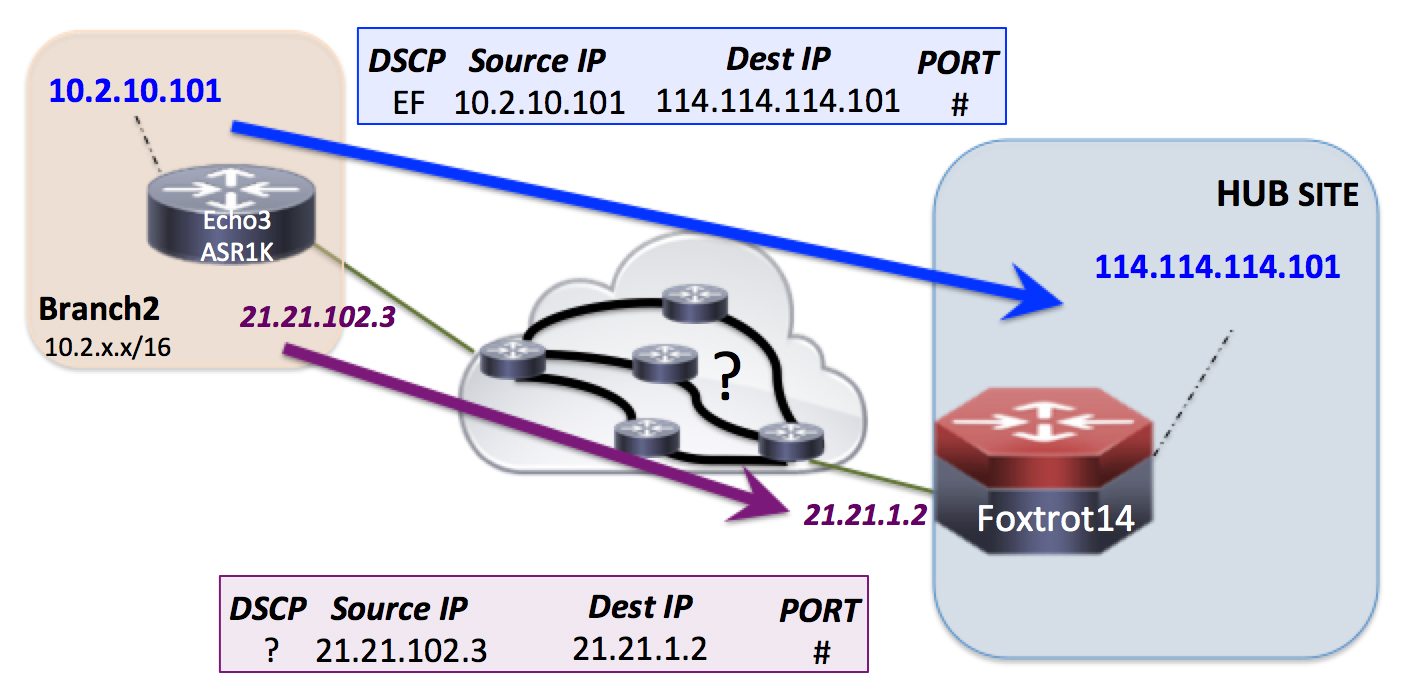
In the above picture we have 2 sites with 1 host per site, and 1 WAN connection between the two.
- Branch2 w/ host 10.2.10.101
- Hub Site w/ host 114.114.114.101
- WAN connection w/ 21.21.102.3 on the Branch2 side and 21.21.1.2 on the Hub Site side.
Let’s say you check the health of the path between Branch2 and the Hub Site with some type of probe/IP SLA. You will be doing it from the 2 WAN IP addresses 21.21.102.3 and 21.21.1.2. Right? Continue reading
Slideshow: v0dgeball Adds a Dose of Action to VMworld
 A pre-VMworld tradition, v0dgeball is a charity dodgeball tournament that drew 16 teams eager to bean each other in the ankles.