Everything looked normal. An audience of company executives and employees, journalists, and analysts staring at the brightly lit stage as the chief executive officer strode from one side to the other boasting of a chip’s performance and power efficiency, the advanced technologies that went into making it, and the marked advantages it held over the best the competition had to offer. …
Faced with economic pressures and a lack of daily interactions with co-workers, some network and IT managers who recently retired are considering that other return to office, namely unretirement.
The original RR design has a lot of limitations. For usual enterprise networks I always suggested to follow the topology with RRs (every interim node is an RR), since this would become the most robust configuration where a link failure would have the less impact.
He’s talking about the extreme case of hierarchical route reflectors, a concept I first encountered when designing a large service provider network. Here’s a simplified conceptual diagram (lines between boxes are physical links as well as IBGP sessions between loopback interfaces):
The original RR design has a lot of limitations. For usual enterprise networks I always suggested to follow the topology with RRs (every interim node is an RR), since this would become the most robust configuration where a link failure would have the less impact.
He’s talking about the extreme case of hierarchical route reflectors, a concept I first encountered when designing a large service provider network. Here’s a simplified conceptual diagram (lines between boxes are physical links as well as IBGP sessions between loopback interfaces):
Sponsored Feature: It’s a decade and a half since researchers dazzled the tech world by demonstrating that GPUs could be used to dramatically accelerate key AI operations. …
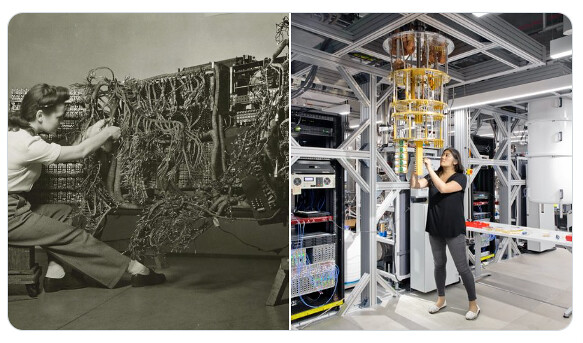
IBM has rolled out its most powerful quantum-computing system so far—the Osprey, a 433-qubit machine that supports three times more qubits than its current Eagle system, and reiterated its plan to have a 1,121-qubit processor, called Condor, out in 2023.At the IBM Quantum Summit 2022, the company also said it was continuing development of a modular quantum platform called System Two that will combine multiple processors into a single system with new communication links that IBM says will use hybrid-cloud middleware to integrate quantum and classical workflows.In addition IBM said it will continue to prototype quantum software applications for specific use cases. By 2025, IBM said, developers will be able to explore quantum machine-learning applications and more.To read this article in full, please click here
On Tuesday, November 8, 2022, constituents cast their ballots for the 2022 US midterm elections, which included races for all 435 seats in the House of Representatives, 35 of the 100 seats in the Senate, and many gubernatorial races in states including Florida, Michigan, and Pennsylvania. Preparing for elections is a giant task, and states and localities have their work cut out for them with corralling poll workers, setting up polling places, and managing the physical security of ballots and voting machines.
We at Cloudflare are proud to be able to play a role in helping safeguard the integrity of the electoral process. Through our Impact programs, we provide cyber security products to help protect access to authoritative voting information and the security of sensitive voter data.
We have reported on our work in the election space with the Athenian Project, dedicated to protecting state and local governments that run elections; Cloudflare for Campaigns, a project with a suite of Cloudflare products to secure political campaigns’ and state parties’ websites and internal teams; and Project Galileo, in which we have helped voting rights organizations and election results sites stay online during traffic spikes.
On today's Day Two Cloud we talk about testing. While developers do the testing, operators may be responsible for setting up testing environments, which can be a lot of work. That work increases with microservices because of all the complexities and dependencies that come with connecting and orchestrating microservices-based applications. Today we talk about how to address testing challenges with Arjun Iyer, and explore a solution he's developed for simplifying end-to-end microservices testing in a Kubernetes environment. This is not a sponsored show, but we do talk about Signadot, a startup Arjun founded in the testing space.
Applications generally assume the network provides near-real-time packet transmission without regard for what the application is trying to do, what kind of traffic is being transmitted, etc. Back in the real world, its often important for the network to coordinate with applications to more efficiently carry traffic offered. The Path Aware Research Group (PANRG) in the Internet Research Task Force (IRTF) is looking at the problems involved in understanding and signaling the path characteristics to applications.
In this episode of the Hedge, Brian Trammel joins Tom Ammon and Russ White to discuss the current work on path aware networking.
Intel has announced new processors with high-bandwidth memory (HBM) geared toward high-performance computing (HPC), supercomputing, and artificial intelligence (AI).The products are known as the Xeon CPU Max series and GPU Max series. The chips are based on existing technology; the CPU is 4th Generation Xeon Scalable, aka Sapphire Rapids, and the GPU is Ponte Vecchio, the data center version of Intel's Xe GPU technology.To read this article in full, please click here
It is very rare for any of the major semiconductor suppliers of the world to ever admit that things are going wrong, even when we all know that they have been. …