It is perplexing to us that the world’s largest distributor of client and server operating systems and also the creator of the Linux-based, open source SONiC network operating system – that would be Microsoft with its Windows and Windows Server franchises – did not see the benefit or the need to commercialize SONiC and lead the open networking revolution. …
On today's Day Two Cloud we talk about what it's like to interview for a job at a massive tech company. How do you get yourself in line? What can you expect from the interview? How do you prepare? How do you overcome your own imposter syndrome? Our guest is Nathaniel Avery, Outbound Product Manager at Google Cloud. He recently ran the gauntlet of the tech interview, and is here to share tips and insights on the process.
On today's Day Two Cloud we talk about what it's like to interview for a job at a massive tech company. How do you get yourself in line? What can you expect from the interview? How do you prepare? How do you overcome your own imposter syndrome? Our guest is Nathaniel Avery, Outbound Product Manager at Google Cloud. He recently ran the gauntlet of the tech interview, and is here to share tips and insights on the process.
The datacenter is becoming hyperdistributed and incorporating some multiple of capacity – 2X, 3X, 4X, or maybe 10X – outside of the traditional datacenter walls because applications and storage live increasingly at the edge. …
Three years ago, when we posed the question, “Apache Kafka was emerging as the default go-to-publish/subscribe messaging engine for the cloud era. At the time, we drew comparisons with IPO’ed while Databricks continues Pulsar recently emerged as a competing project, but is it game over? Hyperscalers are offering alternatives like Azure Event Hub, and AWS co-markets Confluent Cloud, with a similar arrangement with Jay Kreps evangelized streaming using electricity as the metaphor. Kreps positioned streaming as pivotal to the next wave of apps in chicken and egg terms. That is, when electricity Continue reading
Welcome to our DDoS Threat Report for the third quarter of 2022. This report includes insights and trends about the DDoS threat landscape - as observed across Cloudflare’s global network.
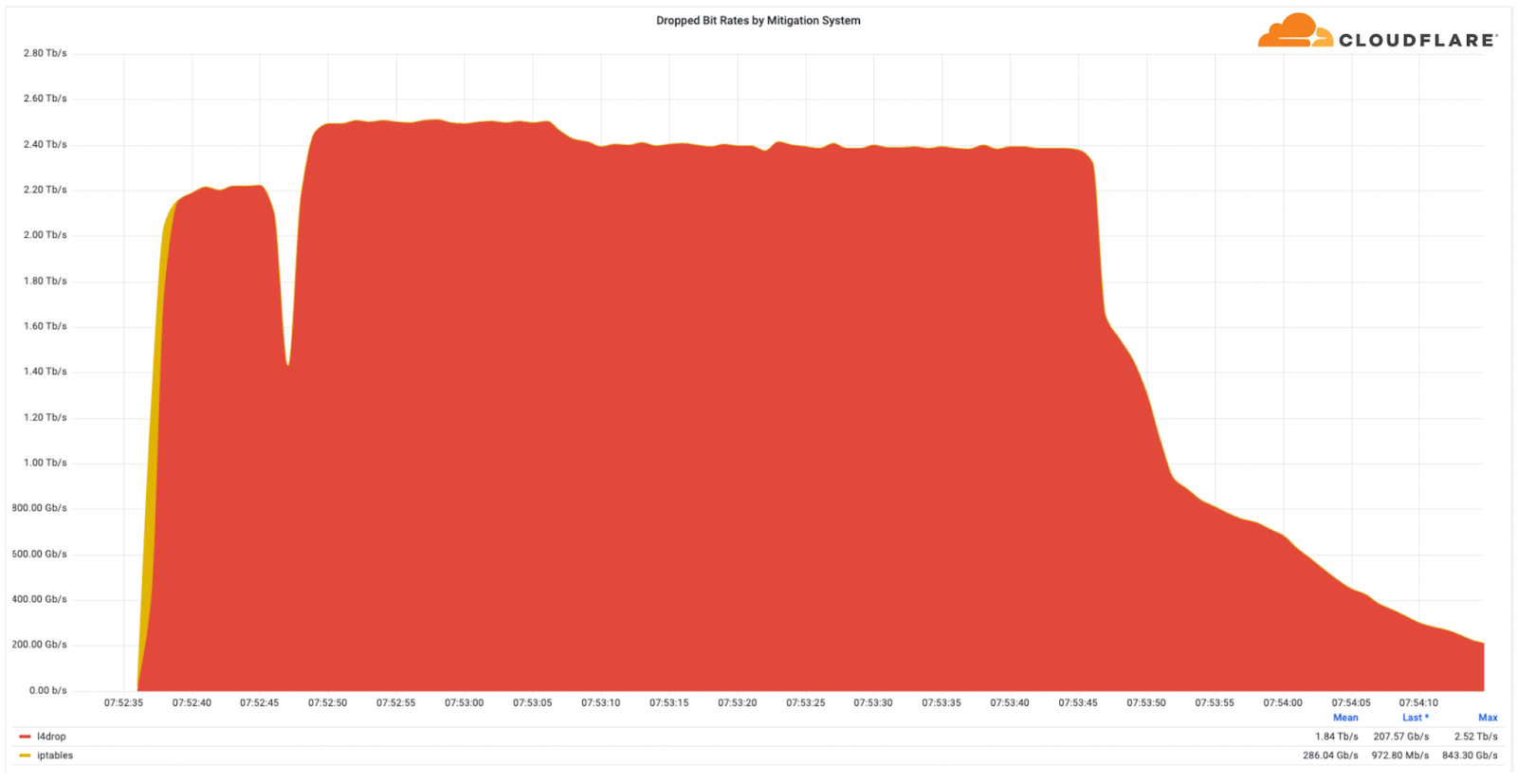
Multi-terabit strong DDoS attacks have become increasingly frequent. In Q3, Cloudflare automatically detected and mitigated multiple attacks that exceeded 1 Tbps. The largest attack was a 2.5 Tbps DDoS attack launched by a Mirai botnet variant, aimed at the Minecraft server, Wynncraft. This is the largest attack we’ve ever seen from the bitrate perspective.
It was a multi-vector attack consisting of UDP and TCP floods. However, Wynncraft, a massively multiplayer online role-playing game Minecraft server where hundreds and thousands of users can play on the same server, didn’t even notice the attack, since Cloudflare filtered it out for them.
The 2.5 Tbps DDoS attack that targeted Wynncraft — launched by Mirai
General DDoS attack trends
Overall this quarter, we've seen:
An increase in DDoS attacks compared to last year.
Longer-lasting volumetric attacks, a spike in attacks generated by the Mirai botnet and its variants.
While forwarding a received Type-5 LSA to other areas, why does the ABR not change the Advertising Router ID to it’s own IP address? If ABR were able to change the Advertising Router ID in the Type-5 LSA, then there would be no need for Type-4 LSA which meant less OSPF overhead on the network.
TL&DR: The current implementation of external routes in OSPF minimizes topology database size (memory utilization)
Before going to the details, try to imagine the environment in which OSPF was designed, and the problems it was solving.
While forwarding a received Type-5 LSA to other areas, why does the ABR not change the Advertising Router ID to it’s own IP address? If ABR were able to change the Advertising Router ID in the Type-5 LSA, then there would be no need for Type-4 LSA which meant less OSPF overhead on the network.
TL&DR: The current implementation of external routes in OSPF minimizes topology database size (memory utilization)
Before going to the details, try to imagine the environment in which OSPF was designed, and the problems it was solving.
By most definitions, the network router’s purpose is defined by its name – it routes packets from one location to another. But over the course of decades of internet networking, the value of the router has grown significantly, offering enterprises additional functions such as network security, content filtering, quality of service, and more.At its most basic level, a router is a device that connects networks to each other, forwarding data packets from one location to another until they reaches their destination. Within a local area network (LAN), a router can also allow multiple devices to use the same Internet connection, such as how a home router allows users to connect their laptops, phones and tablets (among countless other devices) at the same time.To read this article in full, please click here
By most definitions, the network router’s purpose is defined by its name – it routes packets from one location to another. But over the course of decades of internet networking, the value of the router has grown significantly, offering enterprises additional functions such as network security, content filtering, quality of service, and more.At its most basic level, a router is a device that connects networks to each other, forwarding data packets from one location to another until they reaches their destination. Within a local area network (LAN), a router can also allow multiple devices to use the same Internet connection, such as how a home router allows users to connect their laptops, phones and tablets (among countless other devices) at the same time.To read this article in full, please click here
The topic of the robustness of IPv6 Extension Headers has experienced a resurgence of interest in recent months. I’d like to update our earlier report on this topic with some more recent measurement data.
Today on the Tech Bytes podcast we’re talking deception. That is, deceiving attackers that try to exploit your network by creating fake assets and infrastructure. Sponsor Fortinet is here to talk about using deception techniques to spot intruders via its FortiDeceptor product. We’ll also talk about threat reconnaissance capabilities of a product called FortiRecon. Our guest is Moshe Ben Simon, VP of Product Management.
Today on the Tech Bytes podcast we’re talking deception. That is, deceiving attackers that try to exploit your network by creating fake assets and infrastructure. Sponsor Fortinet is here to talk about using deception techniques to spot intruders via its FortiDeceptor product. We’ll also talk about threat reconnaissance capabilities of a product called FortiRecon. Our guest is Moshe Ben Simon, VP of Product Management.
Using a function in bash allows you to create something in Linux that works as if it were a script within a script. Whenever the data being processed matches a set of conditions, your script can call a function that does further processing.The format of a function is very straightforward. The syntax looks like this:<function_name> () {
<commands>
}
You can also use the following format that uses the word "function" if you prefer:function <function_name> {
<commands>
}
In fact, you can also create a function on a single line if the commands to be run are limited, but note the required “;” that follows the command(s):To read this article in full, please click here
Using a function in bash allows you to create something in Linux that works as if it were a script within a script. Whenever the data being processed matches a set of conditions, your script can call a function that does further processing.The format of a function is very straightforward. The syntax looks like this:<function_name> () {
<commands>
}
You can also use the following format that uses the word "function" if you prefer:function <function_name> {
<commands>
}
In fact, you can also create a function on a single line if the commands to be run are limited, but note the required “;” that follows the command(s):To read this article in full, please click here
Infrastructure services such as virtual switching, security, and storage can consume a significant number of CPU cycles. Infrastructure Processing Units (IPUs) accelerate network infrastructure, freeing up CPU cores for improved application performance.
Google Cloud is rolling out new network and security features, including a service that provides Layer-7 security.The new offerings announced at Google Cloud Next also include firewall and web application-protection options aimed at advancing existing cloud connectivity and ensuring the security of cloud-based resources.“We are fundamentally enhancing our network fabric—which includes 35 regions, 106 zones and 173 network edge locations across 200-plus countries—and making it simpler and easier for organizations to migrate their existing workloads and modernize applications all while securing and making them easier to manage,” said Muninder Sambi, vice president and general manager of networking for Google Cloud.To read this article in full, please click here
Google Cloud is rolling out new network and security features, including a service that provides Layer-7 security.The new offerings announced at Google Cloud Next also include firewall and web application-protection options aimed at advancing existing cloud connectivity and ensuring the security of cloud-based resources.“We are fundamentally enhancing our network fabric—which includes 35 regions, 106 zones and 173 network edge locations across 200-plus countries—and making it simpler and easier for organizations to migrate their existing workloads and modernize applications all while securing and making them easier to manage,” said Muninder Sambi, vice president and general manager of networking for Google Cloud.To read this article in full, please click here