Worth Reading: The Trap of The Premature Senior
Here’s another riff on the “when you’re the smartest person in the room, change the room” theme: The Trap of The Premature Senior by inimitable Charity Majors. Enjoy!
Here’s another riff on the “when you’re the smartest person in the room, change the room” theme: The Trap of The Premature Senior by inimitable Charity Majors. Enjoy!

Wanna make your security team’s blood run cold? Remind them that all that time and effort they put in to securing the enterprise from attackers and data exfiltration is currently sitting unused while we all work from home. You might have even heard them screaming at the sky just now.
Enterprise security isn’t easy, nor should it be. We constantly have to be on the offensive to find new attack vectors and hunt down threats and exploits. We have spent years and careers building defense-in-depth to an artform not unlike making buttery croissants. It’s all great when that apparatus is protecting our enterprise data center and cloud presence like a Scottish castle repelling invaders. Right now we’re in the wilderness with nothing but a tired sentry to protect us from the marauders.
During Security Field Day 4, I led a discussion panel with the delegates about the challenges of working from home securely. Here’s a link to our discussion that I wanted to spend some time elaborating on:
BYOD was a huge watershed moment for the enterprise because we realized for the first time that we had to learn to secure other people’s Continue reading
In this discussion, Greg accosts...no, converses with...Simon Sharwood on a variety of issues highly relevant to networking's future. It turns out, Simon is not short on opinions. And thusly, Simon and Greg opine about sundry topics.
The post Heavy Networking 549: The Future Of Networking With Simon Sharwood appeared first on Packet Pushers.

Net-á-porter: The South African Chapter of the Internet Society has been promoting an “Internet-in-a-box” initiative using an SD card to configure an inexpensive Raspberry Pi device. Interested people can configure an SD card or even order a pre-loaded SD card.
Taxing the ‘Net: The Mexico Chapter has gone on record as opposing a digital services tax proposed by the Mexican government. “If this initiative is approved, which would have a negative impact on free access to content and information by citizens, [and] we could find ourselves with a potential instrument of discrimination and censorship,” the Chapter said. The tax on foreign digital services would be 16 percent.
Moving governance forward: Pacific Islands Chapter member Swaran Ravindra noted that cybersecurity and digital inclusion were big topics at the recent Asia Pacific Regional Internet Governance Forum 2020. “Disruptive technologies … have enormous benefits for the Pacific region at large, but we cannot ignore the need for our people to be completely cognizant of the cybersecurity issues which we are being exposed to,” she wrote. “Fiji struggles with cyberbullying, suicide, mental health issues, fraud, and crime [that] technology may have been a part of, either intentionally or unintentionally. In order to leverage technology Continue reading
Hey, no power outages this week, so it's finally HighScalability time!

Stunning: Tycho Crater Region with Colours by Alain Paillou
Do you like this sort of Stuff? Without your support on Patreon this Stuff won't happen.
Know someone who could benefit from becoming one with the cloud? I wrote Explain the Cloud Like I'm 10 just for them. On Amazon it has 189 mostly 5 star reviews. Here's a 100% lactose-free review:

Welcome to Technology Short Take #133! This time around, I have a collection of links featuring the new Raspberry Pi 400, some macOS security-related articles, information on AWS Nitro Enclaves and gVisor, and a few other topics. Enjoy!
Cybersecurity consumes an ever-increasing amount of our time and budgets, yet gaps remain and are inevitably exploited by bad actors. One of the biggest gaps is unpatched vulnerabilities: a recent survey found that 60% of cyberattacks in 2019 were associated with vulnerabilities for which patches were availablei.
Most companies have a patch schedule that is barely able to keep up with applying the most important patches to the most critical vulnerabilities. Yet new ones crop up all the time: approximately 15,000 new vulnerability are discovered every year, which translates to one every 30 minutes ii. They impact all types of workloads, from multiple vendors, as well as open source projects.
It’s a constant race to try to find and fix the most dangerous vulnerabilities before the bad actors can exploit them. But ignoring them is not an option.
Why not just patch everything or fix flaws in the code? Because it’s operationally challenging – and almost impossible.
First, patching is an expensive and largely manual process. Second, applications may rely Continue reading
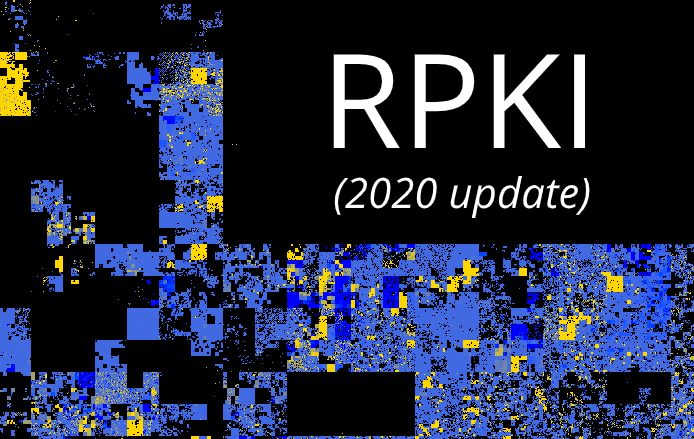
The Internet is a network of networks. In order to find the path between two points and exchange data, the network devices rely on the information from their peers. This information consists of IP addresses and Autonomous Systems (AS) which announce the addresses using Border Gateway Protocol (BGP).
One problem arises from this design: what protects against a malevolent peer who decides to announce incorrect information? The damage caused by route hijacks can be major.
Routing Public Key Infrastructure (RPKI) is a framework created in 2008. Its goal is to provide a source of truth for Internet Resources (IP addresses) and ASes in signed cryptographically signed records called Route Origin Objects (ROA).
Recently, we’ve seen the significant threshold of two hundred thousands of ROAs being passed. This represents a big step in making the Internet more secure against accidental and deliberate BGP tampering.
We have talked about RPKI in the past but we thought it would be a good time for an update.
In a more technical context, the RPKI framework consists of two parts:
In the last part of his Cumulus Linux 4.0 Update Pete Lumbis talked about using NetQ to capture streaming telemetry and increase network observability, and the new model-driven configuration approach (including all the usual buzzwords like NETCONF, RPC, YAML, JSON, and OpenConfig) coming in 2020.
In the last part of his Cumulus Linux 4.0 Update Pete Lumbis talked about using NetQ to capture streaming telemetry and increase network observability, and the new model-driven configuration approach (including all the usual buzzwords like NETCONF, RPC, YAML, JSON, and OpenConfig) coming in 2020.
Today we are pleased to announce that we have reached a major milestone, reaching GA and our V1 of both the Compose CLI and the ACI integration. 
In May we announced the partnership between Docker and Microsoft to make it easier to deploy containerized applications from the Desktop to the cloud with Azure Container Instances (ACI). We are happy to let you know that all users of Docker Desktop now have the ACI experience available to them by default, allowing them to easily use existing Docker commands to deploy and manage containers running in ACI.
As part of this I want to also call out a thank you to the MSFT team who have worked with us to make this all happen! That is a big thank you to Mike Morton, Karol Zadora-Przylecki, Brandon Waterloo, MacKenzie Olson, and Paul Yuknewicz.
Getting started with Docker and ACI
As a new starter, to get going all you will need to do is upgrade your existing Docker Desktop to the latest stable version (2.5.0.0 or later), store your image on Docker Hub so you can deploy it (you can get started with Hub here) and then lastly you Continue reading
If you want to get a sense of what is happening in the high-end of the Ethernet switch and routing market, it is Arista Networks, formerly an upstart and now just one of the bigger vendors taking on the hegemony of Cisco Systems in networking in the datacenter and now on the campus and at the edge, is probably the best bellwether there is. …
Switching Back Into A Higher Gear was written by Timothy Prickett Morgan at The Next Platform.
Here at the Internet Society, we believe that the Internet is for everyone. Our work focuses on ensuring that the Internet remains open, globally-connected, trustworthy, and secure.
In 2020, we saw the world change in ways that no one could have anticipated. Because of this, like so many other organizations, we had to assess our current and future plans and evaluate the resources available to us. As a result, we have made some changes to our activities for the upcoming year.
Moving into 2021, we will reduce activities related to our Open Standards Everywhere (OSE) and Time Security projects.
We still deeply believe that open Internet standards and securing the Internet’s time synchronization infrastructure are critical components for building an open and trustworthy Internet. So, while OSE and Time Security will no longer be standalone projects next year, we will continue to promote and defend these concepts through our other projects, initiatives, and activities.
Our work in 2020 in both these areas has had a measurable impact and many successes, which we will document in the 2020 Impact Report that will be published in early 2021. We will continue to finish work in progress on Time Security and OSE Continue reading
Meet co-hosts Brandon Heller and Derick Winkworth and learn about why we created this podcast: to bring you authentic conversations from the broader computer networking community.
We’re on a journey to understand what an increasingly connected world means for all of us.