Huawei Cops To Lack of US Ambition
“We don’t necessarily have any ambition in the U.S. market just because this is such a...
The feature allows for central management of data protection of Kubernetes clusters running across...
Some of our favorite Heavy Networking discussions are with folks deep in the hot aisle making technology work. No slide decks, just engineers doing the thing. How did it go? What do you wish you had done differently? What worked out well? We have one of these chats today with Jamie Hughes, Infrastructure Architect at Terracon. He's rolled out many complex network changes with Gluware's network automation platform.
The post Heavy Networking 525: Gluware Automating Terracon’s Network (Sponsored) appeared first on Packet Pushers.
COVID-19 has pushed the world into a digital revolution and closing Nepal’s digital divide has never been more important.
Nepal is a landlocked least developed country, and according to the International Telecommunication Union, less than 20% of its population are online compared to 87% in developed countries.
While connecting some of Nepal’s most remote places isn’t easy, two community network projects are case studies of how it can be done. They are Wireless for Communities (W4C) Nepal and Rural Communities Access to Information Society (RUCCESS), both supported by the Internet Society.
Community networks are networks built, managed and used by local communities. They are often established in rural and remote areas that are not commercially viable for Internet service providers (ISPs). The networks are often built using low-cost WiFi equipment and unlicensed spectrum bands to interconnect members of the community and improve their lives.
W4C Nepal
W4C Nepal was launched in the aftermath of the Gorkha Earthquake in April 2015, in partnership with the Nepal Wireless Networking Project, an initiative of Mahabir Pun, an Internet Hall of Fame recipient and winner of the Ramon Magsaysay Award.
Using wireless networks, all powered by solar panels as the villages are Continue reading
Hey, it's HighScalability time!

Line noise? Perl? Still uncertain? It's how you program a quantum computer. Silq.
Do you like this sort of Stuff? Without your support on Patreon this kind of Stuff can't happen. You are that important to the fate of the smart and thoughtful world.
Know someone who could benefit from understanding the cloud? Of course you do. I wrote Explain the Cloud Like I'm 10 just for them. On Amazon it has 115 mostly 5 star reviews. Here's a 100% gluten-free review:

We are delighted that our valued partner, Gigamon, and it’s GigaVUE Cloud Suite has met the certification requirements for VMware NSX-T service insertion.
Service Insertion for NSX-T
The concept of service insertion is key for the NSX platform, enabling users to seamlessly add third party applications at various points throughout the network. Having a robust ecosystem of partners provides maximum flexibility for NSX-T, allowing customers to add partner functionality, tailored to their unique requirements without degrading performance elsewhere in the software-defined data center (SDDC). Partner applications are put through a rigorous certification process ensuring the highest level of interoperability and reliability.
With the certification, GigaVUE Cloud Suite is now interoperable with VMware’s NSX-T and vCenter Server through APIs for improved agility and reduced manual management tasks. Gigamon customers now have comprehensive application visibility across complex hybrid environments, including east-west traffic, at scale.
Learn more
Please join the VMware and Gigamon teams at a joint webinar, Illuminate Applications in VMware-based Clouds to Secure and Optimize, on June 30, 10 am PDT. Learn about NSX service insertion, Gigamon GigaVue, and the advantages and a demo of Gigamon next-generation network visibility solutions.
The post VMware NSX-T Service Insertion and Gigamon GigaVUE Continue reading
Red Hat Satellite is a great tool to automate deployment, provisioning, patching and configuration of your infrastructure, but how can you automate Satellite itself?
Using the Red Hat Ansible Automation Platform and the Satellite Ansible Content Collection, of course!
Since you’re already tuning in, you probably don’t need convincing that automation is great; it helps enable easier collaboration, better accountability and easier reproducibility. But have you already heard about Collections?
We’ll show you how you can use the Satellite Ansible Content Collection to manage your Satellite installations via Ansible
The Satellite Ansible Content Collection is, as you might have guessed already, a set of Ansible modules and plugins to interact with Red Hat Satellite.
These modules are an evolution from the foreman and katello modules previously available in Ansible itself, as those are deprecated since Ansible 2.8 and are scheduled for removal in 2.12. Due to the use of a Satellite-specific library, the old modules would not work properly in plain Foreman setups and often lacked features that were not present in Red Hat Satellite. At the same time, using the modules together with Satellite wasn’t easy either, as the used Continue reading

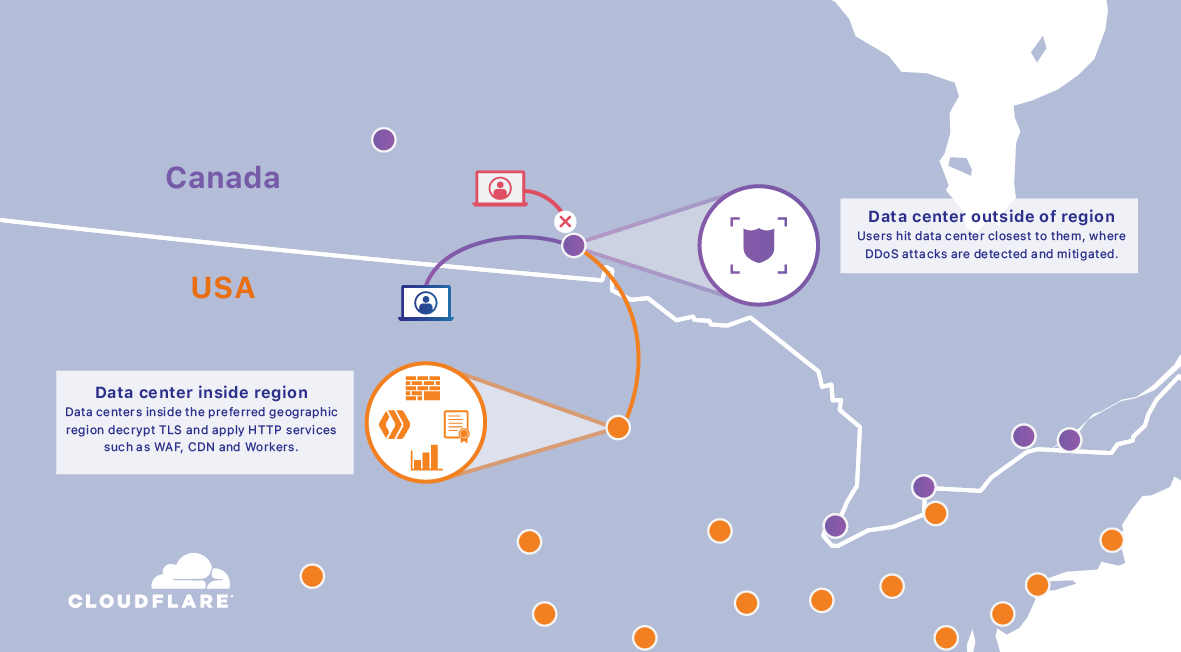
In a world where, increasingly, workloads shift to the cloud, it is often uncertain and unclear how data travels the Internet and in which countries data is processed. Today, Cloudflare is pleased to announce that we're giving our customers control. With Regional Services, we’re providing customers full control over exactly where their traffic is handled.
We operate a global network spanning more than 200 cities. Each data center runs servers with the exact same software stack. This has enabled Cloudflare to quickly and efficiently add capacity where needed. It also allows our engineers to ship features with ease: deploy once and it's available globally.
The same benefit applies to our customers: configure once and that change is applied everywhere in seconds, regardless of whether they’re changing security features, adding a DNS record or deploying a Cloudflare Worker containing code.
Having a homogenous network is great from a routing point of view: whenever a user performs an HTTP request, the closest datacenter is found due to Cloudflare's Anycast network. BGP looks at the hops that would need to be traversed to find the closest data center. This means that someone near the Canadian border (let's say North Dakota) could easily find Continue reading
Python classes are very useful when you need to create objects with the same characteristics. This is often referred to as Object Oriented Programming (OOP). Not having much of a programming background, I found classes to be a bit confusing, and I wasn’t fully understanding the use of __init__ and self. Thanks to the Twitter community, my friend Peter Palúch , and the videos of Cory Schafer, I know feel I have a better understanding, and wanted to share my findings, from a networking person’s perspective.
First, let’s look at why classes are needed in the first case. Let’s say that we want to keep track of our network devices. The attributes we are interested in are:
We can of course create this information manually, without classes, like this:
daniel@devasc:~/DevAsc$ python3 Python 3.8.2 (default, Apr 27 2020, 15:53:34) [GCC 9.3.0] on linux Type "help", "copyright", "credits" or "license" for more information. >>> device1_hostname = "r1" >>> device1_vendor = "Cisco" >>> device1_type = "router" >>> device1_model = "ISR4331" >>> device1_loopback = "192.0.2.1" >>> device2_hostname = "sw1" >>> device2_vendor = "Cisco" >>> device2_type = "switch" >>> device2_model = Continue reading
Almost 30 webinars, an online course, and over 140 blog posts later it’s time for another summer break.
While we’ll do our best to reply to support and sales requests (it might take us a bit longer than usual), don’t expect anything deeply technical for the new two months… but of course you can still watch over 280 hours of existing content, listen to over 100 podcast episodes, or read over 3500 blog posts.
We’ll be back with tons of new content in early September.
In the meantime, automate everything, get away from work, turn off the Internet, and enjoy a few days in your favorite spot with your loved ones!
This is the troubleshooting story about me finding out why some packets were getting dropped when running AX.25 over D-Star DV between a Kenwood TH-D74 and an Icom 9700.
Troubleshooting: “Trouble”, from the latin “turbidus” meaning “a disturbance”. “Shooting”, from American English meaning “to solve a problem”.
The end result is this post, and this is the troubleshooting story.
The setup: laptop->bluetooth->D74->rf->9700->usb->raspberry pi.
I’m downloading from the raspberry pi, with the laptop sending back ACKs. But one of the ACKs is not getting through.
axlisten -a clearly showed that the dropped packet was being sent
from the laptop:
radio: fm M0XXX to 2E0XXX-9 ctl RR6-
But nothing received on the receiver side. I saw the D74 light up red
to TX, and the 9700 light up green on RX, but then nothing. Error
counters in ifconfig ax0 were counting up on the receiver side. So
something is being sent over the air.
And it wasn’t the first packet. All the ones before it were fine. They
were always fine. This packet was always dropped. It was always only
that packet that caused it to stall. The window size was set to 2, so
session establishment, RR0, RR2 Continue reading
June is Alzheimer’s and Brain Awareness Month. And with 50 million people suffering from Alzheimer’s disease and other types of dementia worldwide, this sadly common brain health condition is one of the biggest health problems in the world today.
Alzheimer’s is a degenerative brain disease. Although its cruel effects are not noticeable at first, doctors believe that brain degeneration begins around 20 years before symptoms first appear, possibly earlier. This means that although younger people may consider that Alzheimer’s only affects “old people” it is important to remember that this disease does not suddenly appear fully formed once you have hit senior age. Alzheimer’s can hit people in their early 50s in some cases, so what you do in your 20s and 30s will certainly have an impact on your long-term brain health.
Nobody fully understands the causes and risk factors for Alzheimer’s disease. There could be a genetic link to the condition, but growing evidence points towards dietary factors. Studies show that a diet rich in antioxidants, with plenty of fresh fruit and vegetables and oily fish – such as the Mediterranean diet does have a neuroprotective effect.
However with the average American diet which is Continue reading
In this week's episode Ed, Scott, and Tom draw on their years of (sometimes painful) experience in deploying IPv6 to offer some practical guidance on how not to mess up your enterprise IPv6 deployment.
The post IPv6 Buzz 054: How (Not) To Mess Up Your IPv6 Deployment! appeared first on Packet Pushers.
Up until now, when I used Pulumi to create infrastructure on AWS, my code would create all-new infrastructure: a new VPC, new subnets, new route tables, new Internet gateway, etc. One thing bothered me, though: when I created a new VPC, that new VPC automatically came with a default route table. My code, however, would create a new route table and then explicitly associate the subnets with that new route table. This seemed less than ideal. (What can I say? I’m a stickler for details.) While building a Go-based replacement for my existing TypeScript code, I found a way to resolve this duplication of resources. In this post, I’ll show you how to “adopt” the default route table of an AWS VPC so that you can manage it in your Pulumi code.
Let’s assume you are creating a new VPC using code that looks something like this:
vpc, err := ec2.NewVpc(ctx, "testvpc", &ec2.VpcArgs{
CidrBlock: pulumi.String("10.100.0.0/16"),
Tags: pulumi.Map {
"Name": pulumi.String("testvpc"),
k8sTag: pulumi.String("shared"),
},
})
(Note that this snippet of code doesn’t show anything happening with the return values of the ec2.NewVpc function, which Go will complain about. Make Continue reading
Subscribe to Kernel of Truth on iTunes, Google Play, Spotify, Cast Box and Sticher!
Click here for our previous episode.
If you’ve listened to the podcast before you may have heard us reference our customers from time to time. In this episode we’re switching things up and instead of referencing a customer, you’re going to hear directly from one! Manuel Schweizer, CEO of Cloudscale, joins host Roopa Prabhu, Attilla de Groot and Mark Horsfield to chat about Cloudscale’s first hand experience with open networking and what they hope the near and distant future of open networking will look like.
Guest Bios
Roopa Prabhu: Roopa Prabhu is a Linux Architect at Cumulus Networks, now NVIDIA. At Cumulus she and her team work on all things kernel networking and Linux system infrastructure areas. Her primary focus areas in the Linux kernel are Linux bridge, Netlink, VxLAN, Lightweight tunnels. She is currently focused on building Linux kernel dataplane for E-VPN. She loves working with the Linux kernel networking and debian communities. Her past experience includes Linux clusters, ethernet drivers and Linux KVM virtualization platforms. She has a BS and MS in Computer Science. You can find her on Twitter at Continue reading
Earlier this month Docker announced our partnership with Microsoft to shorten the developer commute between the desktop and running containers in the cloud. We are excited to announce the first release of the new Docker Azure Container Instances (ACI) experience today and wanted to give you an overview of how you can get started using it.
The new Docker and Microsoft ACI experience allows developers to easily move between working locally and in the Cloud with ACI; using the same Docker CLI experience used today! We have done this by expanding the existing docker context command to now support ACI as a new backend. We worked with Microsoft to target ACI as we felt its performance and ‘zero cost when nothing is running’ made it a great place to jump into running containers in the cloud.
ACI is a Microsoft serverless container solution for running a single Docker container or a service composed of a group of multiple containers defined with a Docker Compose file. Developers can run their containers in the cloud without needing to set up any infrastructure and take advantage of features such as mounting Azure Storage and GitHub repositories as volumes. For production cases, you can Continue reading

You’ve probably been hearing a lot about analytics and artificial intelligence in the past couple of years. Every software platform under the sun is looking to increase their visibility into the way that networks and systems behave. They can then take that data and plug it into a model and make recommendations about the way things need to be configured or designed.
Using analytics to aid troubleshooting is nothing new. We used to be able to tell when hard disks were about to go bad because of SMART reporting. Today we can use predictive analysis to determine when the disk has passed the point of no return and should be replaced well ahead of the actual failure. We can even plug that data into an AI algorithm to determine which drives on which devices need to be examined first based on a chart of performance data.
The power of this kind of data-driven network and systems operation does help our beleaguered IT departments feel as though they have a handle on things. And the power that data can offer to us has it being tracked like a precious natural resource. More than a few times I’ve heard data referred to Continue reading