Say it once: introducing Bot Preference Sync
We’re constantly building for the different goals of our customers. Some customers want to optimize for discovery, while others want to protect their content with the strictest security policy. Among these differing policies, there are multiple ways to mitigate bot traffic. Some mechanisms simply state your preference, assuming best intent from crawlers, and other approaches actually lock down content by outright blocking with a Bot Management solution.
We recognize that it's cumbersome to maintain multiple layers of protection on your website. For example, there are cases in which your robots.txt states that a crawler is Disallowed from accessing your website, while your enforcement rules actually don’t block that crawler. When your stated preferences and your enforced rules disagree, some crawlers treat it as a basis to disregard your preferences or try to bypass your enforced rules.
A couple of years ago, Cloudflare announced an easier way to disallow AI training on your website by tackling two of these layers: a managed value of robots.txt that told a fixed list of major Training crawlers not to train on your content, along with edge-enforced blocks to Training crawlers. On July 1, 2026, we launched easier options to manage different kinds Continue reading
HN838: Meet Mr. Packets – Building Your Own Agentic AI Team Member
What does it take to build your own AI agent that could help with day-to-day network tasks? Hank Preston, a Distinguished Architect at Cisco, asked himself that question. He developed a presentation that walks through all the elements one might need to build such an agent, as well as the risks to consider. On today’s... Read more »TNO069: Network to Code Gets Enterprise Open-Core Right with Nautobot (Sponsored)
Network to Code’s Jason Edelman, Founder and CTO; and Jeff Bradbury, VP of Marketing of Network, join host Scott Robohn for this sponsored episode to discuss open-core done right — community first, and creating a path to scalable automation results for enterprise success. They update Scott on Nautobot 3.1, which includes AI and AI agents... Read more »From all-or-nothing to task-based OAuth consent
Since June, developers have created thousands of third-party OAuth apps on Cloudflare, with more than a million authorizations since.
OAuth makes delegated access possible. It lets applications act on a user’s behalf without asking them to handle long-lived credentials or hand over a password. That model works well when an application can describe its access needs with a small set of scopes.
Developers use OAuth for SaaS integrations, internal tools, CLIs, and agents. Our permission model has become more granular over time to support better scoping of these different workflows. That is great for security, but it makes a purely all-or-nothing consent screen hard to justify.
Cloudflare OAuth already allows clients to request a subset of their configured scopes. But once the client made that request, the user could not narrow it any further on the consent screen. For the user on the consent screen, the experience was still an all-or-nothing one. If an application requested more access than a user was comfortable granting, their only options were to approve the full request, or deny outright.
MCP servers are a good example of this. An MCP server might request a broad set of permissions, because in Continue reading
Hedge 316: AI Governance
Deploying AI for AI Ops, or even just for general use in your network, is very simple–but we often forget that these kinds of new technologies need to be governed. From privacy through cost, operators need to decide how to govern their AI deployments to control costs, ensure accuracy, measure productivity, and make certain these systems are being used effectively. Colin Cosgrove joins Russ and Tom to look at AI governance.
download
IPB206: Do IPv6 Mandates Work?
Nick Burgalio and Tom Coffeen discuss a Reddit post that had what appeared to be new federal guidance on IPv6 adoption. While it seems the timelines and guidelines haven’t changed, the post raises questions about the effectiveness of mandates in driving IPv6 adoption. They posit that enabling IPv6 is not just a technical requirement but... Read more »N4N062: Your First Wi-FI Network, Part 3
In the third installment of the Wi-Fi networks series, Ethan Banks and Holly Podbielak discuss the basics of wireless security, the standards related to roaming between access points, and how to analyze access points to figure out which AP brand will best meet your organization’s needs. AdSpot Sponsor: Meter Most IT teams are managing networks... Read more »Worth Reading: Reading the Git Crime Scene
Tony Mattke continues publishing excellent “Git for Networking Engineers” content. In his latest article, he described how to find who made what changes (and why) in a Git repository.
Absolutely worth reading if you’re new to Git, but even oldtimers might find a few useful tidbits (Git is one of those things one never truly masters).
TCG082: AI News Roundtable – Copyrights, AI Watermarks, and the Open Weight Debate
William Collins and Eyvonne Sharp dig into the latest AI headlines, from the largest copyright settlement in American history to stolen AI models and invisible watermarks on Claude output. Plus, they discuss why so many companies have rallied around NVIDIA’s support for open weight AI models. Our hosts also examine the biggest questions arising from... Read more »A revisit of remote Spectre attacks on Cloudflare Workers
In 2021, we assessed remote Spectre attacks against Cloudflare Workers. Based on the results, we shipped a production defense called Dynamic Process Isolation (DyPrIs), which identifies maliciously looking scripts and isolates them into separate processes. Since then, newer techniques in the area of stabilizing Spectre attacks have been discovered. To understand if these techniques posed a threat to our Workers production environment, we decided to internally reassess the remote Spectre attack. Building an updated proof-of-concept on the production environment allowed us to empirically assess the risk of Spectre attacks under production workloads.
To mount a successful side-channel attack in production, an external attacker has to overcome additional obstacles such as activity on shared hardware resources, interrupts, context switches, and coarse-grained timers. Our research uncovered a limitation in the implementation of DyPrIs and we managed to demonstrate a remote Spectre attack reliably leaking up to 12 bit/s with a 99% accuracy in the production environment of Cloudflare Workers. As a consequence of this research, we improved DyPrIs, integrated the V8 Sandbox and an in-process isolation mechanism to further reduce the risk of memory disclosure attacks.
Today we are publishing a paper describing our findings, co-authored by Albert Pedersen, Haocheng Continue reading
NAN129: How Do We Make Network Engineering Cool Again?
Known across the industry for making network engineering cool again with her highly relatable tech content, Alexis Bertholf is a powerhouse when it comes to combining technical expertise with personal branding. Eric Chou sat down with Alexis at AutoCon 5 to chat about Alexis’ career, the art of storytelling in 60 seconds or less, the... Read more »New Tool – VLAN / QinQ Tag Overhead Calculator
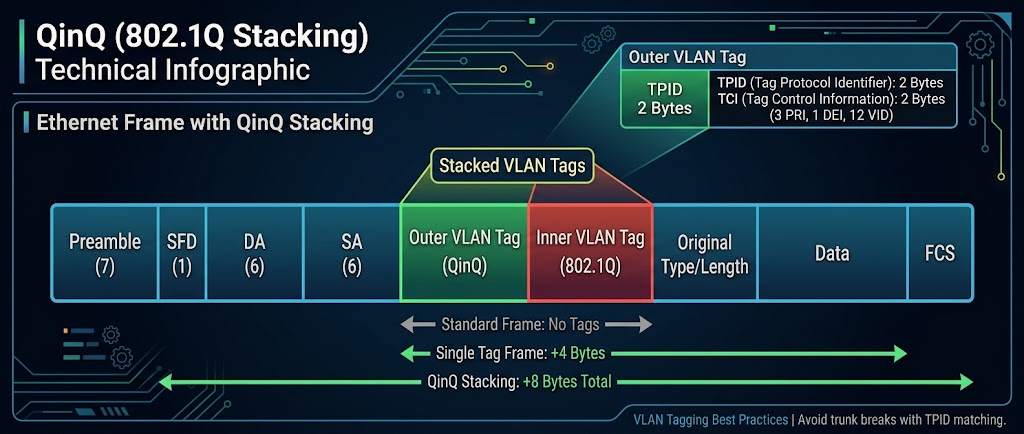
New on the Network Tools page: a VLAN / QinQ Tag Overhead Calculator. It exists because of the same problem that led to the MTU / Encapsulation Overhead Calculator — vendors don’t agree on what a config knob actually means, and it costs you an afternoon before you find that out.
The history behind this one
The MTU tool exists because mtu isn’t the same number on every platform. Classic Cisco IOS treats it as the L3 payload size. Junos and IOS-XR fold the 14-byte Ethernet header into it. Same command, same-looking number, two different frames on the wire — and the failure mode is never an error message, it’s just silent fragmentation or a black-holed jumbo-frame flow that only shows up under load.
Worth Reading: On AI Coding and Its Discontents
A lot of AI-coding enthusiasts are making claims along the lines of “AI coding tools are like compilers; you supply intent, they translate it into code, and who ever looked at the machine-code output?” Unfortunately, there is a bit of a gap between hope and reality; traditional compilers were always deterministic, and are (after decades of development and bug-fixing) pretty much bug-free. AI coding tools are neither, and no amount of “agentic loops” will solve that.
PP122: Using Burp Suite to Understand How Apps Collect and Share Our Data
Zack Whittaker is a journalist for TechCrunch and author of the newsletter “This Week In Security.” He recently wrote a post describing how he uses Burp Suite, an open source penetration testing tool, to see what data apps are collecting from users, and what other sites those apps share that data with. Zack joins JJ... Read more »BGP Role model: tracking the adoption of RFC 9234
Route leaks push traffic down paths it was never meant to take. We have written and spoken publicly in the past about route leaks in Border Gateway Protocol (BGP), depicting these events as impactful incidents that cause misdirection of traffic through unintended network paths. BGP routing is driven by the relationships between Autonomous Systems (ASes), i.e., customer-provider and peer-peer. Customers pay providers for access to the rest of the Internet, while peers exchange traffic with one another typically under a “settlement-free” arrangement where no money changes hands. These relationships help define routing rules that form plausible paths. For example, the rules form a “valley-free” hierarchy of how routes should propagate: a route learned from a provider or a peer should be announced only downward to customers, never back up to another provider or peer. Rules like this express an intent or expectation about Internet routes. A route leak is what happens when that intent is violated.
Historically, each network has had to implement this intent on its own, using complex, error-prone routing policies. RFC 9234 (Route Leak Prevention and Detection Using Roles in UPDATE and OPEN Messages) simplifies this by expressing intent within the protocol Continue reading
HS140: AI and Technical Debt – Boon or Bane?
Does AI increase or reduce technical debt? Join Johna Johnson and John Burke as they discuss how to make strategy in environments in which AI fuels untrammeled growth in enterprise complexity–but also points the way to automated optimization (and concomitant technical debt reduction). Episode Links: Watch this episode on YouTube The AI Technical Debt Crisis:... Read more »
Exploring the BGP Neighbor CONNECT State
Sakar left an interesting comment on my The Curious Case of the BGP Connect State blog post, claiming that Cisco IOS/XE goes through a CONNECT state when opening an incoming BGP session.
I wanted to double-check this behavior, so I needed a scenario where one router would keep sending TCP SYN requests, the other would not (or we wouldn’t learn anything), and the two routers could not communicate (or they’d quickly go into the OPEN state).
Here’s my first attempt at meeting those requirements:
Broadband RF scanner revisited
I have previously blogged about doing RF surveys using software defined radio. The most interesting aspect to me has been to inventory the business of the different WiFi channels, in order to not clash with neighbouring access points.
I’ve now written better software for doing these surveys.
2.4GHz is a mess (overlapping channels), has much less spectrum, and goes through walls more than 5GHz worth. There’s also a bunch of other crap on 2.4GHz polluting the airwaves, including microwave ovens. So if you’ve thought about this at all, you know to stay off of 2.4GHz.
It’s tempting to get a QuadRF in order to add more dimensions to the 5GHz RF survey, but so far I’ve resisted buying this particular toy.
I’m plotting the spectrum power in both dB and linear. With linear scale the busyness really pops.
2.4GHz
As expected, this is a mess:
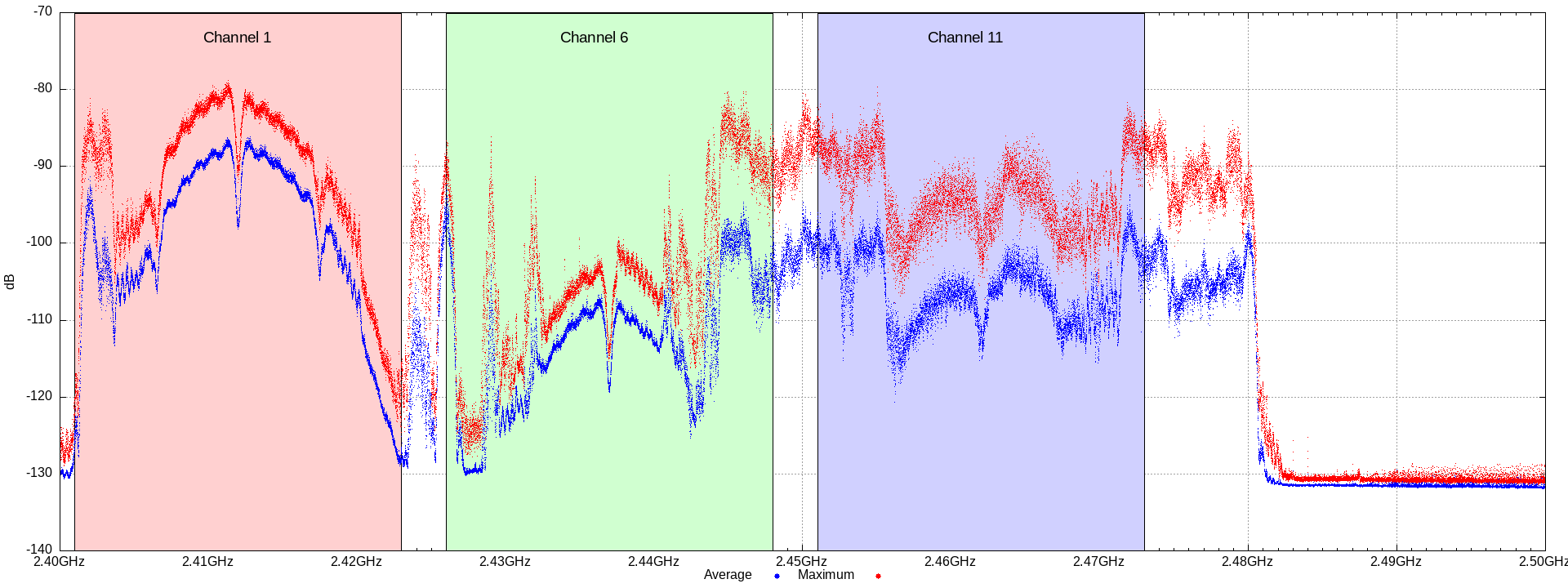
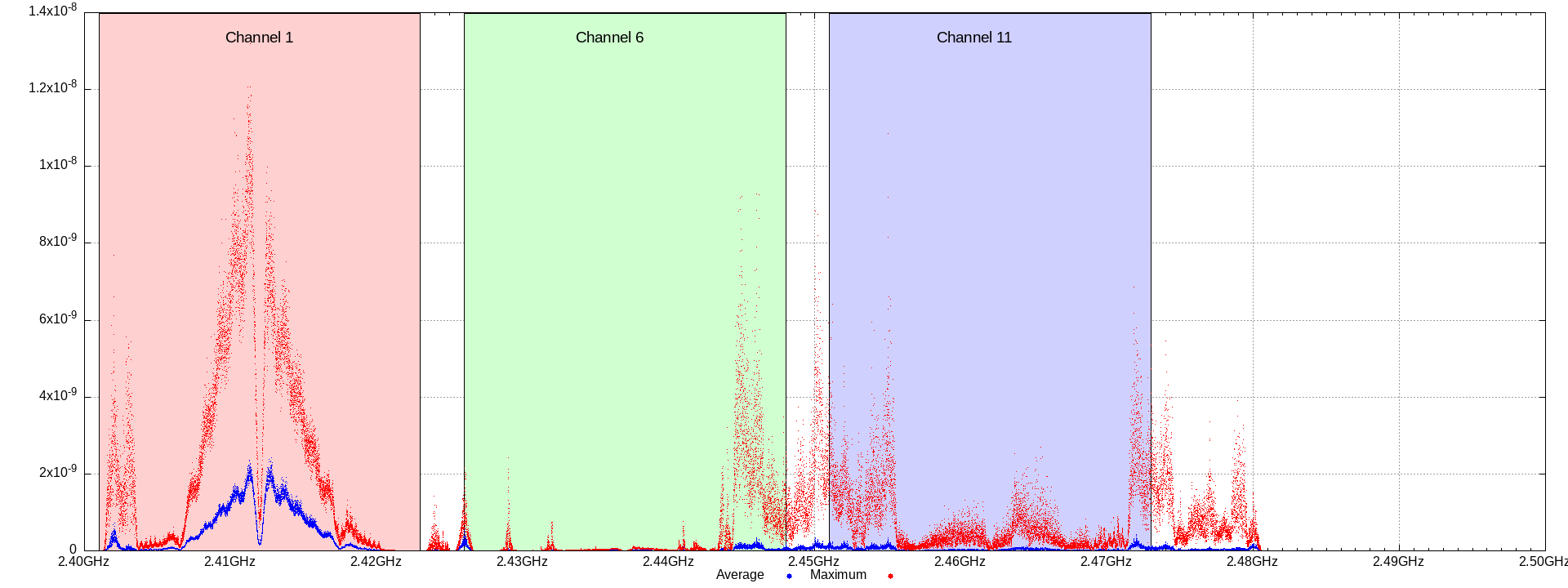
There’s even a bunch of noise between the channels. Is it microwaves? Or someone running the 1/5/9/13 channel split? No, if anything it looks like channel 14, which is not legal here.
5GHz
Background traffic
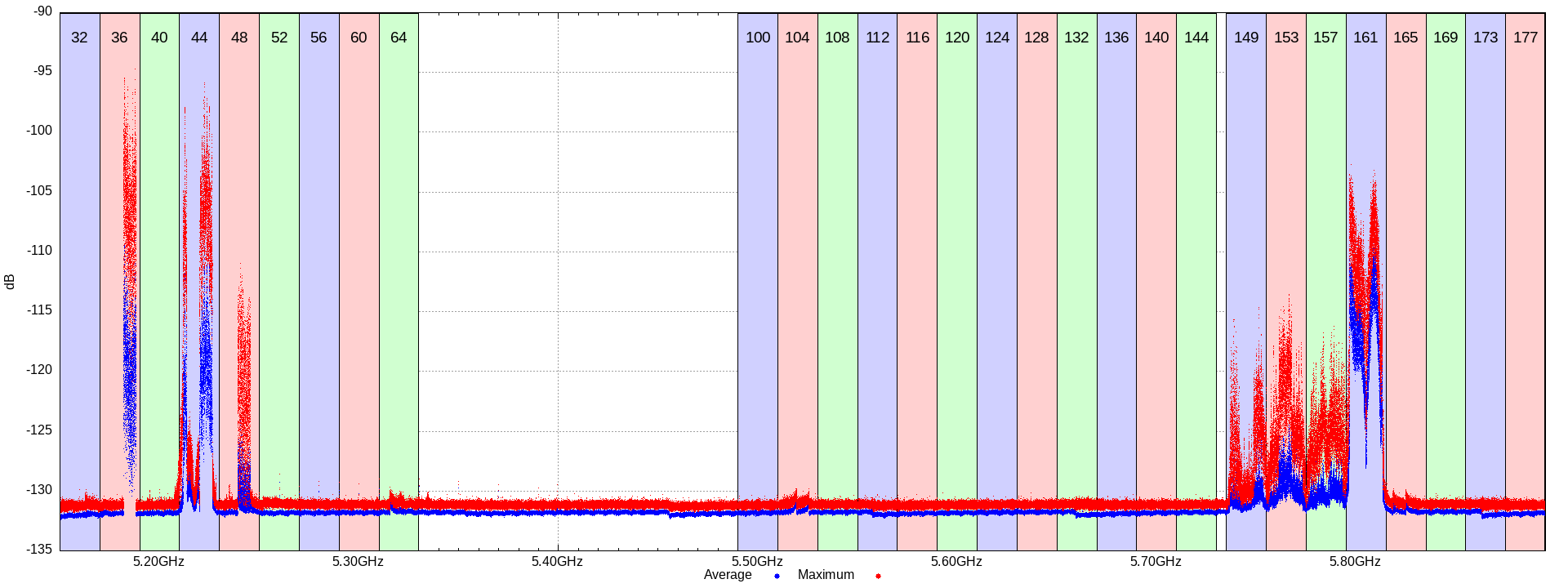
Busy
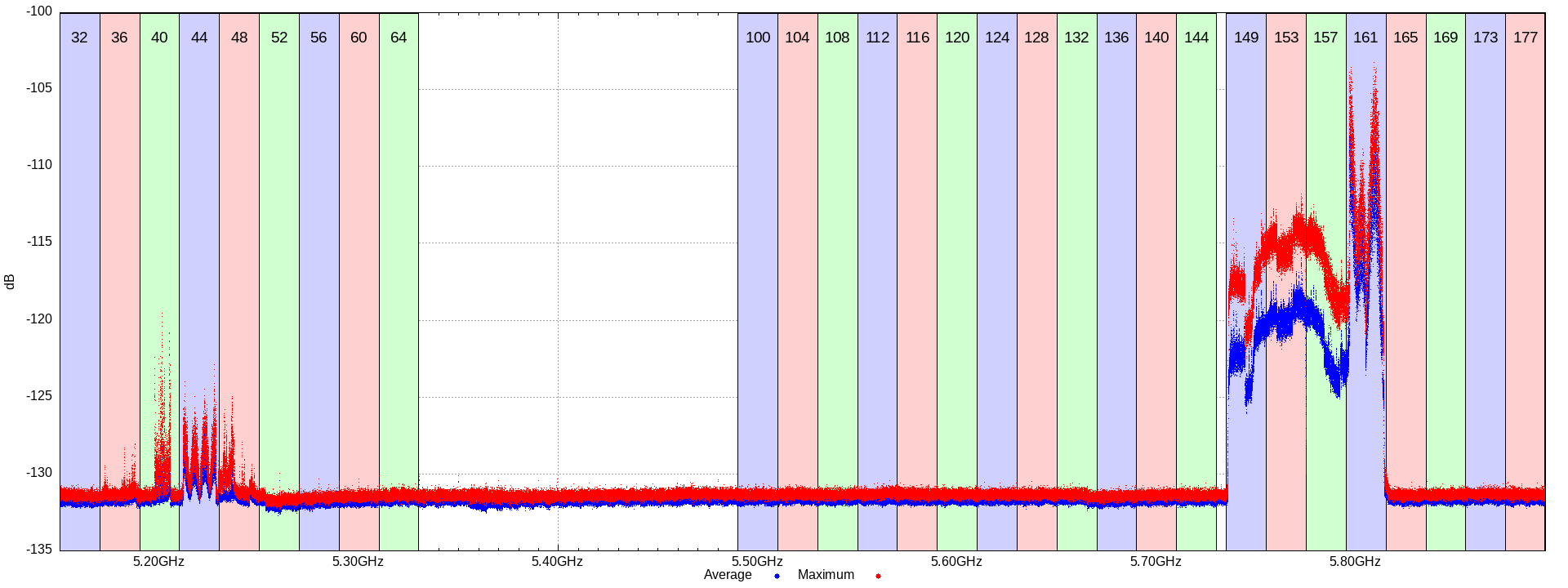
As a power WiFi user I started using U-NII-3 channels (149-165) as soon as they Continue reading
SONiC Deep Dive: Intra-Switch Inter-VLAN Routing and Packet Forwarding
The title of this section might seem a little
overwhelming, but it reflects the focus of the chapter. The SONiC Redis
database programming pipeline is examined through the configuration of two
Layer-2 VLANs, VLAN 10 and VLAN 20, together with their respective Layer-3
routing interfaces.
VLAN 10 and VLAN 20 represent two separate
Layer-2 broadcast domains, with each VLAN associated with its own IP subnet.
VLAN 10 uses the 10.0.10.0/24 subnet, while VLAN 20 uses the 10.0.20.0/24
subnet. Because the two hosts belong to different broadcast domains and IP
subnets, communication between them requires Layer-3 routing. In this example,
the routing is performed locally by Leaf-1 through the routing interfaces
configured for the two VLANs.
Figure 5-15 depicts the basic building blocks
and IP addressing scheme used in this example. PC1, with IP address
10.0.10.101/24, belongs to VLAN 10 and is connected to the Leaf-1 Ethernet0
interface. PC2, with IP address 10.0.20.101/24, belongs to VLAN 20 and is
connected to the Leaf-1 Ethernet1 interface. The routing interfaces for VLAN 10
and VLAN 20 use IP addresses 10.0.10.1/24 and 10.0.20.1/24, respectively.
The Continue reading