Headcount: Firings, Hirings, and Retirings — May 2020
Nutanix furloughed 25% of its workforce, saying COVID-19 is to blame; SAP cloud CFO jumped ship;...
© SDxCentral, LLC. Use of this feed is limited to personal, non-commercial use and is governed by SDxCentral's Terms of Use (https://www.sdxcentral.com/legal/terms-of-service/). Publishing this feed for public or commercial use and/or misrepresentation by a third party is prohibited.
6G Concepts Gain Backing Amid Political Smacking
Efforts to develop what comes after 5G are gaining momentum, but it’s more of a rallying cry to...
© SDxCentral, LLC. Use of this feed is limited to personal, non-commercial use and is governed by SDxCentral's Terms of Use (https://www.sdxcentral.com/legal/terms-of-service/). Publishing this feed for public or commercial use and/or misrepresentation by a third party is prohibited.
Worth Reading: Emerging Communications Technologies
Every few years someone within the ITU-T (the standard organization that mattered when we were still dealing with phones, virtual circuits and modems) realizes how obsolete they are and tries to hijack and/or fork the Internet protocol development. Their latest attempt is the “New IP” framework, and Geoff Huston did a great job completely tearing that stupidity apart in his May 2020 ISP column. My favorite quote:
It’s really not up to some crusty international committee to dictate future consumer preferences. Time and time again these committees with their lofty titles, such as “the Focus Group on Technologies for Network 2030” have been distinguished by their innate ability to see their considered prognostications comprehensively contradicted by reality! Their forebears in similar committees missed computer mainframes, then they failed to see the personal computer revolution, and were then totally surprised by the smartphone.
Enjoy!
On this 8th World IPv6 Launchiversary, Help Us Get More Websites Available Over IPv6
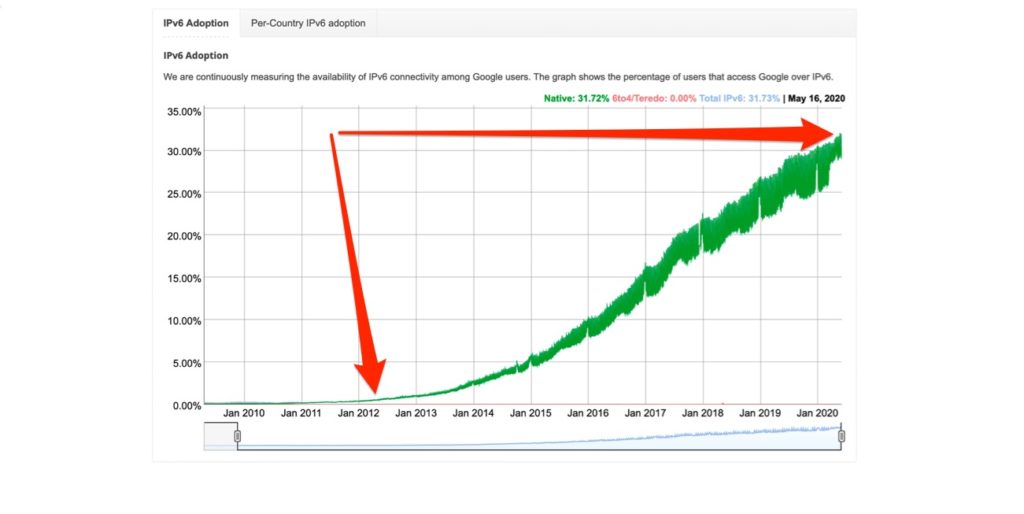
Eight years ago, on June 6, 2012, thousands of companies and organizations came together as part of World IPv6 Launch to permanently enable IPv6 for their websites and networks.
Today, we can see the success! If you visit the World IPv6 Launch measurements site, you can see some amazing numbers:
- Reliance Jio’s network in India has over 90% IPv6 deployment!
- Comcast’s huge network in the US is at 73% IPv6.
- The combined US wireless carriers are over 85% IPv6.
- Deutsche Telekom is over 68% IPv6.
- Claro in Brazil is at 62% IPv6.
Another major source of info, Google’s IPv6 statistics, show that over 30% of all traffic to Googles sites globally is now over IPv6. If you look at Google’s per-country IPv6 adoption, some countries are seeing up around 50% of all traffic to Google’s properties going over IPv6.
This is all fantastic to see. But of course, we want more IPv6 deployment!
Specifically, we want more web sites and services available over IPv6. Increasing numbers of IPv6-only mobile networks are being deployed around the world. To ensure that people can reach websites that are still only available over IPv4, many IPv6-only networks use IPv6-to-IPv4 gateways. But we Continue reading
Daily Roundup: VMware Lassos Lastline
VMware lassoed Lastline to boost security NDR; How to train employees not to fall for phishing...
© SDxCentral, LLC. Use of this feed is limited to personal, non-commercial use and is governed by SDxCentral's Terms of Use (https://www.sdxcentral.com/legal/terms-of-service/). Publishing this feed for public or commercial use and/or misrepresentation by a third party is prohibited.
Weekend Reads 060520
Memory isolation is a cornerstone security feature in the construction of every modern computer system. Allowing the simultaneous execution of multiple mutually distrusting applications at the same time on the same hardware, it is the basis of enabling secure execution of multiple processes on the same machine or in the cloud. The operating system is in charge of enforcing this isolation, as well Continue reading
Ciena Posts Strong Q2 Earnings Beat
Revenues during the quarter reached $894 million, up 3.4% year over year, exceeding investor...
© SDxCentral, LLC. Use of this feed is limited to personal, non-commercial use and is governed by SDxCentral's Terms of Use (https://www.sdxcentral.com/legal/terms-of-service/). Publishing this feed for public or commercial use and/or misrepresentation by a third party is prohibited.
VMware Buys Lastline to Boost Security NDR
Lastline is known for its anti-malware research and artificial intelligence-powered network...
© SDxCentral, LLC. Use of this feed is limited to personal, non-commercial use and is governed by SDxCentral's Terms of Use (https://www.sdxcentral.com/legal/terms-of-service/). Publishing this feed for public or commercial use and/or misrepresentation by a third party is prohibited.
Heavy Networking 521: Diving Into Dell Technologies’ SONiC Network OS For The Enterprise (Sponsored)
Today's Heavy Networking podcast explores Dell Technologies' SONiC network OS for enterprises. This distro offers hardware support across multiple ASIC platforms and full enterprise support. We dive into technical details, discuss the business and operational value propositions, explore use cases, and more. Dell Technologies is our sponsor for this episode. Our guest is Alley Hasan, Director, Product Strategy and Business Development.
The post Heavy Networking 521: Diving Into Dell Technologies’ SONiC Network OS For The Enterprise (Sponsored) appeared first on Packet Pushers.
Heavy Networking 521: Diving Into Dell Technologies’ SONiC Network OS For The Enterprise (Sponsored)
Today's Heavy Networking podcast explores Dell Technologies' SONiC network OS for enterprises. This distro offers hardware support across multiple ASIC platforms and full enterprise support. We dive into technical details, discuss the business and operational value propositions, explore use cases, and more. Dell Technologies is our sponsor for this episode. Our guest is Alley Hasan, Director, Product Strategy and Business Development.Attention Resource Deficit

How much did your last laptop cost? You probably know down to the penny. How much time did it take for you to put together your last Powerpoint deck or fix an issue for a customer? You can probably track that time in the hours you recorded on your timesheet. What about the last big meeting you had of the department? Can you figure out how many hours combined of time that it took to get the business discussed? Pretty easy to calculate when you know how many people and how long it took.
All of these examples are ways that we track resources in the workplace. We want to know how many dollars were invested in a particular tool. We want to figure out how many hours someone has worked on a project or a proposal. We want to know how much of the company’s resources are being invested so we can track it and understand productivity and such. But when’s the last time you tracked your personal resources? I’m not talking about work you do or money you spend. I’m talking about something more personal than that. Because one of the things that I’ve seen recently that is Continue reading
How to Train Employees Not to Fall for Phishing Attacks
“I know it’s an extremely overused term in security awareness, but gamification is extremely...
© SDxCentral, LLC. Use of this feed is limited to personal, non-commercial use and is governed by SDxCentral's Terms of Use (https://www.sdxcentral.com/legal/terms-of-service/). Publishing this feed for public or commercial use and/or misrepresentation by a third party is prohibited.
How we use HashiCorp Nomad
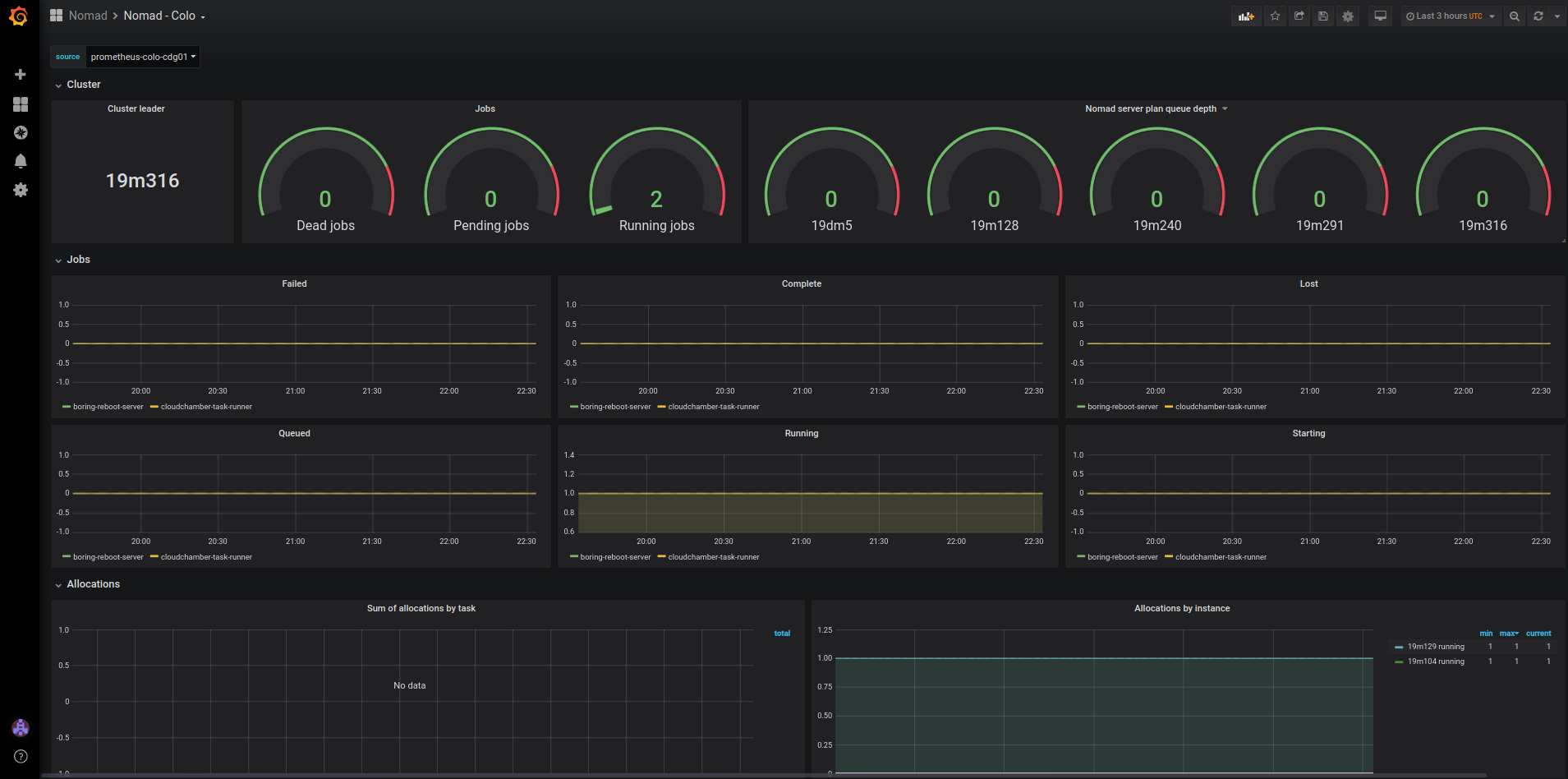
In this blog post, we will walk you through the reliability model of services running in our more than 200 edge cities worldwide. Then, we will go over how deploying a new dynamic task scheduling system, HashiCorp Nomad, helped us improve the availability of services in each of those data centers, covering how we deployed Nomad and the challenges we overcame along the way. Finally, we will show you both how we currently use Nomad and how we are planning on using it in the future.
Reliability model of services running in each data center
For this blog post, we will distinguish between two different categories of services running in each data center:
- Customer-facing services: all of our stack of products that our customers use, such as caching, WAF, DDoS protection, rate-limiting, load-balancing, etc.
- Management services: software required to operate the data center, that is not in the direct request path of customer traffic.
Customer-facing services
The reliability model of our customer-facing services is to run them on all machines in each data center. This works well as it allows each data center’s capacity to scale dynamically by adding more machines.
Scaling is especially made easy thanks to Continue reading
Weekly Wrap: Cisco Licks Wounds, Targets Next Cloud Computing Wave
SDxCentral Weekly Wrap for June 5, 2020: Cisco admits to missing cloud's first wave; ThousandEyes...
© SDxCentral, LLC. Use of this feed is limited to personal, non-commercial use and is governed by SDxCentral's Terms of Use (https://www.sdxcentral.com/legal/terms-of-service/). Publishing this feed for public or commercial use and/or misrepresentation by a third party is prohibited.
Video: Public Cloud Networking Overview
Donal O Duibhir was trying to get me to present at INOG for ages, and as much as I’d love to get to Ireland we always had a scheduling conflict.
Last week we finally made it work - unfortunately only in a virtual event, so I got none of the famous Irish beer - and the video about alternate universes of public cloud networking is already online.
Maximilian Wilhelm had great fun turning my usual black-and-white statements into tweets, here’s a selection of them:
DevAsc – Introduction to JSON
Introduction
JSON, JavaScript Object Notation, is one of the usual suspects when it comes to network automation. YAML and XML being the other two. It’s easy for machines to parse and generate and the readability is good, better than XML, although YAML is easier for humans to read.
JSON is based on a subset of the JavaScript programming language, as the name implies.
JSON, just like YAML, supports single values, lists, and key/value pairs.
JSON is commonly used to interchange between different formats.
Syntax
JSON has no requirement for indentation or white space, which YAML has. That said, to make it human readable, it still makes sense to use white space and spaces, most likely either two or four.
- Strings MUST use double quotes
- Object literal names MUST be lowercase (null, false, true etc)
- Special characters need to be escaped
- { says “begin object”
- } says “end object”
- [ says “begin array”
- ] says “end array”
- : separates key and value in key/value pair
- , separates key/value pair in an object or separates values in an array, think of it as “expect another one”
Data Types
JSON supports the following data types:
- Object
- String
- Number
- Boolean
- Null
- Array
We’ll Continue reading
Palo Alto Networks, Inc. Announces Proposed $1.75 Billion Offering of Convertible Senior Notes Due 2025
Palo Alto Networks will offer $1.75 billion aggregate principal amount of convertible senior notes...
© SDxCentral, LLC. Use of this feed is limited to personal, non-commercial use and is governed by SDxCentral's Terms of Use (https://www.sdxcentral.com/legal/terms-of-service/). Publishing this feed for public or commercial use and/or misrepresentation by a third party is prohibited.
Cisco Catches Dozens of IOS Security Bugs
The security vulnerabilities could have allowed attackers to gain remote access and execute...
© SDxCentral, LLC. Use of this feed is limited to personal, non-commercial use and is governed by SDxCentral's Terms of Use (https://www.sdxcentral.com/legal/terms-of-service/). Publishing this feed for public or commercial use and/or misrepresentation by a third party is prohibited.