Today's Tech Bytes dives into failsafe SD-WAN with sponsor Oracle. We discuss how Oracle provides Quality of Experience through techniques such as continuous unidirectional measurement and sub-second response to network events. Our guest is Andy Gottlieb, VP, SD-WAN Solutions at Oracle.
I recorded the hands-on demos in advance so we had plenty of time to discuss Azure API and CLI, geographies, regions and availability zones, high-availability concepts, and deployments models… and spent the second half of the live session focusing on virtual networks, subnets, interface, and IP addresses. The videos are already online and accessible with Standard ipSpace.net Subscription.
Next step (on September 24th): network security and user-defined routes.
We haven’t covered a blockchain paper on The Morning Paper for a while, and today’s choice won the best paper award at VLDB’19. The goal here is to enable smart contracts to be written in which the contract logic depends on the history, or provenance of its inputs.
For example, a contract that sends a reward amount of tokens to a user based on that user’s average balance per day over some period.
That’s hard to do in today’s blockchain systems for two reasons:
Provenance can only be determined by querying and replaying all on-chain transactions, which is inefficient and an offline activity.
As a consequence the computation of provenance and issuing a subsequent transaction are decoupled and hence there are no serializability guarantees. “In blockchains with native currencies, serializabiliy violations can be exploited for Transaction-Ordering attacks that cause substantial financial loss to the users.”
In other words, smart contracts cannot access historical blockchain states in a tamper-evident manner.
In designing a blockchain-friendly provenance mechanism, three aspects unique to the blockchain environment differentiate the problem from that of traditional database provenance:
I apologize to my regular readers for a completely off-topic post, but if I manage to save a single traveller the frustrations I experienced a few weeks ago it was well worth it. Also, please help spread the word…
TL&DR: If you travel to Slovenia, DO NOT even consider flying with Adria Airways (and carefully check the code-share flights, they might be hiding under a Lufthansa or Swiss flight number). Their actual flight schedule is resembling a lottery, and while I always had great experience with the friendly, courteous and highly professional cabin crews, it’s totally impossible to reach their customer service.
2019-09-30: The agony ended sooner than I expected. On September 30th Adria Airways declared bankruptcy, ending the frustration and uncertainty of thousands of passengers they left stranded across Europe for almost 10 days. So long Adria, and thanks for all the good flights (we'll eventually forget all the mess you made in the last year)
2019-09-22: Added updates on what happened during last week. The whole thing is becoming a soap opera
TFW adding the 301st subscriber to your bridged WISP….
Why are bridged networks so popular?
Getting an ISP network started can be a daunting task. Especially, if you don’t have a networking background.
Understanding L1/L2/L3 is not easy – I spent a number of years working in IT before I really started to grasp concepts like subnetting, the OSI model and Layer 2 vs. Layer 3. It takes a while.
Bridged networks are very attractive when first starting out. No subnetting is required and the entire network can be NATted out an upstream router with minimal configuration.
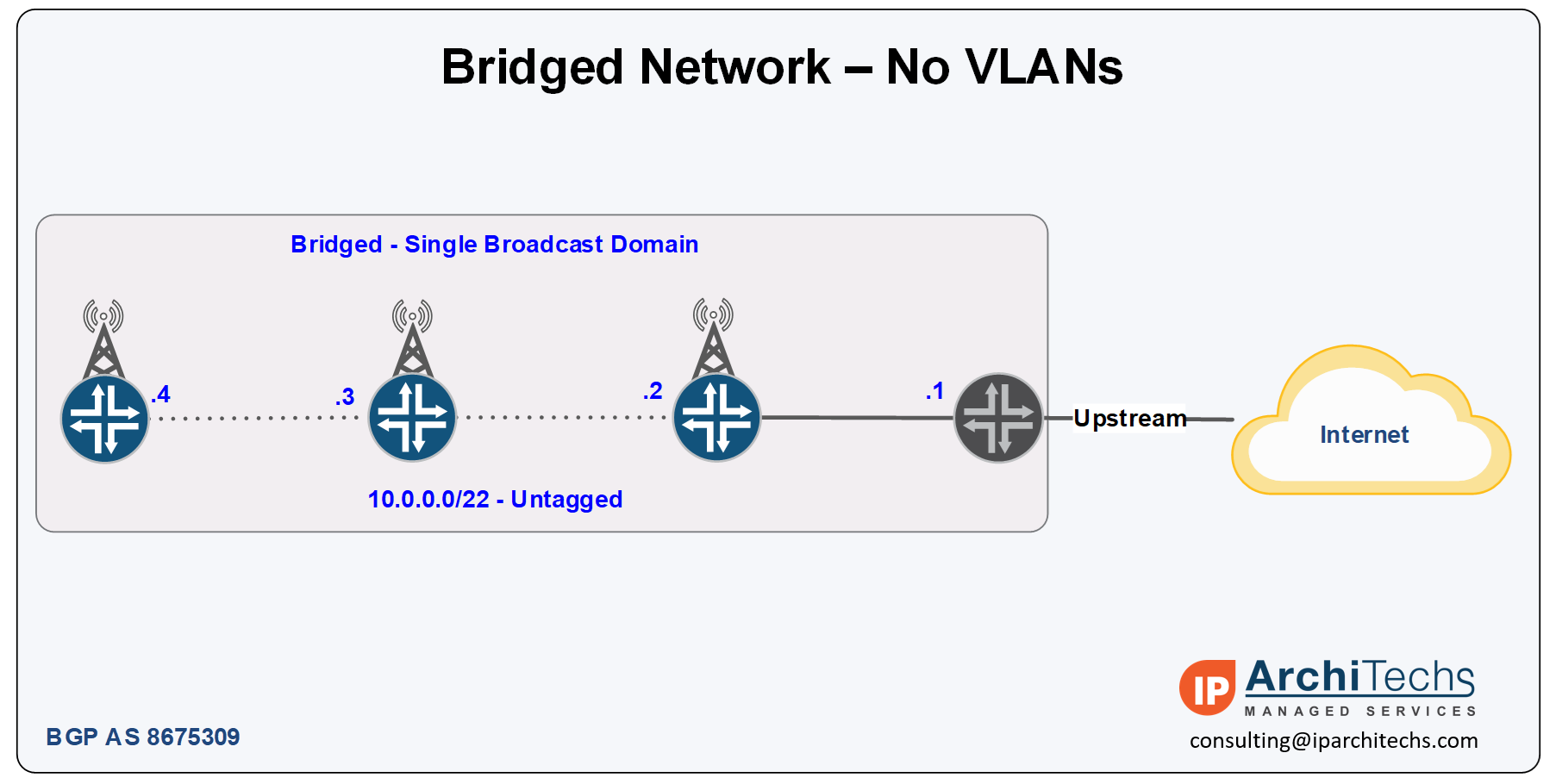
What does a “bridged” network look like?
Bridged networks use a single Layer 3 subnet across the same Layer 2 broadcast domain (typically over switches and software/hardware bridges) which is extended to all towers in the WISP
Bridging can be done with or without VLANs but they are most commonly untagged.
The diagram below is a very common example of a bridged WISP network.
What is the difference between switching and bridging?
These days, there isn’t much difference between the two terms, switch is a marketing term for a multiport hardware-accelerated bridge that became popular in the 1990s to Continue reading
TFW adding the 301st subscriber to your bridged WISP….
Why are bridged networks so popular?
Getting an ISP network started can be a daunting task. Especially, if you don’t have a networking background.
Understanding L1/L2/L3 is not easy – I spent a number of years working in IT before I really started to grasp concepts like subnetting, the OSI model and Layer 2 vs. Layer 3. It takes a while.
Bridged networks are very attractive when first starting out. No subnetting is required and the entire network can be NATted out an upstream router with minimal configuration.
What does a “bridged” network look like?
Bridged networks use a single Layer 3 subnet across the same Layer 2 broadcast domain (typically over switches and software/hardware bridges) which is extended to all towers in the WISP
Bridging can be done with or without VLANs but they are most commonly untagged.
The diagram below is a very common example of a bridged WISP network.
What is the difference between switching and bridging?
These days, there isn’t much difference between the two terms, switch is a marketing term for a multiport hardware-accelerated bridge that became popular in the 1990s to Continue reading
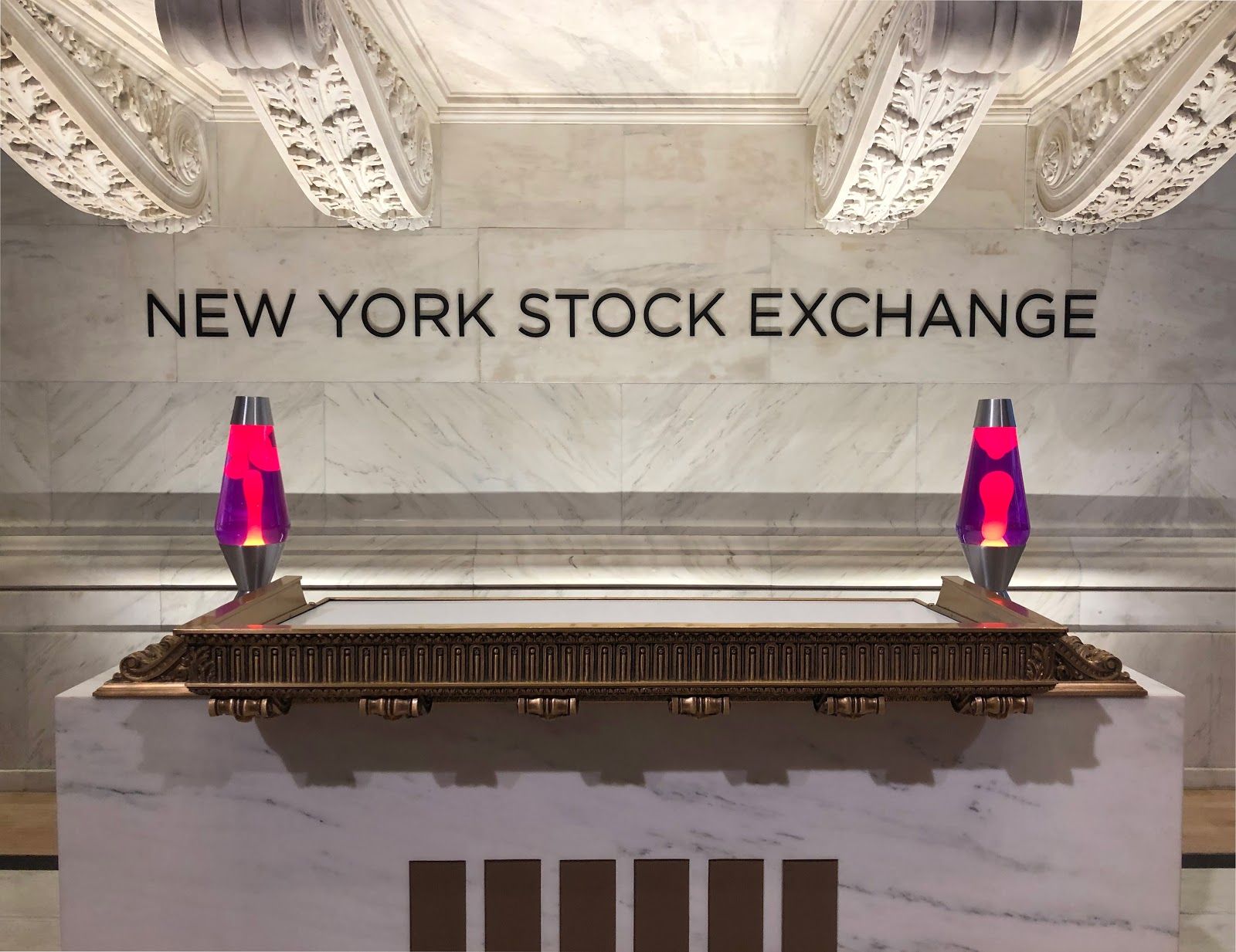
Today has been a big day for Cloudflare, as we became a public company on the New York Stock Exchange (NYSE: NET). To mark the occasion, we decided to bring our favorite entropy machines to the floor of the NYSE. Footage of these lava lamps is being used as an additional seed to our entropy-generation system LavaRand — bolstering Internet encryption for over 20 million Internet properties worldwide.
(This is mostly for fun. But when’s the last time you saw a lava lamp on the trading floor of the New York Stock Exchange?)
A little context: generating truly random numbers using computers is impossible, because code is inherently deterministic (i.e. predictable). To compensate for this, engineers draw from pools of randomness created by entropy generators, which is a fancy term for "things that are truly unpredictable".
It turns out that lava lamps are fantastic sources of entropy, as was first shown by Silicon Graphics in the 1990s. It’s a torch we’ve been proud to carry forward: today, Cloudflare uses lava lamps to generate entropy that helps make millions of Internet properties more secure.
Housed in our San Francisco headquarters is a wall filled with dozens of lava lamps, Continue reading
What's lurking in the shadows of YOUR organization? What you don't know can hurt you. Insider Pro columnist Mike Elgan looks at how your business is at risk and offers six steps to minimize it.
What's lurking in the shadows of YOUR organization? What you don't know can hurt you. Insider Pro columnist Mike Elgan looks at how your business is at risk and offers six steps to minimize it.
The speed bumps with switch ASICs are coming fast and furious these days, and the datacenter is no longer dominated by the big switch incumbents such as Cisco Systems and Juniper Networks, which made their own chips, switches, and operating systems, and the networking divisions of server OEMs like Dell and Hewlett Packard Enterprise, which made some of their own gear – including ASICs – and acquired other companies to help build out their networking businesses – who sometimes also did their own ASICs. …
Today's Heavy Networking welcomes back sponsor Arrcus to discuss the latest advancements in its ArcOS NOS, including support for Jericho2 ASICs, the new ArcIQ Analytics platform, and the vote of confidence from investors in the form of a $30 million funding round. Our guests are Keyur Patel, CTO and founder; and Murali Gandluru, VP of Product Management.
When learning a new technology like Istio, it’s always a good idea to take a look at sample apps. Istio repo has a few sample apps but they fall short in various ways. BookInfo is covered in the docs and it is a good first step. However, it is too verbose with too many services for me and the docs seem to focus on managing the BookInfo app, rather than building it from ground up. There’s a smaller helloworld sample but it’s more about autoscaling than anything else.
In this post, I’d like to get to the basics and show you what it takes to build an Istio enabled ‘HelloWorld’ app from ground up. One thing to keep in mind is that Istio only manages the traffic of your app. The app lifecycle is managed by the underlying platform, Kubernetes in this case. Therefore, you need to understand containers and Kubernetes basics and you need to know about Istio Routing primitives such as Gateway, VirtualService, DestinationRuleupfront. I’m assuming that most people know containers and Kubernetes basics at this point. I will focus on Istio Routing instead in this post.
Dell EMC has updated its PowerMax line of enterprise storage systems to offer Intel’s Optane persistent storage and NVMe-over-Fabric, both of which will give the PowerMax a big boost in performance.Last year, Dell launched the PowerMax line with high-performance storage, specifically targeting industries that need very low latency and high resiliency, such as banking, healthcare, and cloud service providers.The company claims the new PowerMax is the first-to-market with dual port Intel Optane SSDs and the use of storage-class memory (SCM) as persistent storage. The Optane is a new type of non-volatile storage that sits between SSDs and memory. It has the persistence of a SSD but almost the speed of a DRAM. Optane storage also has a ridiculous price tag. For example, a 512 GB stick costs nearly $8,000.To read this article in full, please click here
Dell EMC has updated its PowerMax line of enterprise storage systems to offer Intel’s Optane persistent storage and NVMe-over-Fabric, both of which will give the PowerMax a big boost in performance.Last year, Dell launched the PowerMax line with high-performance storage, specifically targeting industries that need very low latency and high resiliency, such as banking, healthcare, and cloud service providers.The company claims the new PowerMax is the first-to-market with dual port Intel Optane SSDs and the use of storage-class memory (SCM) as persistent storage. The Optane is a new type of non-volatile storage that sits between SSDs and memory. It has the persistence of a SSD but almost the speed of a DRAM. Optane storage also has a ridiculous price tag. For example, a 512 GB stick costs nearly $8,000.To read this article in full, please click here