This is a really important paper for anyone working with language or generative models, and just in general for anyone interested in understanding some of the broader implications and possible unintended consequences of deep learning. There’s also a lovely sense of the human drama accompanying the discoveries that just creeps through around the edges.
Disclosure of secrets is of particular concern in neural network models that classify or predict sequences of natural language text… even if sensitive or private training data text is very rare, one should assume that well-trained models have paid attention to its precise details…. The users of such models may discover— either by accident or on purpose— that entering certain text prefixes causes the models to output surprisingly revealing text completions.
Take a system trained to make predictions on a language (word or character) model – an example you’re probably familiar with is Google Smart Compose. Now feed it a prefix such as “My social security number is “. Can you guess what happens next?
As a small scale demonstration, the authors trained a model on Continue reading
Moving the DNS from the access ISP to the browser may not necessarily enhance open competition in the DNS world. In today's Internet just two browsers, Chrome and Safari dominate the browser world with an estimated 80% share of all users. If the DNS becomes a browser-specific setting, then what would that mean for the DNS resolver market? And why should we care? It would be useful to understand what is going on in the DNS today, before there has been any major shift to adopt DoH or DoT by high-use applications such as browsers. Can we measure the level of DNS centrality in the Internet today?
September has always been a special month for Cloudflare. Nine years ago — on September 27th — we launched Cloudflare. And, each year since, we’ve celebrated our birthday with a week full of new products and innovations that support our mission of helping to build a better Internet.
Our mission guides everything we do. One of the most intentional words in our mission is ‘helping’. Building an Internet that can meet the world’s needs cannot be done by any one company or individual; rather, it takes a global community — from nonprofit organizations and businesses to governments and individuals — collaborating to deliver new standards, technologies, and innovations. We believe Cloudflare should be an active participant in the community and help where we can and should.
Our customers and partners are an active part of the community. I often say that customers are one of my favorite parts of my job (our team is my other favorite part). Our customers give us feedback all the time about what they'd like to see to make their Internet properties more secure, more performant and more reliable. Our partners bring forward standards to help make the Internet run more smoothly. For Birthday Week Continue reading
I am doing some prototyping for a project and part of this includes becoming more familiar with the NATS project, including its Go client (since all of the components in my project that will be talking to NATS are written in Go). In short, I have a bunch of little services that need to talk to each other, and a message broker like NATS fits the bill.
One thing that drew me to NATS specifically is that it is unapologetically - nay, proudly - simple.
I am doing some prototyping for a project and part of this includes becoming more familiar with the NATS project, including its Go client (since all of the components in my project that will be talking to NATS are written in Go). In short, I have a bunch of little services that need to talk to each other, and a message broker like NATS fits the bill.
One thing that drew me to NATS specifically is that it is unapologetically - nay, proudly - simple.
People who can explain complex topics in simple terms, or focus on the essentials of a particular topic are exceedingly rare… and two of the best are Randall Munroe of the XKCD fame and Julia Evans, the mastermind behind WizardZines. I loved her recent curl and git exercises, and I’m guessing a lot of people in this industry would benefit from her latest HTTP zine.
Similarly to what I did a long time ago with ipSpace.net, Julia recently decided to go all-in, leaving her job and focusing on explaining things. I hope it will work out and we’ll keep enjoying her tidbits of wisdom for years to come.
Solid-state drives (SSDs) operate by writing to cells within the chip, and after so many writes, the cell eventually dies off and can no longer be written to. For that reason, SSDs have more actual capacity than listed. A 1TB drive, for example, has about 1.2TB of capacity, and as chips die off from repeated writes, new ones are brought online to keep the 1TB capacity.But that's for gradual wear. Sometimes SSDs just up and die completely, and without warning after a whole chip fails, not just a few cells. So Samsung is trying to address that with a new generation of SSD memory chips with a technology it calls fail-in-place (FIP).To read this article in full, please click here
If you are deploying an enterprise QoS scheme, wireless QoS matters to you. On today's episode, we go through the basics of wireless QoS, covering some of the standards, terminology, and thinking required to get your head around how we can prioritize packets over a shared medium. Our guest is Ryan Adzima.
In an age when every company is a technology business, digital transformation becomes imperative for enterprises to remain competitive. The first wave of digital transformation focused on moving workloads to the cloud. Enterprises undergoing large-scale digital transformations centralized data processing and storage by migrating entire operations to public or private cloud services. The recent influx of connected devices and the resulting data explosion is putting a strain on this model, and now companies are looking toward the next wave of transformation that will move them closer to the edge and their customers.Today, the explosion of IoT devices, autonomous vehicles, robotic systems, and other digital platforms has resulted in a deluge of data and a vast expansion at the edge of the network. This is putting a strain on the network and requires new ways of processing, analyzing, and acting on this data in real time. This intersection of new technologies and the massive amounts of data they produce put us at an inflection point when we consider the architectures that will help us manage the global economy.To read this article in full, please click here
In 2019, CISOs struggle more than ever to contain and counter cyberattacks despite an apparently flourishing IT security market and hundreds of millions of dollars in venture capital fueling yearly waves of new startups. Why?
If you review the IT security landscape today, you’ll find it crowded with startups and mainstream vendors offering solutions against cybersecurity threats that have fundamentally remained unchanged for the last two decades. Yes, a small minority of those solutions focus on protecting new infrastructures and platforms (like container-based ones) and new application architecture (like serverless computing), but for the most part, the threats and attack methods against these targets have remained largely the same as in the past.
This crowded market, propelled by increasing venture capital investments, is challenging to assess, and can make it difficult for a CISO to identify and select the best possible solution to protect an enterprise IT environment. On top of this, none of the solutions on the market solve all security problems, and so the average security portfolio of a large end user organization can often comprise of dozens of products, sometimes up to 50 different vendors and overlap in multiple areas.
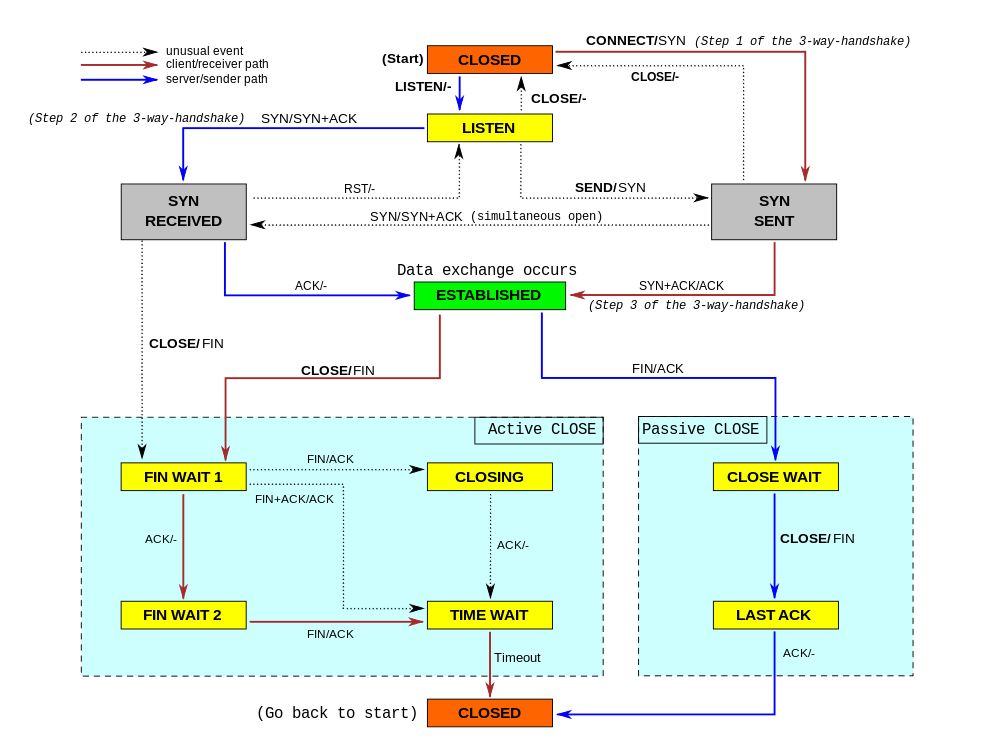
While working on our Spectrum server, we noticed something weird: the TCP sockets which we thought should have been closed were lingering around. We realized we don't really understand when TCP sockets are supposed to time out!
In our code, we wanted to make sure we don't hold connections to dead hosts. In our early code we naively thought enabling TCP keepalives would be enough... but it isn't. It turns out a fairly modern TCP_USER_TIMEOUT socket option is equally as important. Furthermore it interacts with TCP keepalives in subtle ways. Many people are confused by this.
In this blog post, we'll try to show how these options work. We'll show how a TCP socket can timeout during various stages of its lifetime, and how TCP keepalives and user timeout influence that. To better illustrate the internals of TCP connections, we'll mix the outputs of the tcpdump and the ss -o commands. This nicely shows the transmitted packets and the changing parameters of the TCP connections.
SYN-SENT
Let's start from the simplest case - what happens when one attempts to establish a connection to a server which discards inbound SYN packets?
Do you like this sort of Stuff? I'd love your support on Patreon. I wrote Explain the Cloud Like I'm 10 for people who need to understand the cloud. And who doesn't these days? On Amazon it has 54 mostly 5 star reviews (125 on Goodreads). They'll learn a lot and likely add you to their will.
Number Stuff:
Don't miss all that the Internet has to say on Scalability, click below and become eventually consistent with all scalability knowledge (which means this post has many more items to read so please keep on reading)...
Docker support for cross-platform applications is better than ever. At this month’s Docker Virtual Meetup, we featured Docker Architect Elton Stoneman showing how to build and run truly cross-platform apps using Docker’s buildx functionality.
With Docker Desktop, you can now describe all the compilation and packaging steps for your app in a single Dockerfile, and use it to build an image that will run on Linux, Windows, Intel and Arm – 32-bit and 64-bit. In the video, Elton covers the Docker runtime and its understanding of OS and CPU architecture, together with the concept of multi-architecture images and manifests.
The key takeaways from the meetup on using buildx:
Everything should be multi-platform
Always use multi-stage Dockerfiles
buildx is experimental but solid (based on BuildKit)
Alternatively use docker manifest — also experimental
Terry Slattery has a distinguished career in networking and is well known for his contributions to the Cisco CLI, being the second person to obtain the CCIE, providing consultation to many organizations, and the list goes on. If it’s happened in networking, there’s a very good chance that Terry has experience in it. Today Terry joins us to to talk about how he got started into networking and how he’s navigated a very successful career in networking.
How many times have your users come to your office and told you the wireless was down? Or maybe you get a phone call or a text message sent from their phone. If there’s a way for people to figure out that the wireless isn’t working they will not hesitate to tell you about it. But is it always the wireless?
Path of Destruction
During CWNP Wi-Fi Trek 2019, Keith Parsons (@KeithRParsons) gave a great talk about Tips, Techniques, and Tools for Troubleshooting Wireless LAN. It went into a lot of detail about how many things you have to look at when you start troubleshooting wireless issues. It makes your head spin when you try and figure out exactly where the issues all lie.
However, I did have to put up a point that I didn’t necessarily agree with Keith on:
So, I will take a point here to disagree with @KeithRParsons: If your problem with your wireless is in the network side of things, it’s still a wireless problem (to your users). Just like a problem in the network between a SAN and a VM is still a storage problem to the users.