SDxCentral’s Weekly Roundup — April 20, 2018
 Huawei enhances its storage platform; Orange and Siemens partner on industrial IoT; Equinix completes $804 million acquisition of Metronode.
Huawei enhances its storage platform; Orange and Siemens partner on industrial IoT; Equinix completes $804 million acquisition of Metronode.

Breaking into an industry isn’t easy. When you look at the amount of material that is necessary to learn IT skills it can be daunting and overwhelming. Don’t let the for-profit trade school ads fool you. You can’t go from ditch digger to computer engineer in just a few months. It takes time and knowledge to get there.
However, there is one concept in non-technical job roles that feels very appropriate to how we do IT training, specifically for security. And that’s the apprenticeship.
Apprenticeship is a standard for electricians and carpenters. It’s the way that we train new people to do the work of the existing workforce. It requires time and effort and a lot of training. But, it also fixes several problems with the current trend of IT certification:
As we continue our work related to the upcoming General Data Protection Regulation (GDPR), we have published an updated Privacy Policy for all visitors to our websites. This version makes some minor clarifications to our previous Privacy Policy from August 2017.
We also published a Privacy Policy Frequently Asked Questions (FAQ) list with more details about how we comply with various provisions of the policy. If you have any questions about this, please contact me at [email protected].
See also:
The post Updated Privacy Policy with minor clarifications appeared first on Internet Society.

Cloudflare’s team of security analysts monitor for upcoming threats and vulnerabilities and where possible put protection in place for upcoming threats before they compromise our customers. This post examines how we protected people against a new major vulnerability in the Drupal CMS, nicknamed Drupalgeddon 2.
Two weeks after adding protection with WAF rule ID D0003 which mitigates the critical remote code execution Drupal exploit (SA-CORE-2018-002/CVE-2018-7600), we have seen significant spikes of attack attempts. Since the 13th of April the Drupal security team has been aware of automated attack attempts and it significantly increased the security risk score of the vulnerability. It makes sense to go back and analyse what happened in the last seven days in Cloudflare’s WAF environment.
The vulnerability potentially allows attackers to exploit multiple attack vectors on a Drupal site, which could make a site completely compromised.
Drupal introduced renderable arrays, which are a key-value structure, with keys starting with a ‘#’ symbol, that allows you to alter data during form rendering. These arrays however, did not have enough input validation. This means that an attacker could inject a custom renderable array on one of these keys in the form structure.
Hey, it's HighScalability time:
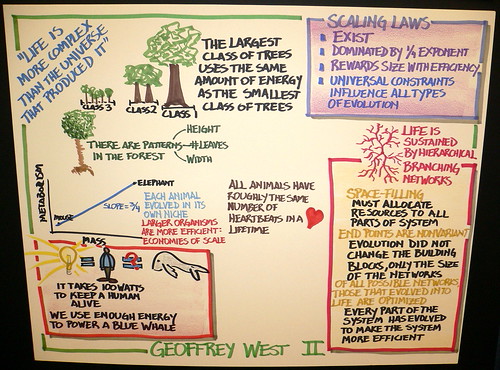
Freeman Dyson dissects Geoffrey West's book on universal scaling laws, Scale. (Image: Steve Jurvetson)
If you like this sort of Stuff then please support me on Patreon. And I'd appreciate if you would recommend my new book—Explain the Cloud Like I'm 10—to anyone who needs to understand the cloud (who doesn't?). I think they'll learn a lot, even if they're already familiar with the basics.
Security researchers have been warning about an ongoing malware campaign hijacking Internet routers to distribute Android banking malware that steals users’ sensitive information, login credentials and the secret code for two-factor authentication. In order to trick Continue reading
 That effort is supported by approximately 1,700 developers, with the carrier pushing around 30 Cloud Foundry updates per day.
In this Short Take Russ White argues that the traditional seven layer model for network communication is antiquated and inadequate in explaining modern networking. He also proposes an alternative model and invites everyone to the eventual funeral of the OSI seven layer model.


The post Short Take – Death Of The Seven Layer Model appeared first on Network Collective.
The Internet Society Elections Committee is pleased to announce the final results of the 2018 elections for the Board of Trustees. The voting concluded on 9 April 2018. The challenge period (for appeals) was opened on 11 April and closed on 18 April.
There were no challenges filed. Therefore the election results stand:
Also, following the process documented in RFC 3677, the Internet Architecture Board has selected and the IETF has confirmed:
to each serve second terms on the board.
The term of office for all 4 of these Trustees will be 3 years, commencing with the 2018 Annual General Meeting of the Internet Society, 29 June – 1 July.
The Elections Committee congratulates all of the new and renewing Trustees. We also extend our thanks again to all the candidates and to everyone who participated in the process this year.
The post 2018 Internet Society Board of Trustees Final Election Results & IETF Appointments appeared first on Internet Society.
Blockchain is a promising revolutionary technology, but must overcome scalability and other deployment issues.
The thing about platforms that have a wide adoption and deep history is that they tend to persist. They have such economic inertia that, so long as they can keep morphing and grafting on new technologies, that they persist long after alternatives have emerged and dominated data processing. Every company ultimately wants to build a platform for this reason, and has since the dawn of commercial computing, for precisely this reason, for this inertia – it takes too much effort to change or replace it – is what generates the profits.
It is with this in mind that we contemplate …
The Contradictions Of IBM’s Platform Strategy was written by Timothy Prickett Morgan at The Next Platform.
Continuing the series of data center routing protocol podcasts, we sat down with Russ White (of the CCDE fame), author of another proposal: OpenFabric.
As always, we started with the “what’s wrong with what we have right now, like using BGP as a better IGP” question, resulting in “BGP is becoming the trash can of the Internet”.
Read more ...The architectural implications of autonomous driving: constraints and acceleration Lin et al., ASPLOS’18
Today’s paper is another example of complementing CPUs with GPUs, FPGAs, and ASICs in order to build a system with the desired performance. In this instance, the challenge is to build an autonomous self-driving car!
Architecting autonomous driving systems is particularly challenging for a number of reasons…
There are several defined levels of automation, with level 2 being ‘partial automation’ in which the automated system controls steering and acceleration/deceleration under limited driving conditions. At level 3 the automated system handles all driving tasks under limited conditions (with a human driver taking over outside of that). By level 5 Continue reading
During the last month or two, I’d gotten into a habit of trawling through Imgur, looking for memes I could spin into humorous tweets about networking. It became a game to see what tweets I could create that people would find funny.
That game was successful, in that I had many tweets that were liked and/or retweeted dozens or, in a few cases, hundreds of times. But there was a downside. I was spending a lot of time on Imgur seeking inspiration. I was also spending a lot of time composing tweets and checking reactions.
This led to the familiar cycle of Internet addiction. I was hooked on Twitter…again. I’ve been through this with Twitter off and on for many years now. My use of Imgur was also obsessive, opening the app on my phone multiple times per day and scrolling, scrolling, scrolling while looking for new fodder.
Using social media in the context of addiction is subtly different from simply wasting time. Addiction, for me, means using social media when I didn’t plan to. There’s a compulsion that would drive me to fire up Tweetdeck and check out all of my carefully curated columns, review Continue reading
During the last month or two, I’d gotten into a habit of trawling through Imgur, looking for memes I could spin into humorous tweets about networking. It became a game to see what tweets I could create that people would find funny.
That game was successful, in that I had many tweets that were liked and/or retweeted dozens or, in a few cases, hundreds of times. But there was a downside. I was spending a lot of time on Imgur seeking inspiration. I was also spending a lot of time composing tweets and checking reactions.
This led to the familiar cycle of Internet addiction. I was hooked on Twitter…again. I’ve been through this with Twitter off and on for many years now. My use of Imgur was also obsessive, opening the app on my phone multiple times per day and scrolling, scrolling, scrolling while looking for new fodder.
Using social media in the context of addiction is subtly different from simply wasting time. Addiction, for me, means using social media when I didn’t plan to. There’s a compulsion that would drive me to fire up Tweetdeck and check out all of my carefully curated columns, review Continue reading
 An integrated SD-WAN security product would likely involve at least three Cisco technologies: Viptela SD-WAN, Meraki network automation, and Umbrella cloud security.

The Ansible Networking Team is excited about the release of Ansible 2.5. Back in February, I wrote about new Networking Features in Ansible 2.5, and one of the biggest areas of feedback was around the network_cli connection plugin. For more background on this connection plugin, please refer to the previous blog post.
In this post, I convert existing networking playbooks that use connection: local to use connection: network_cli. Please note that the passwords are in plain text for demonstration purposes only. Refer to the following Ansible Networking documentation page recommendation for using Ansible Vault for secure password storage and usage.
To demonstrate, let’s use an existing GitHub repository with working playbooks using the legacy connection local method. NOTE: The connection local method will continue to be supported for quite some time, and has not been announced as deprecated yet. This repository has several examples using Ansible and NAPALM but we are highlighting the Ansible Playbooks in this post. The GitHub repository can be found here.
Networking platforms use their specific *_config platform module for easy backups within Ansible. For this playbook we are running the Ansible Playbook Continue reading