… and not surprisingly, a lot of people chimed in saying “don’t give up, we still prefer reading”. Unfortunately, it does seem like the amount of worthy content is constantly decreasing, and way too many quality blogs disappeared over the years, so I’ll try to lift the veil of depression a bit ;)
… and not surprisingly, a lot of people chimed in saying “don’t give up, we still prefer reading”. Unfortunately, it does seem like the amount of worthy content is constantly decreasing, and way too many quality blogs disappeared over the years, so I’ll try to lift the veil of depression a bit ;)
The &&, ||, and ! operators allow you to run a lot of useful commands on Linux, but you first need to get used to syntax that is a little trickier than the if-then-else command you might normally use.To get started, I should explain that one thing the command examples in this post have in common is the use of something that I might call a shorthand “if” test. Here’s an example:$ [ -f donuts ]
$ echo %?1
The -f donuts command asks if there is a file (-f) named “donuts”. Unless we display the return code afterwards with "echo $?", the result of the test is not displayed. In this case, it’s false (i.e., not zero), so we know the file doesn’t exist. No donuts for us!To read this article in full, please click here
The &&, ||, and ! operators allow you to run a lot of useful commands on Linux, but you first need to get used to syntax that is a little trickier than the if-then-else command you might normally use.To get started, I should explain that one thing the command examples in this post have in common is the use of something that I might call a shorthand “if” test. Here’s an example:$ [ -f donuts ]
$ echo %?1
The -f donuts command asks if there is a file (-f) named “donuts”. Unless we display the return code afterwards with "echo $?", the result of the test is not displayed. In this case, it’s false (i.e., not zero), so we know the file doesn’t exist. No donuts for us!To read this article in full, please click here
There is a likelihood that we could see both British chip designer Arm Holdings and one of its server-focused startup adherents, Ampere Computing, go public this year, as indicated by recent rumors of the first and news from Ampere itself this morning that it has confidentially filed for an initial public offering. …
You want edge computing? How about 250 miles straight up? HP Enterprise has announced that the Spaceborne Computer-2 (SBC-2) on the International Space Station (ISS) has successfully completed 24 research experiments in less than a year.The SBC-2 is the first in-space commercial edge computing and AI-enabled system to run on the ISS, according to HPE, and was installed in May 2021. The experiments involved real-time data processing and testing of new applications to prove reliability in space to increase autonomy for astronauts. HPE said the experiments reduced the time-to-insight from days and months to minutes.How to choose an edge gateway
SBC-2 consists of HPE’s Edgeline Converged EL4000 Edge system, which is designed to perform in harsher edge environments, including space. SBC-2 is also made up of the HPE ProLiant DL360 high-performance server designed for workloads like HPC, and AI.To read this article in full, please click here
You want edge computing? How about 250 miles straight up? HP Enterprise has announced that the Spaceborne Computer-2 (SBC-2) on the International Space Station (ISS) has successfully completed 24 research experiments in less than a year.The SBC-2 is the first in-space commercial edge computing and AI-enabled system to run on the ISS, according to HPE, and was installed in May 2021. The experiments involved real-time data processing and testing of new applications to prove reliability in space to increase autonomy for astronauts. HPE said the experiments reduced the time-to-insight from days and months to minutes.How to choose an edge gateway
SBC-2 consists of HPE’s Edgeline Converged EL4000 Edge system, which is designed to perform in harsher edge environments, including space. SBC-2 is also made up of the HPE ProLiant DL360 high-performance server designed for workloads like HPC, and AI.To read this article in full, please click here
You want edge computing? How about 250 miles straight up? HP Enterprise has announced that the Spaceborne Computer-2 (SBC-2) on the International Space Station (ISS) has successfully completed 24 research experiments in less than a year.The SBC-2 is the first in-space commercial edge computing and AI-enabled system to run on the ISS, according to HPE, and was installed in May 2021. The experiments involved real-time data processing and testing of new applications to prove reliability in space to increase autonomy for astronauts. HPE said the experiments reduced the time-to-insight from days and months to minutes.How to choose an edge gateway
SBC-2 consists of HPE’s Edgeline Converged EL4000 Edge system, which is designed to perform in harsher edge environments, including space. SBC-2 is also made up of the HPE ProLiant DL360 high-performance server designed for workloads like HPC, and AI.To read this article in full, please click here
You want edge computing? How about 250 miles straight up? HP Enterprise has announced that the Spaceborne Computer-2 (SBC-2) on the International Space Station (ISS) has successfully completed 24 research experiments in less than a year.The SBC-2 is the first in-space commercial edge computing and AI-enabled system to run on the ISS, according to HPE, and was installed in May 2021. The experiments involved real-time data processing and testing of new applications to prove reliability in space to increase autonomy for astronauts. HPE said the experiments reduced the time-to-insight from days and months to minutes.How to choose an edge gateway
SBC-2 consists of HPE’s Edgeline Converged EL4000 Edge system, which is designed to perform in harsher edge environments, including space. SBC-2 is also made up of the HPE ProLiant DL360 high-performance server designed for workloads like HPC, and AI.To read this article in full, please click here
You want edge computing? How about 250 miles straight up? HP Enterprise has announced that the Spaceborne Computer-2 (SBC-2) on the International Space Station (ISS) has successfully completed 24 research experiments in less than a year.The SBC-2 is the first in-space commercial edge computing and AI-enabled system to run on the ISS, according to HPE, and was installed in May 2021. The experiments involved real-time data processing and testing of new applications to prove reliability in space to increase autonomy for astronauts. HPE said the experiments reduced the time-to-insight from days and months to minutes.How to choose an edge gateway
SBC-2 consists of HPE’s Edgeline Converged EL4000 Edge system, which is designed to perform in harsher edge environments, including space. SBC-2 is also made up of the HPE ProLiant DL360 high-performance server designed for workloads like HPC, and AI.To read this article in full, please click here
You want edge computing? How about 250 miles straight up? HP Enterprise has announced that the Spaceborne Computer-2 (SBC-2) on the International Space Station (ISS) has successfully completed 24 research experiments in less than a year.The SBC-2 is the first in-space commercial edge computing and AI-enabled system to run on the ISS, according to HPE, and was installed in May 2021. The experiments involved real-time data processing and testing of new applications to prove reliability in space to increase autonomy for astronauts. HPE said the experiments reduced the time-to-insight from days and months to minutes.How to choose an edge gateway
SBC-2 consists of HPE’s Edgeline Converged EL4000 Edge system, which is designed to perform in harsher edge environments, including space. SBC-2 is also made up of the HPE ProLiant DL360 high-performance server designed for workloads like HPC, and AI.To read this article in full, please click here
Today on the Tech Bytes podcast we talk with sponsor Nokia about its Edge Network Controller, a Kubernetes-based application that lets you configure switch hardware in edge cloud locations and support a NetOps environment for edge deployments.
Today on the Tech Bytes podcast we talk with sponsor Nokia about its Edge Network Controller, a Kubernetes-based application that lets you configure switch hardware in edge cloud locations and support a NetOps environment for edge deployments.
I’m teaching a three-hour webinar on troubleshooting on the 22nd of April:
This training focuses on the half-split system of troubleshooting, which is widely used in the electronic and civil engineering domains. The importance of tracing the path of the signal, using models to put the system in context, and the use of a simple troubleshooting “loop” to focus on asking how, what, and why are added to the half-split method to create a complete theory of troubleshooting. Other concepts covered in this course are the difference between permanent and temporary fixes and a review of measuring reliability. The final third of the course contains several practical examples of working through problems to help in applying the theory covered in the first two sections to the real world.
This is offered on Safari Books Online through Pearson. I think that if you register for the course, you can watch a recording later.
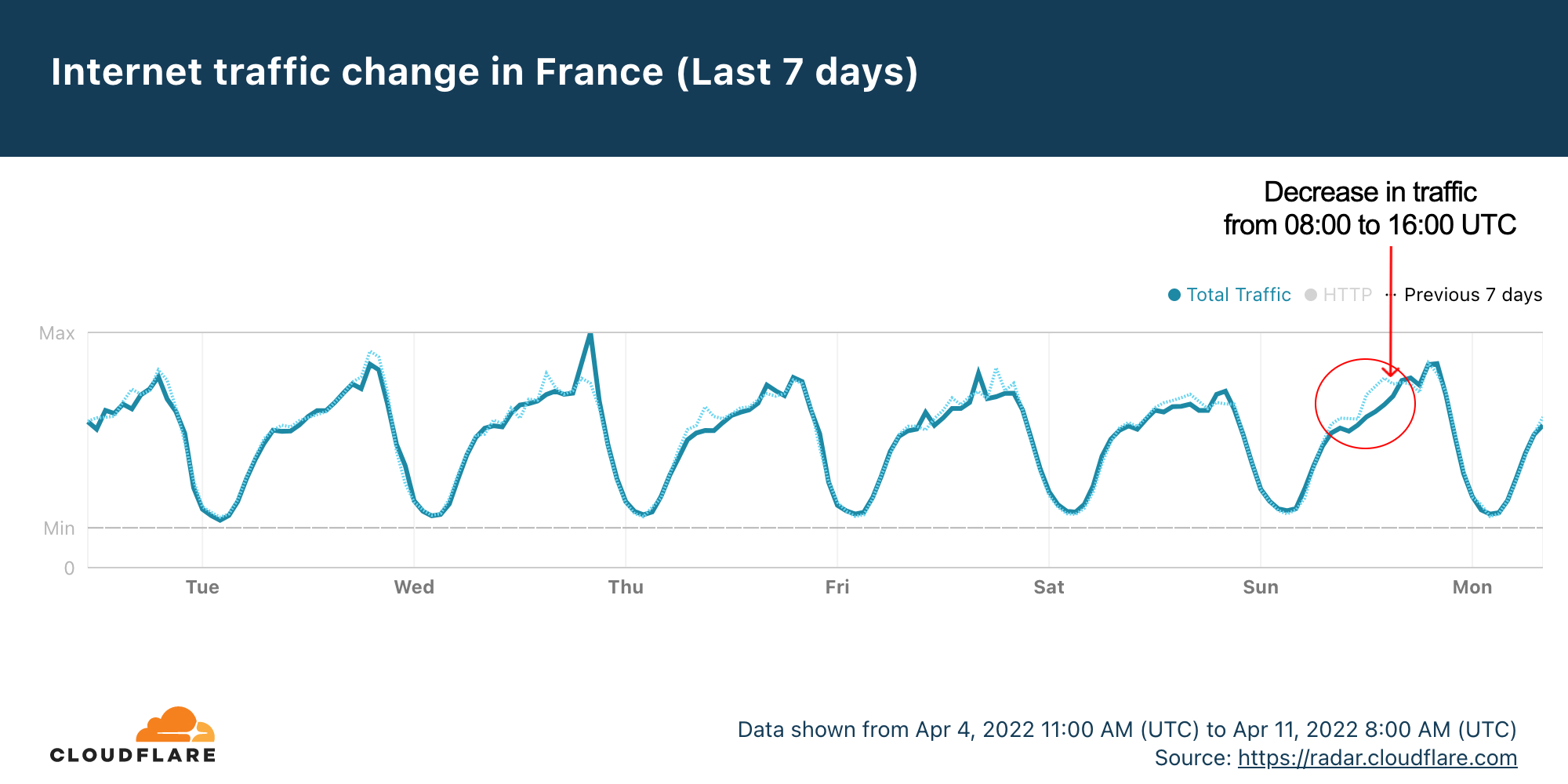
The first round of the 2022 French presidential elections were held this past Sunday, April 10, 2022, and a run-off will be held on April 24 between the top two candidates, Emmanuel Macron and Marine Le Pen. Looking at Internet trends in France for Sunday, it appears that when people were voting Internet traffic went down, and, no surprise, it went back up when results are coming in — that includes major spikes to news and election-related websites.
Cloudflare Radar data shows that Sundays are usually high-traffic days in France. But this Sunday looked a little different.
The seven-day Radar chart shows that there was a decrease in traffic compared to the previous Sunday between 08:00 and 16:00 UTC, that’s 10:00 and 18:00 in local time — bear in mind that polling stations in France were open between 08:00 and 19:00 (or 20:00 in big cities) local time. So, the decrease in traffic was ‘inside’ the period when French citizens were allowed to vote.
That’s a similar trend we have seen in other elections, like the Portuguese one back in January 2022.
The time of the French election day with the largest difference compared to the previous Sunday was 14:00 Continue reading
The hyperscalers have taught us many lessons in the past two decades, and one of them is that everything that can be defined in software should be so that it can be controlled automatically and programmatically – and that goes double for hardware, which has required so much human babysitting over the decades. …
If you want to create routine backups on your device or a local server, Cisco offers the “archive” feature on its IOS platform. I cover the various options we can pass to the archive command and go over an example of its use.
This week's Network Break discusses AMD's $1.9 billion bid for Pensando, why Juniper is partnering with Synopsys on silicon photonics, a new application access control feature from Cato Networks, and a new mainframe from IBM and a new lawsuit against it. Plus more tech news!