Over the last few episodes of the Hedge, we’ve been talking to folks involved in bringing network products to market. In this episode, Tom Ammon and Russ White talk to Jeff Jakab about the role of the Product Line Manager in helping bring new networking products to life. Join us to understand the roles various people play in the vendor side of the world—both so you can understand the range of roles network engineers can play at a vendor, and so you can better understand how products are designed, developed, and deployed.
Internet outages are more common than most people think, and may be caused by misconfigurations, power outages, extreme weather, or infrastructure damage. Note that such outages are distinct from state-imposed shutdowns that also happen all too frequently, generally used to deal with situations of unrest, elections or even exams.
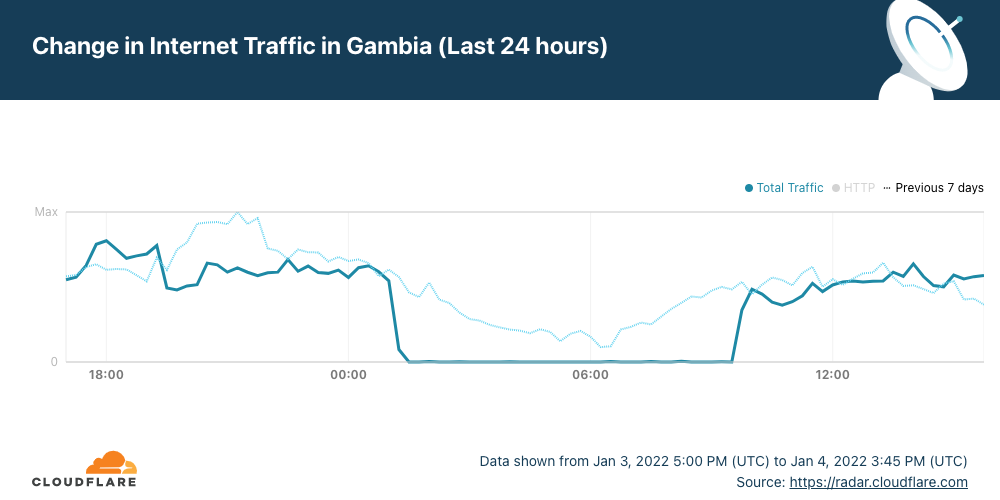
On the morning of January 4, 2022, citizens of The Gambia woke up to a country-wide Internet outage. Gamtel (the main state-owned telecommunications company of the West Africa country), announced that it happened due to "technical issues on the backup links" — we elaborate more on this below.
Cloudflare Radar shows that the outage had a significant impact on Internet traffic in the country and started after 01:00 UTC (which is the same local time), lasting until ~09:45 — a disruption of over 8 hours.
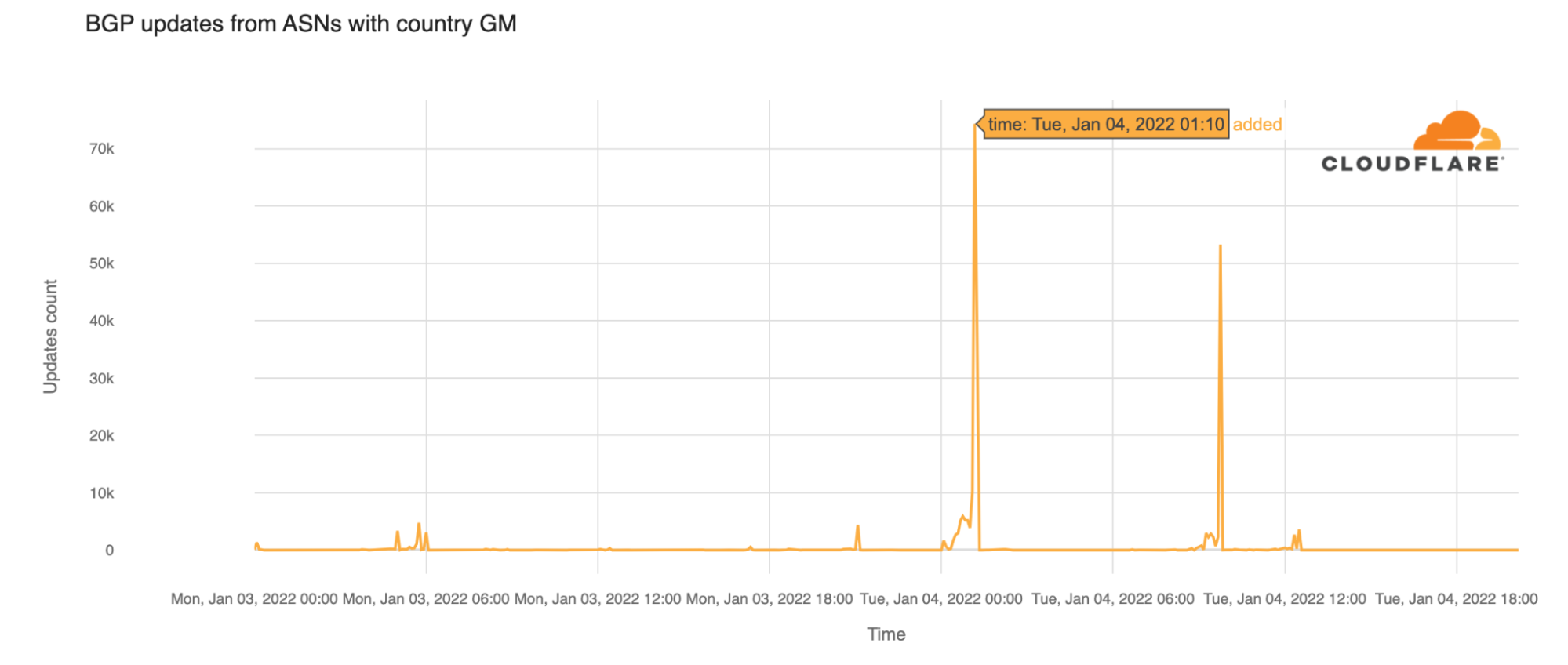
Looking at BGP (Border Gateway Protocol) updates from Gambian ASNs around the time of the outage, we see a clear spike at 01:10 UTC. These update messages are BGP signaling that the Gambian ASNs are no longer routable.
It is important to know that BGP is a mechanism to exchange routing information between autonomous systems (networks) on the Internet. The routers that make the Continue reading
This post was originally published on the Packet Pushers’ Ignition site on September 21, 2021. It sounds trite to say that enterprise IT environments are multi-cloud, but the extent of cloud heterogeneity might shock those not paying attention. A recent survey found that 44 percent of organizations had more than half of their workloads deployed […]
All BGP implementations I’ve seen so far use recursive next hop lookup:
The next hop in the IP routing table is the BGP next hop advertised in the incoming update
That next hop is resolved into the actual next hop using one or more recursive lookups into the IP routing table.
Furthermore, all BGP implementations I’ve seen used multiple recursive next hops (if available) to implement load balancing toward the BGP next hop – that’s how we made EBGP load balancing work in Stone Age of networking.
All BGP implementations I’ve seen so far use recursive next hop lookup:
The next hop in the IP routing table is the BGP next hop advertised in the incoming update
That next hop is resolved into the actual next hop using one or more recursive lookups into the IP routing table.
Furthermore, all BGP implementations I’ve seen used multiple recursive next hops (if available) to implement load balancing toward the BGP next hop – that’s how we made EBGP load balancing work in Stone Age of networking.
One could argue that the last few years have highlighted some of the most pressing semiconductor industry issues but there are challenges on the horizon well beyond current supply chain and silicon manufacturing bottlenecks. …
It’s been a while, hope all are well. This is a behind the scenes update to share with you what has been going on with us at NC and where we are headed. Short story, we’ve taken a break but are getting back to it with new content, new ideas, and quite a few changes. If you want a heads up on what is coming, give this episode a listen. If you like surprises, well just ride it out and you’ll see soon enough. It’s good to be back.
While the U.S., China, Japan and other countries have laid out, or even achieved, exascale supercomputing goals, the European continent has been less clear on its own path. …
The Graviton family of Arm server chips designed by the Annapurna Labs division of Amazon Web Services is arguably the highest volume Arm server chips the datacenter market today, and they have precisely one – and only one – customer. …
While I liked reading the Where to Stick the Firewall blog post by Peter Welcher, it bothered me a bit that he used microsegmentation to mean security groups.
I know that microsegmentation became approximately as well-defined as cloud or SDN1, but let’s aim our shiny lance 2 at the nearest windmill and gallop away…
While I liked reading the Where to Stick the Firewall blog post by Peter Welcher, it bothered me a bit that he used microsegmentation to mean security groups.
I know that microsegmentation became approximately as well-defined as cloud or SDN1, but let’s aim our shiny lance 2 at the nearest windmill and gallop away…
At the start of each year, I have been reporting on the behaviour of the inter-domain routing system over the past 12 months, looking in some detail at some metrics from the routing system that can show the essential shape and behaviour of the underlying interconnection fabric of the Internet.
There’s no point in having a quantum computer if it’s not smokin’ fast; otherwise it’s way too much trouble, what with all the subzero temperatures and instability and such. So it’s always newsworthy when somebody sets a new standard for quantum computing processing speeds, even if quantum computers are far from common commercial use.In this case that somebody is IBM, which recently announced its newly developed quantum computing processor, called Eagle, has broken the 100-qubit barrier. IBM[Get regularly scheduled insights by signing up for Network World newsletters.]
Fusion boldly (if clumsily) says it views Eagle “as a step in a technological revolution in the history of computation.” (It sounds like an algorithm wrote that sentence! Is this where you’re leading us, Big Blue? A quantum future of incoherent techspeak?)To read this article in full, please click here
There’s no point in having a quantum computer if it’s not smokin’ fast; otherwise it’s way too much trouble, what with all the subzero temperatures and instability and such. So it’s always newsworthy when somebody sets a new standard for quantum computing processing speeds, even if quantum computers are far from common commercial use.In this case that somebody is IBM, which recently announced its newly developed quantum computing processor, called Eagle, has broken the 100-qubit barrier. IBM[Get regularly scheduled insights by signing up for Network World newsletters.]
Fusion boldly (if clumsily) says it views Eagle “as a step in a technological revolution in the history of computation.” (It sounds like an algorithm wrote that sentence! Is this where you’re leading us, Big Blue? A quantum future of incoherent techspeak?)To read this article in full, please click here
The csplit command is unusual in that allows you to split text files into pieces based on their content. The command allows you to specify a contextual string and use it as a delimiter for identifying the chunks to be saved as separate files.As an example, if you wanted to separate diary entries into a series of files each with a single entry, you might do something like this.$ csplit -z diary '/^Dear/' '{*}'
153
123
136
In this example, "diary" is the name of the file to be split. The command is looking for lines that begin with the word "Dear" as in "Dear Diary" to determine where each chunk begins. The -z option tells csplit to not bother saving files that would be empty.To read this article in full, please click here
The csplit command is unusual in that allows you to split text files into pieces based on their content. The command allows you to specify a contextual string and use it as a delimiter for identifying the chunks to be saved as separate files.As an example, if you wanted to separate diary entries into a series of files each with a single entry, you might do something like this.$ csplit -z diary '/^Dear/' '{*}'
153
123
136
In this example, "diary" is the name of the file to be split. The command is looking for lines that begin with the word "Dear" as in "Dear Diary" to determine where each chunk begins. The -z option tells csplit to not bother saving files that would be empty.To read this article in full, please click here
– Small Drone with under 100 grams weight – Suitable for kids and anyone who is starting out to get into drones and programmable ones – Two sites (Tello and tello.edu) offers various addons to support learning and make it more customised for learning – 13 minutes of Flight time – 100m Flight distance – 720p HD Transmission – 2 Antennas – you can also have VR headset compatibility – In collab with DJI and Intel – Operation via various Apps (Paid and Free ones), Programming Languages ( we are interested in this)
Fancy Features
– Throw and Go — you can just toss Tello into the air – 8d Flips (needs battery more than 50%) – Bounce mode (flies up and down from your hand)
Things that I didn’t like :
-First and foremost, there is no way this connects to your home Wifi, Drone goes into an AP Broadcast mode (meaning this starts broadcasting its own AP and we have to connect to it)