Last month I graphed the distance to remote stations as a function of time of day.
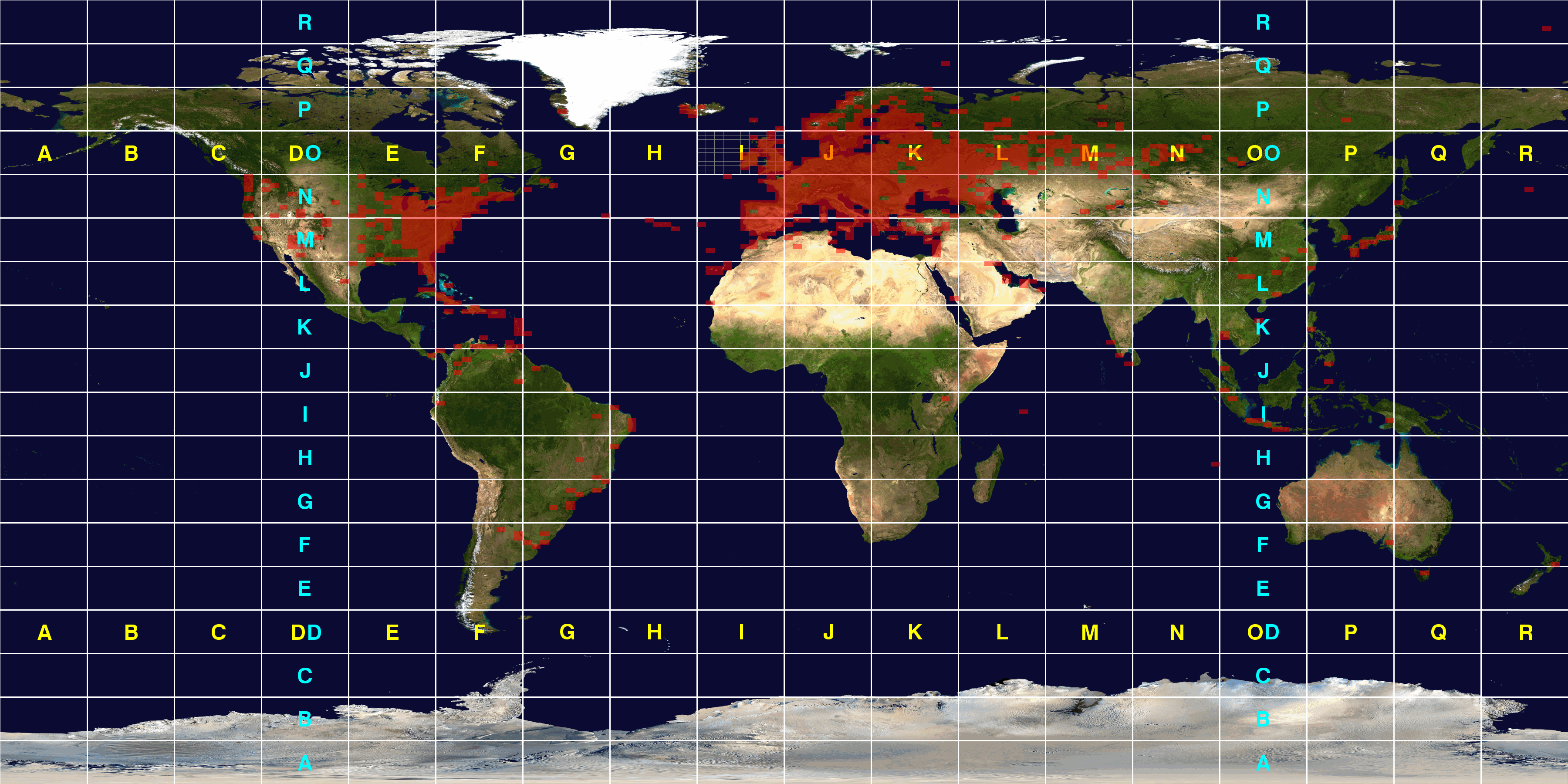
Today I plotted the gridsquare locations on a world map:

Ignore the top right one. That’s “RR73”, and not a real grid square. The rest should be accurate.
More that can be done (more interesting with more data than I can get, though):
If I had access to the data from pskreporter I could even, instead of using just a callsign as input data, use a grid square as input.
So for example I could create an animation to show what the propagation was over the last week from any given gridsquare, and generate them on-demand.
Like last time the scripts are pretty hacky proof of concepts. But they work.
Today's Full Stack Journey delves into developer advocacy: what is it, why do organizations have this role, and what makes a good developer advocate? Host Scott Lowe has invited four practitioners to tackle these questions. He speaks with Jacquie Grindrod, Jeremy Meiss, Josh Wulf, and Ted Neward.
The post Full Stack Journey 053: Exploring Developer Advocacy And Developer Relations appeared first on Packet Pushers.
Guest post by Docker Captain Gianluca Arbezzano
Recently Corey Quinn from LastWeekInAWS wrote an article that made me think “Nobody Cares About the Operating System Anymore”. Please have a look at it! I like the idea that nobody cares about where their application runs. Developers only want them running.

I am one of the maintainers for the Tinkerbell project. A bare metal workflows engine that heavily relies on containers and Docker to get its work done. It tries to find an answer for a reasonable question: how do we manage rooms of pieces of hardware? More in practice, how can we bring an API on top of everybody’s data centers?
Containers are the abstraction we decided to use when running reusable code (that we call actions) in somebody else’s hardware. Mainly because distribution, packaging, and runtime are solved issues. Everyone knows how to build, push and run a container.
I think this scenario compares well with the story Corey highlighted. Operating systems are an established, well-known abstraction for the majority of the use cases.
The lifecycle of a bare metal server can be summarised as follows:


Today, we are announcing the beta of Cloudflare Images: a simple service to store, resize, optimize, and deliver images at scale.
In 2018, we launched Stream to provide a single product that could be used to store, encode, and deliver videos. With Cloudflare Images, we are doing for images what Stream did for videos. Just like Stream, Cloudflare Images eliminates the need to think about storage buckets, egress costs, and many other common problems that are solved for you out of the box. Whether you are building an ecommerce platform with millions of high-res product pictures and videos or a new app for creators, you can build your entire media pipeline by combining Cloudflare Images and Stream.
Any time you are building infrastructure for image storage and processing, there are four fundamental questions you must answer:
Cloudflare Images has a straightforward set Continue reading

While MANRS has gone from strength to strength since its beginning in 2014, gaining attention, interest, and credibility from network operators worldwide, for the initiative to be sustainable and impactful in the long run there should be a stronger sense of ownership by the community. MANRS is an industry-led initiative whose participants set and develop […]
The post Feedback Requested: Chartering the MANRS Community appeared first on Internet Society.


Starting today, your team can create a private network on Cloudflare’s network. Team members click a single button to connect to private IPs in environments that you control. Cloudflare’s network routes their connection through a data center in one of over 200 cities around the world. On the other side, administrators deploy a lightweight software connector that replaces traditional VPN appliances.
Cloudflare’s private network combines IP level connectivity and Zero Trust controls. Thick clients like RDP software, SMB file viewers, or other programs can connect to the private IPs already in use in your deployment without any additional configuration. Coming soon, you’ll be able to layer additional identity-based network-level rules to control which users, from which devices, can reach specific IPs.
We are launching this feature as a follow-up to Cloudflare’s Developer Week because we are excited to give your development team, and your entire organization, a seamless platform for building and connecting your internal resources. We built this solution based on feedback from customers who want to move to a Zero Trust model without sacrificing some of the convenience of a private network.
We’re excited to give any team the ability to run their internal network on Cloudflare’s global Continue reading
Scott submitted an interesting the comment to my Does Unequal-Cost Multipath (UCMP) Make Sense blog post:
How about even Large CLOS networks with the same interface capacity, but accounting for things to fail; fabric cards, links or nodes in disaggregated units. You can either UCMP or drain large parts of your network to get the most out of ECMP.
Before I managed to write a reply (sometimes it takes months while an idea is simmering somewhere in my subconscious) Jeff Tantsura pointed me to an excellent article by Erico Vanini that describes the types of asymmetries you might encounter in a leaf-and-spine fabric: an ideal starting point for this discussion.
Scott submitted an interesting the comment to my Does Unequal-Cost Multipath (UCMP) Make Sense blog post:
How about even Large CLOS networks with the same interface capacity, but accounting for things to fail; fabric cards, links or nodes in disaggregated units. You can either UCMP or drain large parts of your network to get the most out of ECMP.
Before I managed to write a reply (sometimes it takes months while an idea is simmering somewhere in my subconscious) Jeff Tantsura pointed me to an excellent article by Erico Vanini that describes the types of asymmetries you might encounter in a leaf-and-spine fabric: an ideal starting point for this discussion.
There are lots of reasons to get educated about cloud networking. You might: Be responsible for connecting end users to numerous cloud services Have to link an application in Cloud A to services and data in Cloud B Support a hybrid application that has one foot in your DC and another in AWS, Azure, or […]
The post Get Smart About Cloud Networking – A Packet Pushers Livestream Event, April 22 appeared first on Packet Pushers.