One of the most annoying part in every training content development project was the ubiquitous question somewhere at the end of the process: “and now we’d need a few review questions”. I’m positive anyone ever involved in a similar project can feel the pain that question causes…
Writing good review questions requires a particularly devious state of mind, sometimes combined with “I would really like to get the answer to this one” (obviously you’d mark such questions as “needs further research”, and if you’re Donald Knuth the question would be “prove that P != NP").
In today’s economy, digital assets (applications, data, and processes) determine business success. Cloud-native applications are designed to iterate rapidly, creating rapid time-to-value for businesses. Organizations that are able to rapidly build and deploy their applications have significant competitive advantage. To this end, more and more developers are creating and leading DevOps teams that not only drive application development, but also take on operational responsibilities formerly owned by platform and security teams.
Cloud-native applications are often designed and deployed as microservices. The development team that owns the microservice understands the behavior of the service, and is in the best position to define and manage the network security of their microservice. A self-service model enables developers to follow a simple workflow and generate network policies with minimal effort. When problems occur with. application connectivity, developers should be able to diagnose connectivity issues and resolve them quickly without having to depend on resources outside of the team.
Developers and DevOps teams can also take a leading role in managing security, which is an integral part of cloud-native applications. There are two aspects to security in the context of Kubernetes.
It’s a constant battle to keep your Windows estate updated and secure. Using Red Hat Ansible Automation Platform and Chocolatey, you can easily keep your software up-to-date and react quickly to bug fixes, security issues and 0-days on dozens, hundreds or thousands of nodes.
We’re going to take you through three simple steps to show you how simple it is to deploy and update software using Chocolatey and Ansible.
Ansible uses Winrm by default to communicate with Windows machines. Therefore, we need to ensure we have that enabled by running `Enable-PSRemoting` on the remote Windows computer.
For production use, we recommend enabling HTTPS for WinRM .
The code examples shown below are all using the user ‘ansible’ as the default. If you are using a different username, make sure you change it!
Step 1: Configure Ansible to use Chocolatey.
We need to install the Chocolatey module so that Ansible can use. The Chocolatey Ansible Content Collection is called chocolatey:chocolatey and is maintained by the Chocolatey Team. To install the Collection, and therefore the win_chocolatey modules, on your Ansible server, run:
ansible-galaxy collection install chocolatey.chocolatey
That’s all there is to it! Ansible can Continue reading
Departing Trustee Glenn McKnight looks back at his three years of service as a member of the Internet Society Board of Trustees.
During the past three years we have seen a tremendous amount of productive work by a functional and focused Internet Society Board of Trustees. This included not only the normal board and committee work, but also the extra efforts associated with the selection of a new CEO, creation of the Internet Society Foundation, and meeting the challenges of the proposed PIR/Ethos transaction.
It’s important to learn from these experiences, but it’s also important to focus on achievements and to reassert the core values of the Internet Society as a force of good in the Internet ecosystem. We see the Internet Society focusing its efforts with purposeful strategic direction lead by CEO Andrew Sullivan and his team. As a departing Trustee, I would like to see the Internet Society explore more opportunities for members to learn from one other, including “Meet the Board” to foster improved communication and a means to help teach the community about the role of the Board of Trustees.
During these three years, my work beyond the normal board work has also involved committee Continue reading
Planning a database migration to the cloud? If you're going to do it right, prepare to dig in because you have many options and trade offs to consider, including whether to go with IaaS or PaaS, security and monitoring issues, and much, much more. Day Two Cloud dives into the inner workings of database migration with expert Joey D’Antoni, Principal Consultant at Denny Cherry & Associates.
The post Day Two Cloud 063: The How And Why Of Migrating Databases To The Cloud appeared first on Packet Pushers.

Consistent with our mission to help build a better Internet, Cloudflare has long recognized the importance of conducting our business in a way that respects the rights of Internet users around the world. We provide free services to important voices online - from human rights activists to independent journalists to the entities that help maintain our democracies - who would otherwise be vulnerable to cyberattack. We work hard to develop internal mechanisms and build products that empower user privacy. And we believe that being transparent about the types of requests we receive from government entities and how we respond is critical to maintaining customer trust.
As Cloudflare continues to expand our global network, we think there is more we can do to formalize our commitment to help respect human rights online. To that end, we are excited to announce that we have joined the Global Network Initiative (GNI), one of the world's leading human rights organizations in the information and communications Technology (ICT) sector, as observers.
Understanding Cloudflare’s new partnership with GNI requires some additional background on how human rights concepts apply to businesses.
In 1945, following the end of World War II, 850 delegates Continue reading

Cloudflare Workers — our serverless platform — allows developers around the world to run their applications from our network of 200 datacenters, as close as possible to their users.
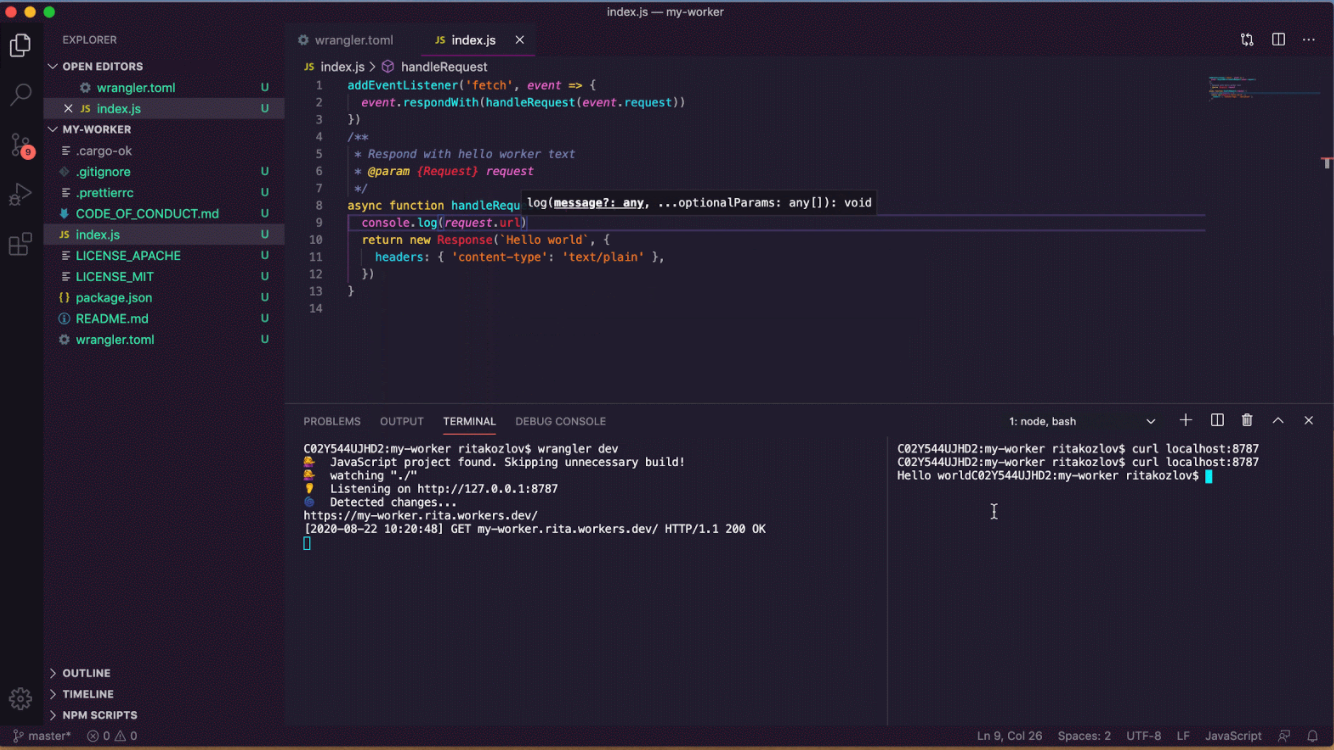
A few weeks ago we announced a release candidate for wrangler dev — today, we're excited to take wrangler dev, the world’s first edge-based development environment, to GA with the release of wrangler 1.11.
It was once assumed that to successfully run an application on the web, one had to go and acquire a server, set it up (in a data center that hopefully you had access to), and then maintain it on an ongoing basis. Luckily for most of us, that assumption was challenged with the emergence of the cloud. The cloud was always assumed to be centralized — large data centers in a single region (“us-east-1”), reserved for compute. The edge? That was for caching static content.
Again, assumptions are being challenged.
Cloudflare Workers is about moving compute from a centralized location to the edge. And it makes sense: if users are distributed all over the globe, why should all of them be routed to us-east-1, on the opposite side of the world, Continue reading
Remember the claim that networking is becoming obsolete and that everyone else will simply bypass the networking teams (source)?
Good news for you – there are many fast growing overlay solutions that are adopted by apps and security teams and bypass the networking teams altogether.
That sounds awesome in a VC pitch deck. Let’s see how well that concept works out in reality using Docker Swarm as an example (Kubernetes is probably even worse).
In-depth with Intel’s Raja Koduri; a unique spin on RDMA; from HPC to DNA storage CTO (market and more); AI inference architecture tradeoffs at ultra-low power; Taboola’s datacenter shutdown and lessons for IT crisis management at scale; much more. …
Next Platform TV for August 25, 2020 was written by Nicole Hemsoth at The Next Platform.
One of the beauties of the Red Hat Ansible Automation Platform is that the language to describe automation is readable not only by a few dedicated experts, but by almost anyone across the IT ecosystem. That means all IT professionals can take part in the automation, enabling cross team collaboration and really drive automation as a culture inside an organization. With so many people contributing to the automation, it is crucial to test the automation content in-depth. So when you’re developing new Ansible Content like playbooks, roles and collections, it’s a good idea to test the content in a test environment before using it to automate production infrastructure. Testing ensures the automation works as designed and avoids unpleasant surprises down the road.
Testing automation content is often a challenge, since it requires the deployment of specific testing infrastructure as well as setting up the testing conditions to ensure the tests are relevant. Molecule is a complete testing framework that helps you develop and test Ansible roles, which allows you to focus on the content instead of focusing on managing testing infrastructure.
According to its official documentation, Molecule is a project:
“designed to aid in the development and testing Continue reading
My next upcoming live webinar on Safari Books is How the Internet Really Works. This was originally a three-hour webinar which I’ve added some material to so it’s now four hours… I’m working with Pearson to add further material and break this into two three-hour webinars, so this will probably be the last four-hour version of this I teach.
Token Ring, in its original form, was—on paper—a very capable physical transport. For instance, because of the token passing capabilities, it could make use of more than 90% of the available bandwidth. In contrast, Ethernet systems, particularly early Ethernet systems using a true “single wire” broadcast domain, cannot achieve nearly that kind of utilization—hence “every device on its own switch port.” The Fiber Distributed Data Interface, or FDDI, is like Token Ring in many ways. For instance, FDDI uses a token to determine when a station connected to the ring can transmit, enabling efficient use of bandwidth.
And yet, Ethernet is the common carrier of almost all wired networks today, and even wireless standards mimic Ethernet’s characteristics. What happened to FDDI?
FDDI is a 100Mbit/second optical standard based on token bus, which used an improved timed token version of the token passing scheme developed for token ring networks. This physical layer protocol standard had a number of fairly unique features. It was a 100Mbit/second standard at a time when Ethernet offered a top speed of 10Mbits/second. Since FDDI could operate over a single mode fiber, it could support distances of 200 kilometers, or around 120 miles. Because it was Continue reading