The Case of the Flapping BGP Routes: A Network Detective Ride-Along
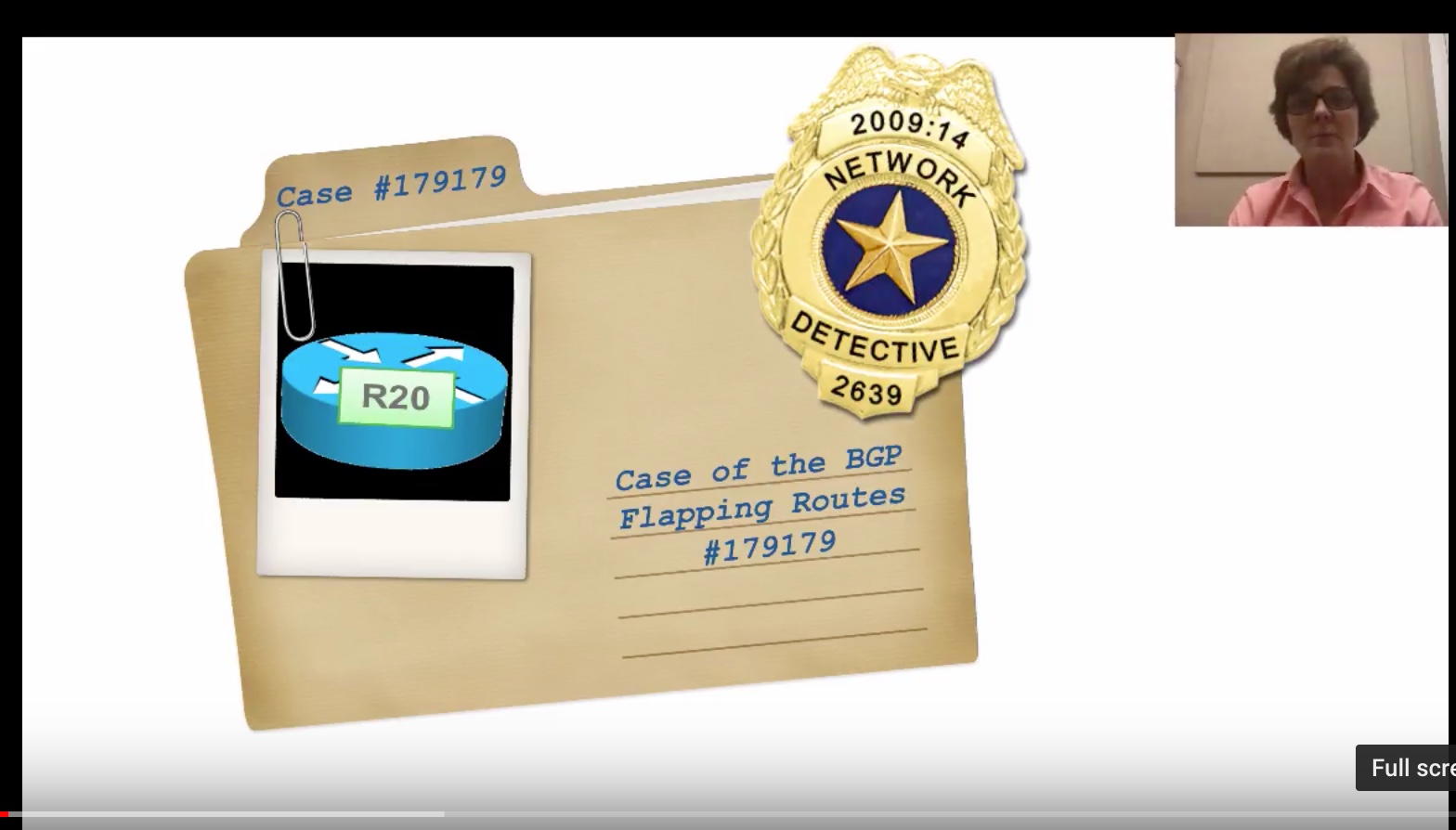
Let’s go on a Network Detective Ride-Along together!  YouTube Style! Case open to case closed in less than 15 minutes. You ride along! Use the 3 part BGP Table Version blog series below the YouTube to see how to use BGP table version in your Network Detecting.
Ready to hop on the case with me? Just click below.
Understanding the BGP Table Version – Part 1: Introduction to BGP Table Version
Understanding the BGP Table Version – Part 2: BGP Table Version in Action
Understanding the BGP Table Version – Part 3: BGP Table Version & Troubleshooting
The Case of the Flapping BGP Routes: A Network Detective Ride-Along
Let’s go on a Network Detective Ride-Along together! YouTube Style! Case open to case closed in less than 15 minutes. You ride along! Use the 3 part BGP Table Version blog series below the YouTube to see how to use BGP table version in your Network Detecting.
Ready to hop on the case with me? Just click below.
Understanding the BGP Table Version – Part 1: Introduction to BGP Table Version
Understanding the BGP Table Version – Part 2: BGP Table Version in Action
Understanding the BGP Table Version – Part 3: BGP Table Version & Troubleshooting
Bye Bye Blackbird


Courtesty of PublicDomainPictures.net
As we have talked about repeatedly in this blog, we at Cloudflare are not fans of the behavior of patent trolls. They prey upon innovative companies using overly-broad patents in an attempt to bleed settlements out of their targets. When we were first sued by a patent troll called Blackbird Technologies last spring, we decided that we weren’t going along with their game by agreeing to a modest settlement in lieu of going through the considerable effort and expense of litigation. We decided to fight.
We’re happy to report that earlier today, the United States District Court for the Northern District of California dismissed the case that Blackbird brought against Cloudflare. In a two-page order (copied below) Judge Vince Chhabria noted that “[a]bstract ideas are not patentable” and then held that Blackbird’s attempted assertion of the patent “attempts to monopolize the abstract idea of monitoring a preexisting data stream between a server” and is invalid as a matter of law. That means that Blackbird loses no matter what the facts of the case would have been.
The court’s ruling comes in response to a preliminary motion filed by Cloudflare under Section 101 of the U. Continue reading
Introducing VMware NSX-T Reference Design
Available now is the VMware NSX-T Reference Design Guide, a deployment path to adopting NSX with diverse multi-domain workload requirements – multi-cloud (private/public), multi-hypervisor, and multiple application frameworks (VMs, PaaS and containers).
Since VMware acquired Nicira almost five years ago, NSX for vSphere has become de-facto standard for private cloud solutions, delivering key use cases in private cloud – namely security, automation and application continuity. Since then, we’ve witnessed our customers datacenter and workload requirements changing; therefore, the demand for a platform that not only can deliver current private cloud requirements, but now many enterprises are looking for integration with the likes of cloud native apps, public/hybrid cloud, and other compute domains covering multiple hypervisors.
VMware NSX-T was introduced last year to meet the demands of the containerized workload, multi-hypervisor and multi-cloud. The NSX-T platform is focused on a diverse set of use cases – from private to public, traditional (multi-tiered architecture) to container (microservices architecture) based apps, automation and monitoring of security at IaaS, to programmatic devops workloads in PaaS and CaaS environments. It is very important to start with an understanding of NSX-T architecture and its components, and some topics (ex. routing) have been discussed Continue reading
Service Assurance Can Transform Your SDN/NFV Investment
 Assurance solutions must be flexible enough to manage change while working toward network virtualization.
Virtuosys Meshes Software with Hardware for MEC Platform
 The MEC platform relies on containers to support edge applications.
Oracle Quadruples Cloud Data Center Footprint
 The company is also expanding autonomous capabilities across its entire PaaS product line.
Citrix Acquires Cedexis to Improve App Performance in Hybrid Clouds
 Citrix will integrate Cedexis’ programmable traffic steering technology into its portfolio.
Viavi Will Help China Mobile on FlexE Slicing Packet Network
 China Mobile wants the ITU to standardize slicing packet network for FlexE.
Reaction: The Pace of Innovation
Dave Ward has an excellent article over at the Cisco blog on the three year journey since he started down the path of trying to work the standards landscape (called SDOs) to improve the many ways in which these organizations are broken. Specifically, he has been trying to connect the open source and open standards communities better—a path I heartily endorse, as I have been intentionally trying to work in both communities in parallel over the last several years, and find places where I can bring them together.
While the entire blog is worth reading, there are two lines I think need some further thought. The first of this is a bit of a scold, so be prepared to have your knuckles rapped.
My real bottom line here is that innovators can’t go faster than their customers and customers can’t go faster than their own understanding of the technology and integration, deployment and operational considerations.
Precisely. Maybe this is just an old man talking, but I sometimes want to scold the networking industry on this very point. We fuss about innovation, but innovation requires customers who understand the technology—and the networking world has largely become a broad set of meta-engineers, Continue reading
Headcount: The Latest in Hirings, Firings, and Retirings — February 12, 2018
 Versa hires SVP of Sales; Former Dell exec joins NetApp; Aryaka snags two from Big Switch.
4 people passed CCDE Lab with my CCDE training recently
I realised just now that I didn’t share the names of the people who used my CCDE resources and got their CCDE numbers recently. I know all of them, their capabilities, technical strength. I am happy to see that they are CCDE now. Congrats to Ken Young , Jaroslaw Dobkowski , Malcolm Booden […]
The post 4 people passed CCDE Lab with my CCDE training recently appeared first on Cisco Network Design and Architecture | CCDE Bootcamp | orhanergun.net.
4 people passed CCDE Lab with my CCDE training recently
I realised just now that I didn’t share the names of the people who used my CCDE resources and got their CCDE numbers recently. I know all of them, their capabilities, technical strength. I am happy to see that they are CCDE now. Congrats to Ken Young , Jaroslaw Dobkowski , Malcolm Booden …
Continue reading "4 people passed CCDE Lab with my CCDE training recently"
The post 4 people passed CCDE Lab with my CCDE training recently appeared first on Cisco Network Design and Architecture | CCDE Bootcamp | orhanergun.net.
4 people passed CCDE Lab with my CCDE training recently
I realised just now that I didn’t share the names of the people who used my CCDE resources and got their CCDE numbers recently. I know all of them, their capabilities, technical strength. I am happy to see that they are CCDE now. Congrats to Ken Young , Jaroslaw Dobkowski , Malcolm Booden …
Continue reading "4 people passed CCDE Lab with my CCDE training recently"
The post 4 people passed CCDE Lab with my CCDE training recently appeared first on Cisco Network Design and Architecture | CCDE Bootcamp | orhanergun.net.
Make before break and Break before make
Make before break and break before make. I shared many posts so far which was covering the terms used in different field of networking. This one is one of them. Also I will introduce, probably to many of you, a new terminology ‘ Break before make ‘ If you are from the IP/MPLS background […]
The post Make before break and Break before make appeared first on Cisco Network Design and Architecture | CCDE Bootcamp | orhanergun.net.
Make before break and Break before make
Make before break and break before make. I shared many posts so far which was covering the terms used in different field of networking. This one is one of them. Also I will introduce, probably to many of you, a new terminology ‘ Break before make ‘ If you are from the IP/MPLS background …
Continue reading "Make before break and Break before make"
The post Make before break and Break before make appeared first on Cisco Network Design and Architecture | CCDE Bootcamp | orhanergun.net.