Day Two Cloud 039: Kubernetes Fundamentals For Infrastructure
Kubernetes is making a lot of noise in the infrastructure world. Day Two Cloud co-host Ethan Banks spent three days taking a deep-dive course on the orchestration platform, and on today's show aims to provide Kubernetes fundamentals as they apply to your infrastructure.
The post Day Two Cloud 039: Kubernetes Fundamentals For Infrastructure appeared first on Packet Pushers.
NtC – Source Of Truth
In this inaugural episode of Network to Code on Network Collective, Jeremy Stretch, John Anderson, Rick Sherman, and Jordan Martin meet up around the virtual roundtable to discuss what a source of truth is, how it can play a critical role in your network automation efforts, and how the open source project Netbox might fill that role in your network.
Jeremy Stretch
Guest
John Anderson
Guest
Rick Sherman
Host
Jordan Martin
Host
Outro Music:
Danger Storm Kevin MacLeod (incompetech.com)
Licensed under Creative Commons: By Attribution 3.0 License
http://creativecommons.org/licenses/by/3.0/
The post NtC – Source Of Truth appeared first on Network Collective.
Open sourcing our Sentry SSO plugin
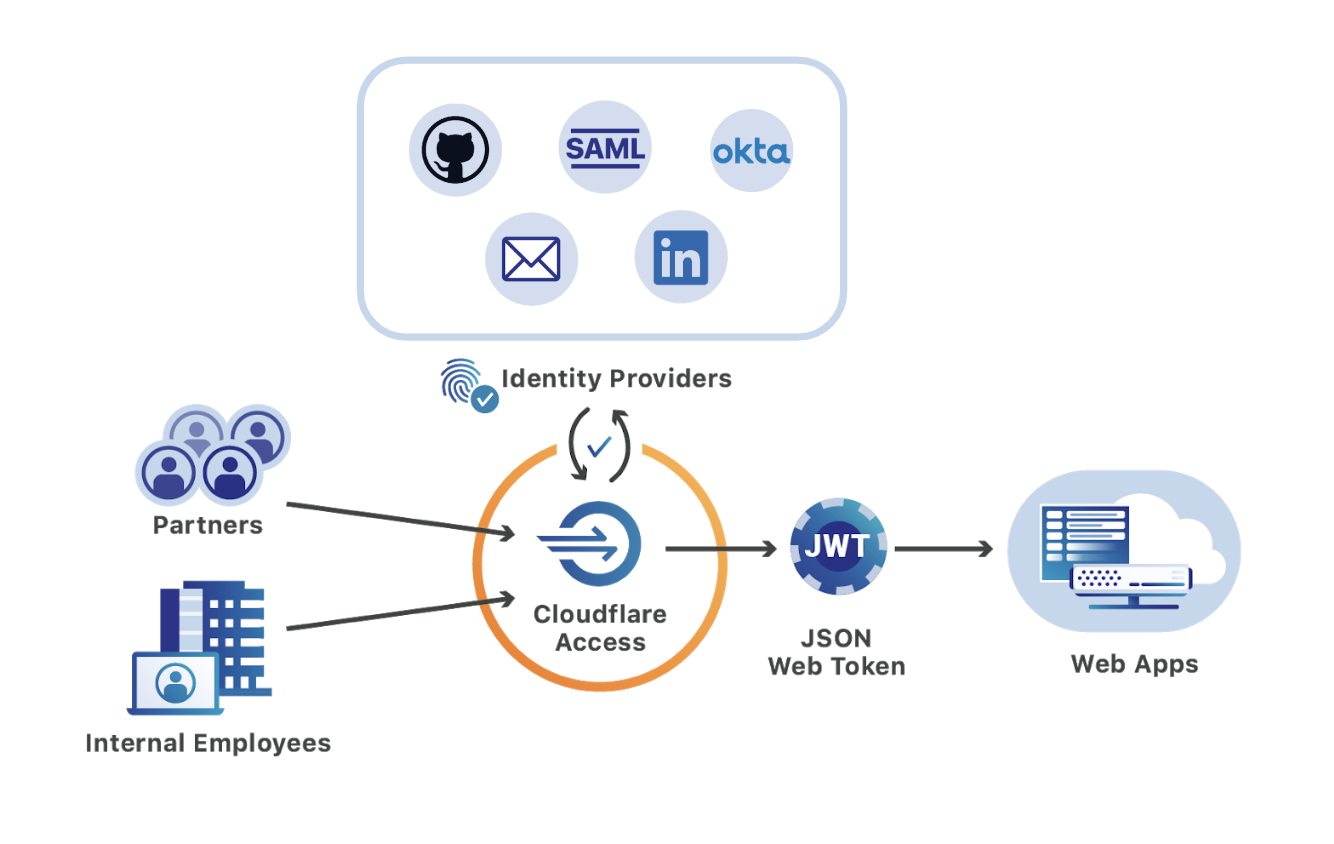
Cloudflare Access, part of Cloudflare for Teams, replaces legacy corporate VPNs with Cloudflare’s global network. Using your existing identity provider, Access enables your end users to login from anywhere — without a clunky agent or traffic backhaul through a centralized appliance or VPN.
Today, we are open sourcing a plugin that continues to improve that experience by making it easier for teams to use Cloudflare Access with one of the software industry’s most popular engineering tools, Sentry.
What is Sentry?
Sentry is an application that helps software teams find and diagnose errors in their products. We use Sentry here at Cloudflare. When you encounter an error when using a Cloudflare product, like our dashboard, we log that event. We then use Sentry to determine what went wrong.
Sentry can categorize and roll up errors, making it easy to identify new problems before investigating them with the tool’s event logging. Engineering managers here can use the dashboards to monitor the health of a new release. Product managers often use those reports as part of prioritizing what to fix next. Engineers on our team can dig into the individual errors as they release a fix.
Sentry is available in two forms: Continue reading
Invitation: Packet Pushers Virtual Happy Hour – March 2020

An open videoconference to be nice to each other, blow the Corona blues away.
The post Invitation: Packet Pushers Virtual Happy Hour – March 2020 appeared first on EtherealMind.
What Data Center Switches Should I Buy with VMware NSX?
Another interesting question I got from an ipSpace.net subscriber:
Assuming we can simplify the physical network when using overlay virtual network solutions like VMware NSX, do we really need datacenter switches (example: Cisco Nexus instead of Catalyst product line) to implement the underlay?
Let’s recap what we really need to run VMware NSX:
What Data Center Switches Should I Buy with VMware NSX?
Another interesting question I got from an ipSpace.net subscriber:
Assuming we can simplify the physical network when using overlay virtual network solutions like VMware NSX, do we really need datacenter switches (example: Cisco Nexus instead of Catalyst product line) to implement the underlay?
Let’s recap what we really need to run VMware NSX:
Read more ...Characterizing, modeling, and benchmarking RocksDB key-value workloads at Facebook
Characterizing, modeling, and benchmarking RocksDB key-value workloads at Facebook, Cao et al., FAST’20
You get good at what you practice. Or in the case of key-value stores, what you benchmark. So if you want to design a system that will offer good real-world performance, it’s really useful to have benchmarks that accurately represent real-world workloads. In this paper, Facebook analyse three of their real-world RocksDB workloads and find (surprise!) that they all look quite different. More interesting, is that there are important differences between the way these real-world workloads behave, and workloads generated by the venerable YCSB benchmark.
Therefore, using the benchmarking results of YCSB as guidance for production might cause some misleading results… To address this issue, we propose a key-range based modelling and develop a benchmark that can better emulate the workloads of real-world key-value stores. This benchmark can synthetically generate more precise key-value queries that represent the reads and writes of key-value stores to the underlying storage system.
The tracing, replay, and analysis tools developed for this work are released in open source as part of the latest RocksDB release, and the new benchmark is now part of the db_bench benchmarking tool.
TL;DR Continue reading
Replicating Elastic File System With AWS DataSync
I recently used AWS DataSync as part of a lab I was building. These are my notes for using DataSync to replicate an Amazon Elastic File System (EFS) share from one region to another.
AWS DataSync is a managed service that enables replication of data between AWS services and from on-prem to AWS. It automates the scheduling of transfer activities, validates copied data, and uses a purpose-built network protocol and multi-threaded architecture to achieve very high efficiency on the wire.
The use case I needed to tackle was replicating an Amazon EFS share in one region to an EFS share in a different region (a one-way replication). (DataSync can also connect to Amazon S3 and Amazon FSx for Windows File Server)
Daily Roundup: Cisco Dreams of 5G WAN
Cisco dreamed of 5G WAN; VMware's modern application strategy spun Kubernetes Goldilocks tale; and...
© SDxCentral, LLC. Use of this feed is limited to personal, non-commercial use and is governed by SDxCentral's Terms of Use (https://www.sdxcentral.com/legal/terms-of-service/). Publishing this feed for public or commercial use and/or misrepresentation by a third party is prohibited.
Tuning The FPGA For Clouds And Comms
It has been a long time since plain vanilla programmable logic circuits known as field programmable gate arrays have been available in a raw form. …
Tuning The FPGA For Clouds And Comms was written by Timothy Prickett Morgan at The Next Platform.
Docker Refocus Targets DevOps Challenges
The vendor has a unique opportunity to help make the code to cloud space incredibly efficient,...
© SDxCentral, LLC. Use of this feed is limited to personal, non-commercial use and is governed by SDxCentral's Terms of Use (https://www.sdxcentral.com/legal/terms-of-service/). Publishing this feed for public or commercial use and/or misrepresentation by a third party is prohibited.
VMware Tanzu Service Mesh, built on VMware NSX is Now Available!
VMware marked its entry into the service mesh space with the announcement of VMware NSX Service Mesh. Today, we have some exciting developments to share. First, VMware NSX Service Mesh is now VMware Tanzu Service Mesh. This new brand aligns with the VMware Tanzu Portfolio for modern applications that we launched today. Second, and more importantly, we are announcing that Tanzu Service Mesh, built on VMware NSX is now available for purchase.
Tanzu Service Mesh provides consistent connectivity and security for microservices – across all your Kubernetes clusters and clouds – in the most demanding multi-cluster and multi-cloud environments. Tanzu Service Mesh can be installed in Tanzu Kubernetes Grid (TKG) clusters and third-party Kubernetes-conformant clusters, and used with clusters managed by Tanzu Mission Control (i.e., Tanzu-managed clusters) or clusters managed by other Kubernetes platforms and managed services.

Beyond its multi-cloud focus, one of the other differentiating characteristics of Tanzu Service Mesh is its ability to support cross-cluster and cross-cloud use cases via Global Namespaces (GNS). A GNS abstracts an application from the underlying Kubernetes cluster namespaces and networking, allowing you to transcend infrastructure limitations and boundaries, and securely stretch applications across clusters and clouds. Global Namespaces allow Continue reading
Rakuten Mobile Plays the (Vendor) Field
A series of deals indicates that incumbent vendors like Nokia still have an important, and...
© SDxCentral, LLC. Use of this feed is limited to personal, non-commercial use and is governed by SDxCentral's Terms of Use (https://www.sdxcentral.com/legal/terms-of-service/). Publishing this feed for public or commercial use and/or misrepresentation by a third party is prohibited.
Docker testbed
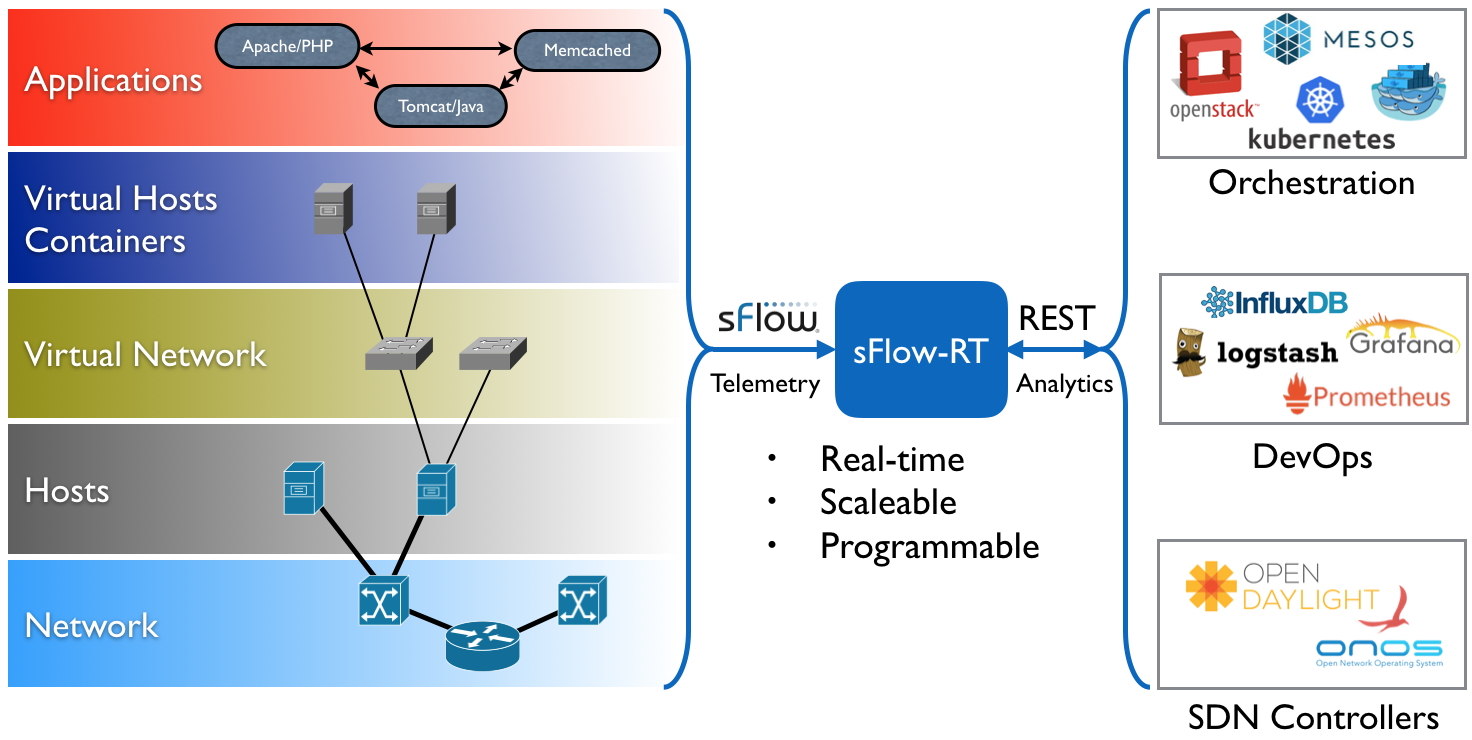
Application development is greatly simplified if you can emulate the infrastructure you want to monitor on your development machine. Mininet flow analytics, Mininet dashboard, and Mininet weathermap describe how to use the open source Mininet network emulator to simulate networks and generate a live stream of standard sFlow telemetry data.
This article describes how to use Docker containers as a development platform. Docker Desktop provides a convenient method of running Docker on Mac and Windows desktops. These instructions assume you have already installed Docker.
Start a Host sFlow agent using the pre-built sflow/host-sflow image:
docker run --rm -d -e "COLLECTOR=host.docker.internal" -e "SAMPLING=10" \Note: Host, Docker, Swarm and Kubernetes monitoring describes how to deploy Host sFlow agents to monitor large scale container environments.
--net=host -v /var/run/docker.sock:/var/run/docker.sock:ro \
--name=host-sflow sflow/host-sflow
Start an iperf3 server using the pre-built sflow/iperf3 image:
docker run --rm -d -p 5201:5201 --name iperf3 sflow/iperf3 -sIn a separate terminal window, run the following command to start sFlow-RT:
Continue reading
Gartner Cancels A Few Conferences Costing 36MM But Its not Giving Up Yet

Conferences are a BIG part of the revenue model
The post Gartner Cancels A Few Conferences Costing 36MM But Its not Giving Up Yet appeared first on EtherealMind.
Stateless Taps Intel’s Barefoot Tofino for Interconnection
Tofino’s P4 programmability is what makes it important to Stateless, a startup targeting...
© SDxCentral, LLC. Use of this feed is limited to personal, non-commercial use and is governed by SDxCentral's Terms of Use (https://www.sdxcentral.com/legal/terms-of-service/). Publishing this feed for public or commercial use and/or misrepresentation by a third party is prohibited.
Now Available: Calico for Windows on Red Hat OpenShift Container Platform
Approximately one year ago, Kubernetes 1.14 made support of Windows containers running on Microsoft Windows Server nodes generally available. This was a declaration that Windows node support was stable, well-tested, and ready for adoption, meaning the vast ecosystem of Windows-based applications could be deployed on the platform.
Collaborating with Microsoft, Tigera leveraged the new Windows platform capabilities to create Calico for Windows, the industry’s first cross-platform Kubernetes solution to manage networking and network policy for Kubernetes deployments on Windows and Linux.
We are excited to announce that Calico for Windows now supports the latest Windows Dev Preview on the Red Hat OpenShift Container Platform (OCP). Built on Red Hat Enterprise Linux and Kubernetes, OCP v4 provides developers and IT organizations with a hybrid and multi-cloud application platform for deploying both new and existing applications on scalable resources, with minimal configuration and management overhead. OCP enables organizations to meet security, privacy, compliance, and governance requirements.
Calico for Windows is the only Kubernetes networking solution for teams using Windows on OpenShift. The combination of Calico for Windows and Red Hat OpenShift Container Platform represents a major leap forward in productivity for organizations that are deploying Windows on Kubernetes. DevOps teams Continue reading
COVID-19 Trade Show Impact
SDxCentral will be keeping a running list of changes to trade shows and events tied to the COVID-19...
© SDxCentral, LLC. Use of this feed is limited to personal, non-commercial use and is governed by SDxCentral's Terms of Use (https://www.sdxcentral.com/legal/terms-of-service/). Publishing this feed for public or commercial use and/or misrepresentation by a third party is prohibited.